Analysts lift 2026 oil forecasts as Iran standoff adds $4–$10 risk premium
A Reuters survey of 34 analysts raised 2026 Brent to $63.85 and WTI to $60.38 as geopolitical tensions and supply uncertainty push prices higher.

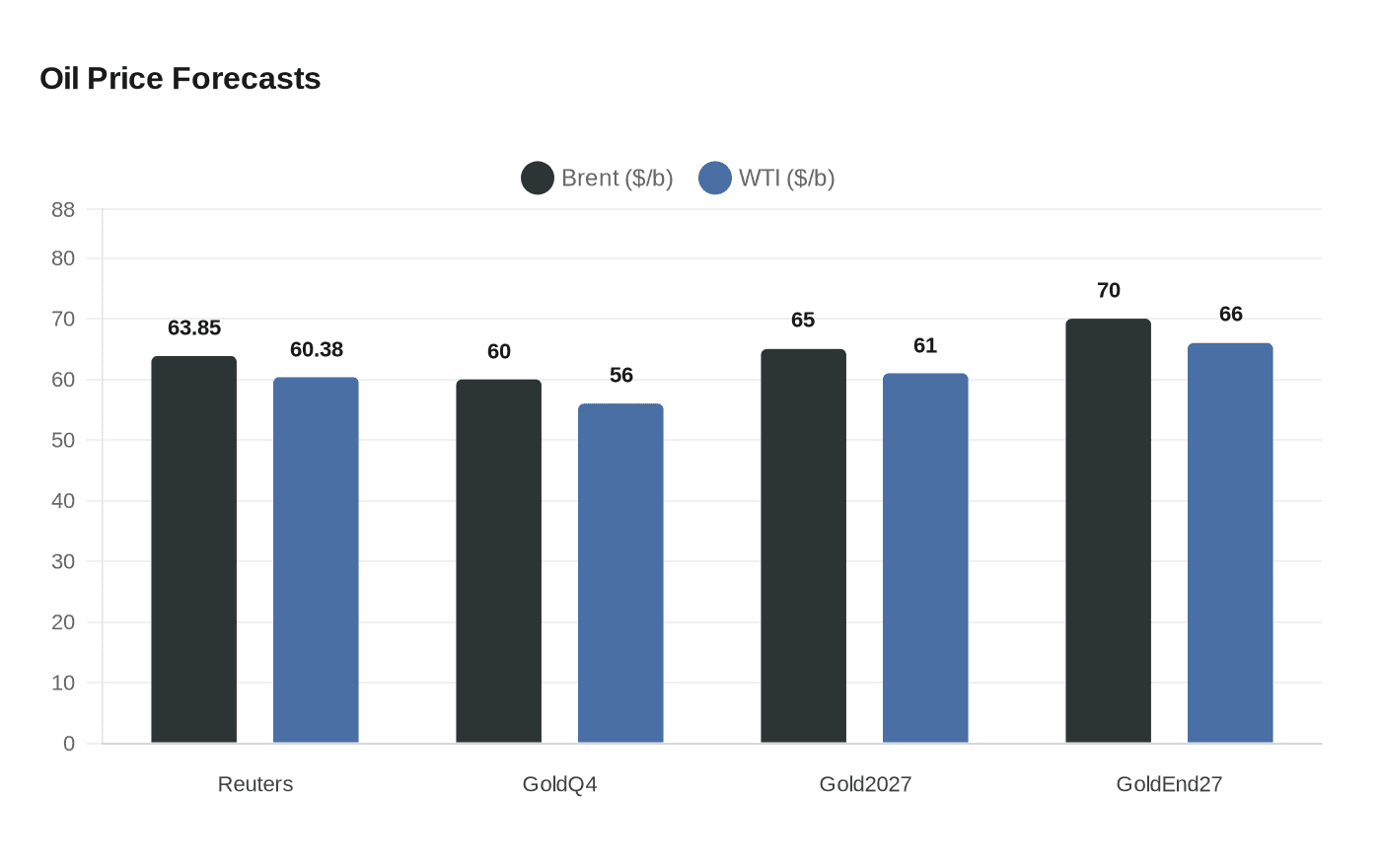
A Reuters-compiled survey of 34 economists and analysts published Feb. 27, 2026 showed forecasters nudged up their 2026 oil-price outlooks, lifting the average Brent crude forecast to $63.85 per barrel from January's $62.02 and U.S. crude (WTI) to $60.38 from $58.72. The upgrades reflect rising concern that a U.S.-Iran standoff and other geopolitical risks have embedded a $4–$10 per barrel premium into global crude markets, even as some analysts warn that an underlying supply glut persists.
Year-to-date benchmark averages cited in the poll stood higher than the revised forecasts, with Brent averaging $70.48 and WTI $65.01, underscoring recent price volatility. Oilprice reported early-Friday intraday moves of roughly 3.7 percent, with Brent near $73 and WTI around $67 after U.S. and Iranian talks adjourned and negotiators planned another round in Vienna; Oman’s Foreign Minister Badr Albusaidi said parties had made "significant progress."
Institutional forecasters offered differing time horizons and assumptions. ING raised its ICE Brent 2026 average from $57 to $62, with Warren Patterson, Head of Commodities Strategy at ING, saying, "We have revised our oil price forecasts higher." ING also flagged speculative positioning, noting traders bought more than 200,000 lots in ICE Brent since mid-December, leaving the largest net-long position since April last year.
Goldman Sachs, cited in a Stockinvest US note on Feb. 23, revised Q4 2026 pricing, pricing Brent at $60 and WTI at $56 and embedding a $6 geopolitical risk premium into its scenarios. Goldman maintained a forecast of roughly a 2.3 million barrels per day global surplus for 2026 but said the decline in OECD stockpiles signaled tighter conditions. The bank estimated that if sanctions on Iran or Russia were lifted sooner than expected, Brent could face downward pressure of about $5 and WTI about $8 in Q4 2026. Goldman projects Brent and WTI to average $65 and $61 respectively in 2027 and to reach $70 and $66 by the end of 2027.
An Ainvest / Refinitiv scenario presented a lower outcome, targeting Brent at $58 in 2026 on the assumption that supply growth outpaces demand by a wide margin. Ainvest projected 2026 supply growth of 2.4 million barrels per day against demand growth of 850,000 bpd, producing average inventory builds of 3.1 million bpd. The same analysis cited a macro backdrop of a weaker dollar, low rates, and 3.3 percent global growth as structural support for prices.
Market structure remains contested. Reuters noted many analysts expect U.S. production to plateau or slightly decline in 2026 while most see global demand rising between 0.5 and 1.1 million bpd. Norbert Rucker of Julius Baer said bluntly, "Oil prices are bloated with a decent geopolitical risk premium," adding, "That said, Iran tensions should prove temporary and once the attention span exhausts, the focus should return on the supply glut and the lasting pressure on prices."
Policy and producer behavior are central to near-term outcomes. Reuters reported that eight OPEC+ producers are set to meet "this Sunday," and Zain Vawda at MarketPulse by OANDA warned, "If the geopolitical risk premium remains in play by then, this may further embolden (OPEC) to resume output hikes." ING cautioned that U.S. military action in Iran would likely force higher forecast revisions if oil flows were disrupted.
The picture is therefore one of tighter prices supported by a geopolitical floor, yet vulnerable to renewed supply upside if diplomacy or sanctions shifts restore crude flows. The Reuters poll represents a consensus snapshot of 34 analysts on Feb. 27, while ING, Goldman and Ainvest offer institution-specific scenarios tied to different periods and assumptions.
This article was produced by Prism’s automated news system from verified source data, official records, and press releases, then run through automated quality and moderation checks before publishing. The system is built and supervised by the people who set the standards it runs under. Read our full AI policy.
Did this article answer your question?