Ancient proteins reveal Homo erectus interbred with Denisovans in China
Proteins from 400,000-year-old teeth in China captured a Denisovan-linked variant inside Homo erectus, the oldest molecular sign yet of interbreeding.
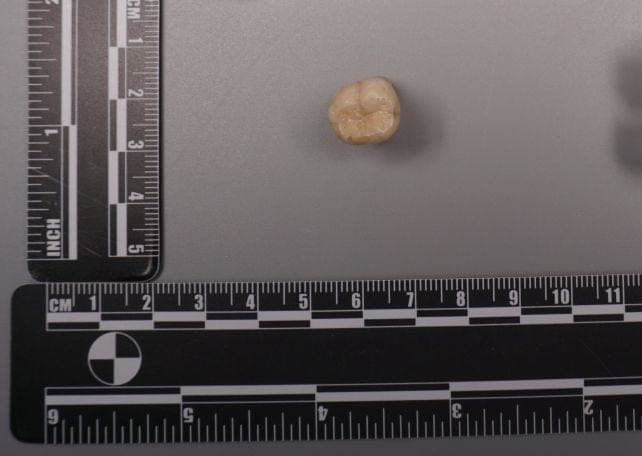
Ancient enamel proteins from six Homo erectus teeth in China have pushed the evidence for interbreeding between human lineages deeper into the past than DNA can reach. The study, published online in Nature on May 13, 2026, found two protein variants in fossils from Zhoukoudian, Hexian and Sunjiadong, including one previously linked to Denisovans, the archaic human relatives closest to Neanderthals.
Led by Qiaomei Fu at the Institute of Vertebrate Paleontology and Paleoanthropology of the Chinese Academy of Sciences, the team analyzed teeth dated to at least about 400,000 years ago. Using a micro-destructive acid-etching method, the researchers recovered proteins without damaging the fossils’ shape, a technical advance that matters as much as the evolutionary finding itself. The paper reports five males and one female among the six individuals, and identifies two AMBN variants: a previously unknown AMBN-A253G and AMBN-M273V, the variant long thought to be specific to Denisovans.

The AMBN-M273V result is the key to the evolutionary story. If that variant was present in Homo erectus teeth and later found in Denisovans, the most plausible explanation is contact and admixture between the two populations, followed by inheritance through later Denisovan lineages. That would make the human family tree look less like a series of clean forks and more like a network of repeated crossings. The study is being treated as the first molecular evidence of interbreeding among human species from this deep time period, and the first to directly involve Homo erectus.
That matters because Homo erectus has long sat near the center of human evolution. It was generally considered the first species in the genus Homo to leave Africa, and its fossil record spans more than 1.5 million years, making it one of the longest-lived human relatives. Earlier work has suggested the species originated in Africa about 2.1 million years ago, with late survivors in Java possibly lasting until about 108,000 years ago. That overlap in time has fueled speculation that late Homo erectus populations in Asia could have encountered Denisovans; the new protein data now gives that idea molecular support.
The finding also helps explain so-called ghost populations, archaic ancestors inferred from later human DNA but not yet tied to a named species. A companion Nature commentary said the work offers new insight into how ancient genetic material eventually entered modern human populations. With Denisovan ancestry still especially prominent in Oceania and Island Southeast Asia, the study strengthens a larger conclusion: deep human evolution was shaped by migration, contact and gene flow, not isolated branches standing apart.
This article was produced by Prism’s automated news system from verified source data, official records, and press releases, then run through automated quality and moderation checks before publishing. The system is built and supervised by the people who set the standards it runs under. Read our full AI policy.
Did this article answer your question?