New study finds global obesity rising unevenly, slowing in richer nations
Obesity is still climbing worldwide, but the new study shows a split path: rates are slowing or falling in some rich countries while poorer nations keep rising.

The global obesity story is no longer moving in one direction. A major new analysis of 4,050 population-based studies, spanning 200 countries and territories from 1980 to 2024, found that obesity has kept rising overall, but the pace has slowed, stabilized and in some places even reversed in wealthier countries while poorer countries continue to see sharp increases.
Researchers from Imperial College London and the NCD Risk Factor Collaboration found the clearest signs of progress in high-income countries, where obesity rates in some places, including France, Italy and Portugal, may already be edging down. The slowdown began first among school-aged children and then, roughly a decade later, among adults. That pattern suggests the shift is not just a statistical blip, but part of a broader change in how diet, income and public health interact in richer societies.
Majid Ezzati, one of the study’s lead researchers, said the results were more optimistic than many expected because they show progress is possible and rising obesity is not inevitable. The findings also complicate the long-running idea of “globesity,” the notion that obesity was spreading everywhere with the same force and at the same pace.
In poorer countries, the picture is the opposite. Obesity is still climbing quickly, reinforcing a growing divide in global health outcomes that tracks closely with social and economic conditions. The researchers pointed to broader social, economic and technological factors, including access to different kinds of food, as part of the reason richer countries have begun to bend the curve. They also cautioned against overstating the short-term effect of drugs such as Ozempic, which they said are too recent to have reshaped long-term global trends, though they could matter more later.
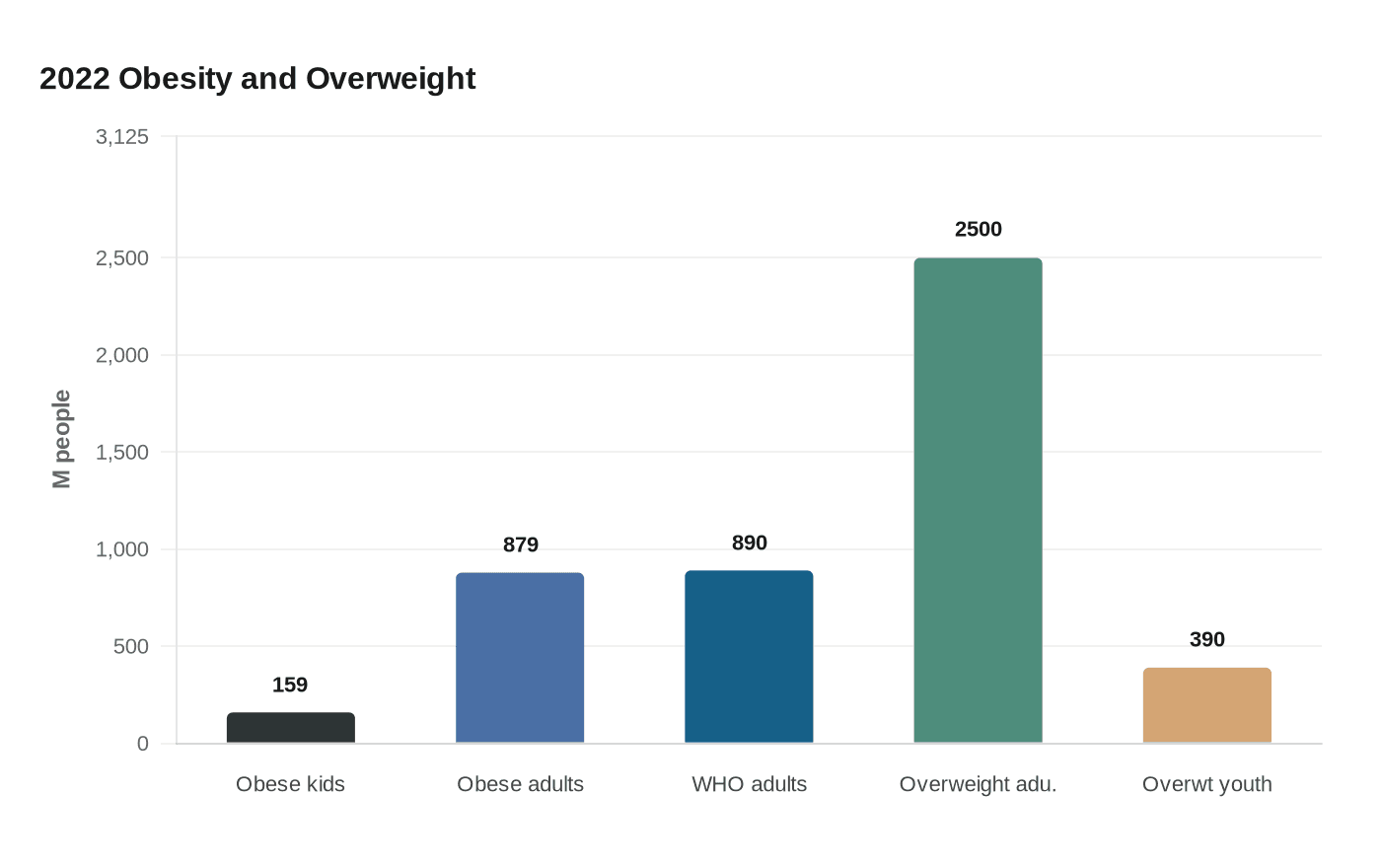
The scale of the problem remains enormous. Imperial’s 2024 global analysis estimated that more than one billion people were living with obesity in 2022, including 159 million children and adolescents and 879 million adults. The World Health Organization says 1 in 8 people worldwide were living with obesity in 2022, adult obesity has more than doubled since 1990 and adolescent obesity has quadrupled. WHO also estimates that 890 million adults were living with obesity in 2022, alongside 2.5 billion overweight adults and more than 390 million overweight children and adolescents aged 5 to 19.
WHO defines obesity as a chronic, relapsing disease shaped by genetics, neurobiology, eating behaviors, access to healthy diets, market forces and the broader environment. That definition matches the new study’s central message: this is no longer a single global epidemic with one trajectory, but a set of different public-health emergencies demanding different responses. At a ministerial event in May 2025, officials called obesity a “development and social justice issue,” and Spain announced it will host a 2026 Global Stocktaking Summit on Obesity. The policy challenge now is not whether obesity matters, but why some countries are finally slowing it while others are still racing upward.
This article was produced by Prism’s automated news system from verified source data, official records, and press releases, then run through automated quality and moderation checks before publishing. The system is built and supervised by the people who set the standards it runs under. Read our full AI policy.
Did this article answer your question?