Antarctic fish fossil reveals clues to vertebrate move onto land
A 380-million-year-old Antarctic fish is revealing hidden skull anatomy that may clarify how vertebrates began the move from water to land.
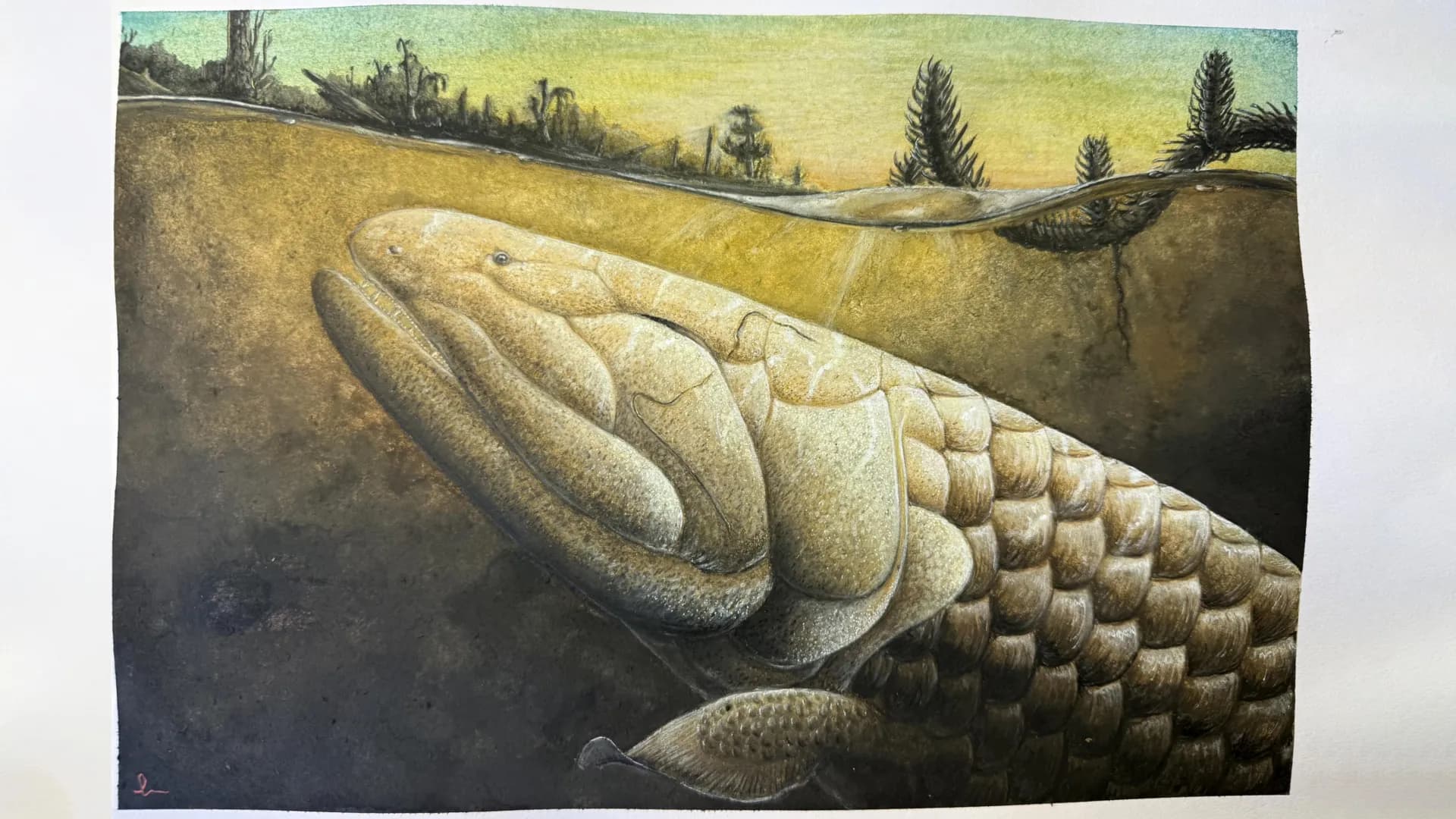
A single Antarctic fish fossil is helping scientists trace one of evolution’s most consequential steps, from swimming in water to eventually supporting life on land. New scans of Koharalepis jarviki exposed skull and body details that had never been seen before, sharpening its place near the vertebrate branch that later produced the first walkers on Earth.
The study, published April 15, 2026 in Frontiers in Ecology and Evolution, examined the only known specimen from the Late Devonian Aztec Siltstone at Mt Crean, Antarctica. Researchers used synchrotron and neutron tomography to look inside the fossil without damaging it, a crucial advantage because this was the only representative of the family preserved wholly in 3D. The imaging revealed new elements of the braincase, palate, mandible and axial skeleton, and also allowed scientists to reconstruct part of the braincase and an endocast, offering rare insight into Koharalepis neuroanatomy.

That internal anatomy matters because the land transition was gradual, not a single leap. Scientists have long known that vertebrates had to evolve new ways to support weight, breathe differently and interact with a new environment. Koharalepis adds a sharper data point to that sequence. The phylogenetic analysis placed the fish inside the Canowindridae and identified Harajicadectes zhumini as its sister taxon. The paper also placed canowindrids crownward of rhizodonts but below tristichopterids and elpistostegalids on the tetrapodomorph tree, a position that helps frame how close these fishes were to the lineage that led to tetrapods, the four-limbed vertebrates that now make up roughly half of vertebrate diversity.
Flinders University said Koharalepis likely grew to about 1 metre and was an ambush predator with relatively small eyes, suggesting it depended heavily on other senses. Researchers also identified features linked to life near the water surface, including openings in the top of the skull for additional air intake and a brain organ associated with light detection and circadian rhythms. Together, those traits suggest a fish already experimenting with biological tools that would later matter in shallow water and beyond it.

The fossil also carries a long field history. John A. Long said he took part in the 1991 Antarctic expedition that found one of the first specimens, and earlier fieldwork in 1971 had already turned up remains of the species. Koharalepis jarviki was first described in 1992. Now, modern imaging has returned to the same fossil and pulled out a new chapter, showing how a rare Antarctic specimen can still change the map of vertebrate evolution.
Know something we missed? Have a correction or additional information?
Submit a Tip