Scientists identify tiny blue octopus as new species near Galápagos
A golf-ball-sized blue octopus from 5,817 feet down near Darwin Island has been named Microeledone galapagensis, adding a new species to the Galápagos.
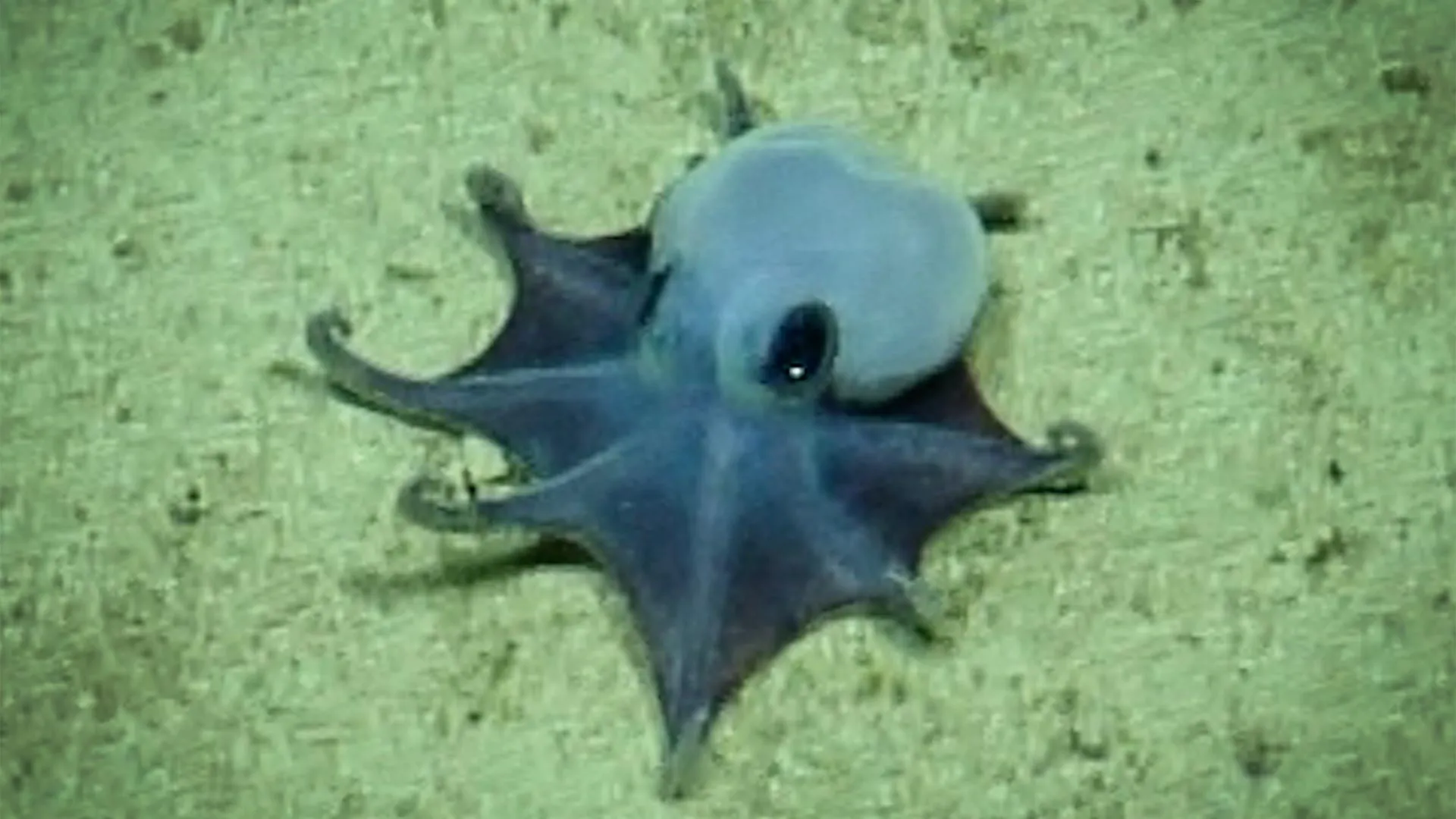
A tiny blue octopus crawling across a submarine mountain nearly 6,000 feet below the Galápagos has turned out to be a species scientists had never formally documented before. Named Microeledone galapagensis, the animal was collected at 1,773 meters, or about 5,817 feet, near Darwin Island and adds another layer to the biodiversity of one of the world’s most closely studied archipelagos.
The octopus first appeared on camera during a 2015 deep-sea expedition aboard the E/V Nautilus, a 68-meter research vessel operated by Ocean Exploration Trust. The ship was working with the Charles Darwin Foundation and the Galápagos National Park Directorate when a remotely operated vehicle found the creature on the seafloor. The audio feed captured the crew’s surprise in real time: “He’s tiny!” and “It’s blue!”
Scientists later collected the single female specimen and preserved it in alcohol and formalin before sending it from the Galápagos to Chicago for closer study. At the Field Museum, Janet Voight, an associate curator of zoology and a specialist in cephalopod mollusks, led the identification work. “Right away, I knew it was something really special,” Voight said, adding that she had never seen anything like it.
Because only one specimen was available, the team depended on detailed anatomy to make the case for a new species. They compared the beak, teeth and other diagnostic features, along with CT scans and physical traits, before concluding that the octopus had not been documented before. The Zootaxa paper describes it as small, squat and short-armed, with few arm suckers and gill lamellae.

The find underscores how much of Earth’s biodiversity still remains hidden, even in a place as iconic as the Galápagos. The islands are famous for giant tortoises, marine iguanas and the ideas that helped shape evolutionary science, but the deep Pacific around them is still yielding surprises. The Field Museum notes that scientists know less about the deep ocean than about the far side of the moon, a reminder of how thin our knowledge remains once the seafloor drops out of sight.
That gap matters because discovery in the deep sea is still slow, expensive and highly dependent on collaboration between local institutions, field crews and museum specialists. The E/V Nautilus spent six weeks of its 2015 Galápagos work exploring and mapping the region, and the specimen’s journey from remote waters to a Chicago collection shows how long it can take for a glimpse on video to become a formally named species. Nearly two centuries after Charles Darwin visited the Galápagos aboard the HMS Beagle in 1835, the islands are still rewriting the catalogue of life.
Know something we missed? Have a correction or additional information?
Submit a Tip