Argentina’s World Cup sticker fever endures in digital age
Argentina’s sticker trade turns World Cup anticipation into a social ritual, where scarcity, nostalgia and face-to-face swaps still beat the app.

Argentina’s World Cup sticker boom is not a nostalgic sideshow. It is a mass social ritual, with thousands crowding plazas, schools and offices to swap Panini stickers and chase completion before kickoff. Even as apps and WhatsApp groups speed up trading, the real value still comes from the physical exchange: the status of finding a rare card, the community of a public swap, and the ritual of pasting each sticker by hand.
Why the album still matters
The appeal of the stickerbook is easy to underestimate if you think of it as a relic. In Argentina, it functions more like a seasonal economy, one driven by scarcity, repetition and identity. Children carry books carefully filled page by page, adults negotiate duplicates in plazas, and entire social circles temporarily reorganize around the hunt for the last missing sticker.
Juan Valora, who was collecting with his girlfriend, captured the appeal plainly: “This connects you with the world. Everyone does it.” He also said that if the hobby moved fully online, people would lose the face-to-face trading and “human touch.” That is the key to understanding why the sticker craze endures in a digital age: the album is not just about possession, but about participation.
How the trading scene works
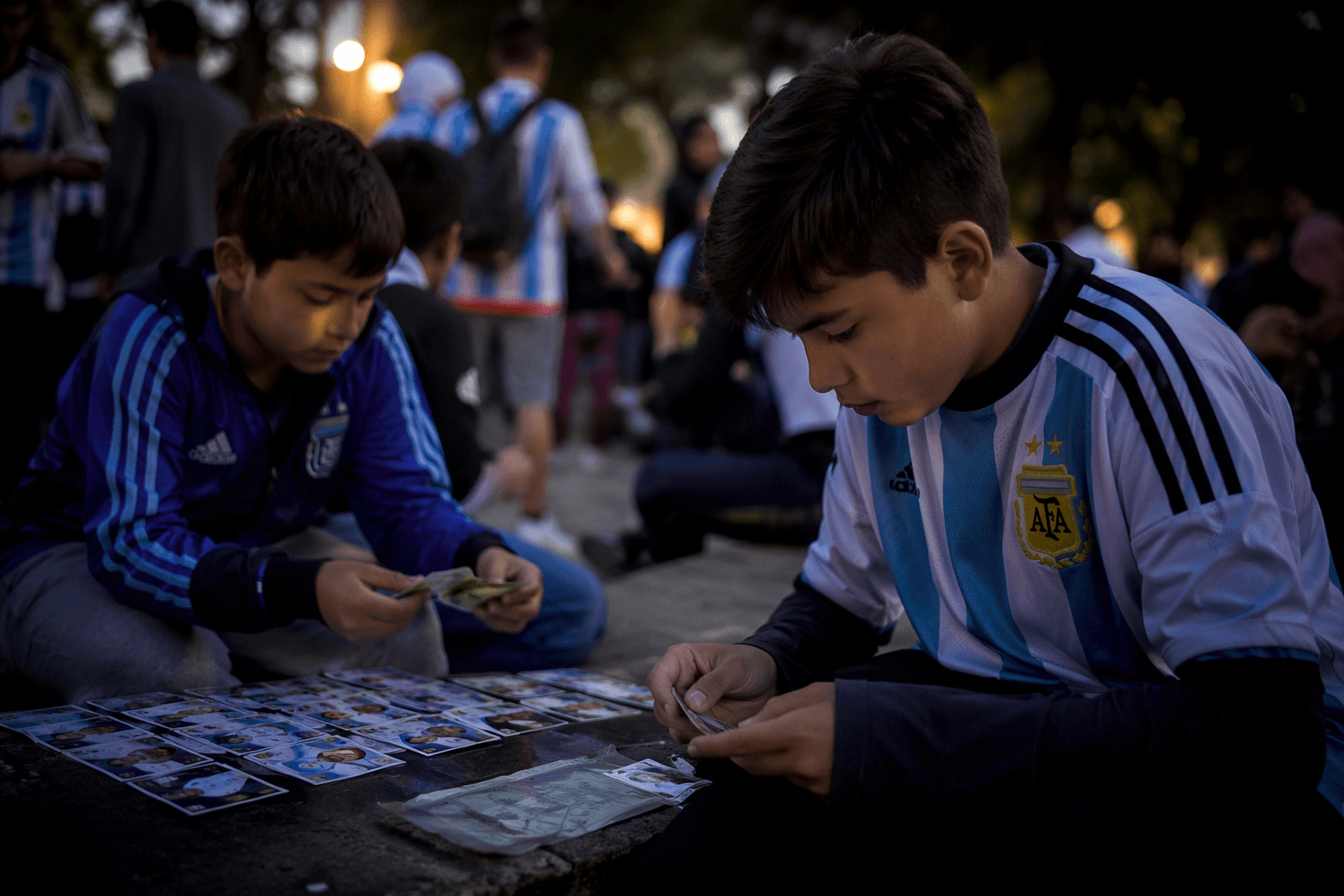
On Sunday, crowds gathered in the heart of Buenos Aires to exchange multicolored sticker decks featuring some of the world’s most famous soccer players. Some people laid out stacks on tables like dealers in a poker game, while children clutched their books and carefully pasted each new find into place. The scene was casual, but the logic behind it was precise: duplicates become currency, rare stickers become bargaining chips, and every plaza becomes a temporary market.
In South America, trading has become even more important than collecting. WhatsApp groups, apps and websites help people find matches more efficiently, but they do not replace the live ritual of swapping in person. The technology speeds up the market; it does not change the fact that the social payoff comes from the transaction itself.
The economics of a sticker economy
Panini’s 2026 World Cup collection is its largest ever, a direct result of FIFA expanding the tournament from 32 teams to 48. That expansion does more than add teams to the album. It raises the number of stickers to chase, extends the hunt, and increases the odds that collectors will spend longer and more money trying to finish the set.
Each pack contains seven stickers and costs about $1.50 in Argentina and Uruguay. For some collectors, the economics push them away from small purchases and toward bulk buying. Boxes of up to 104 sticker packs sell for $180, and installment payments make the upfront cost easier to absorb. Matías Inglesi, a software developer and the father of 9-year-old Lucas, said he spends about $20 a week on the hobby and prefers paying more at the start if it helps complete the album faster.
That spending pattern shows how the album works as a consumer product: it blends affordability with the constant temptation to chase just one more packet. The low unit price makes the hobby feel accessible, but the total cost can rise quickly once collectors try to close the gaps.
Why children, parents and adults all buy in
For many children, completing the album matters even more than seeing their national team lift the trophy. That is not a contradiction in Argentina so much as a reflection of how deeply the World Cup is woven into everyday life. Parents often step in to help children finish the book, turning the hobby into a shared family project rather than an individual pastime.
Adults are no less involved. Some collect with spouses or friends, others trade at work, and many treat the hunt as a seasonal social habit that returns every four years with the tournament. The rare sticker becomes a status symbol, but so does the ability to help others complete their albums. In that sense, the collection works because it rewards both competition and cooperation.
The power of scarcity, even when the “rare” stickers are not truly rare
The market’s psychology depends on the idea of scarcity, even though some of the most desired stickers are widely available. Lionel Messi, Cristiano Ronaldo and Kylian Mbappé all appear among the so-called “rare” stickers, which makes the label as much about demand as about actual production limits. That tension helps explain the frenzy: collectors know the game is designed to keep them hunting.
Panini has also responded by making the 2026 set its largest ever, which turns abundance into another form of challenge. The album includes 980 stickers in total, among them 68 special stickers printed on premium material, and the softcover album has 112 pages with space for the full set. More stickers mean more chances to participate, but also more chances to fall short.
From Mexico 1970 to the end of an era
Panini’s World Cup sticker tradition began with its first officially licensed album for Mexico 1970. That album is now treated as a collector’s item, and it marked the start of a format that would become inseparable from the World Cup itself. The 1970 tournament was a landmark football year, with Pelé, Gerd Müller, Bobby Moore and Giacinto Facchetti among the icons on the field, and Brazil beating Italy 4-1 in the final.
That origin story matters because it shows how the album has always been tied to a broader cultural moment, not just a merchandising idea. The 1970 edition arrived as color television was transforming how many viewers experienced football, and the stickerbook became part of the visual memory of the sport. In that sense, the hobby was built for mass culture long before the digital era arrived.
The next chapter is already finite. Panini’s World Cup stickerbooks are set to end after the 2030 tournament, when Fanatics becomes FIFA’s exclusive sticker partner. That makes the current fever feel even more poignant: Argentina is not just buying stickers, it is preserving a ritual that has survived half a century of technological change and may soon belong to history.
This article was produced by Prism’s automated news system from verified source data, official records, and press releases, then run through automated quality and moderation checks before publishing. The system is built and supervised by the people who set the standards it runs under. Read our full AI policy.
Know something we missed? Have a correction or additional information?
Submit a Tip