Argonne's ATLANTIS collinear-laser beamline with CARIBU probes ruthenium nuclei, refining models
Argonne’s ATLANTIS measured isotope shifts for nine radioactive ruthenium isotopes (106–114Ru), extracting charge radii that match BSkG model predictions including triaxial deformation.
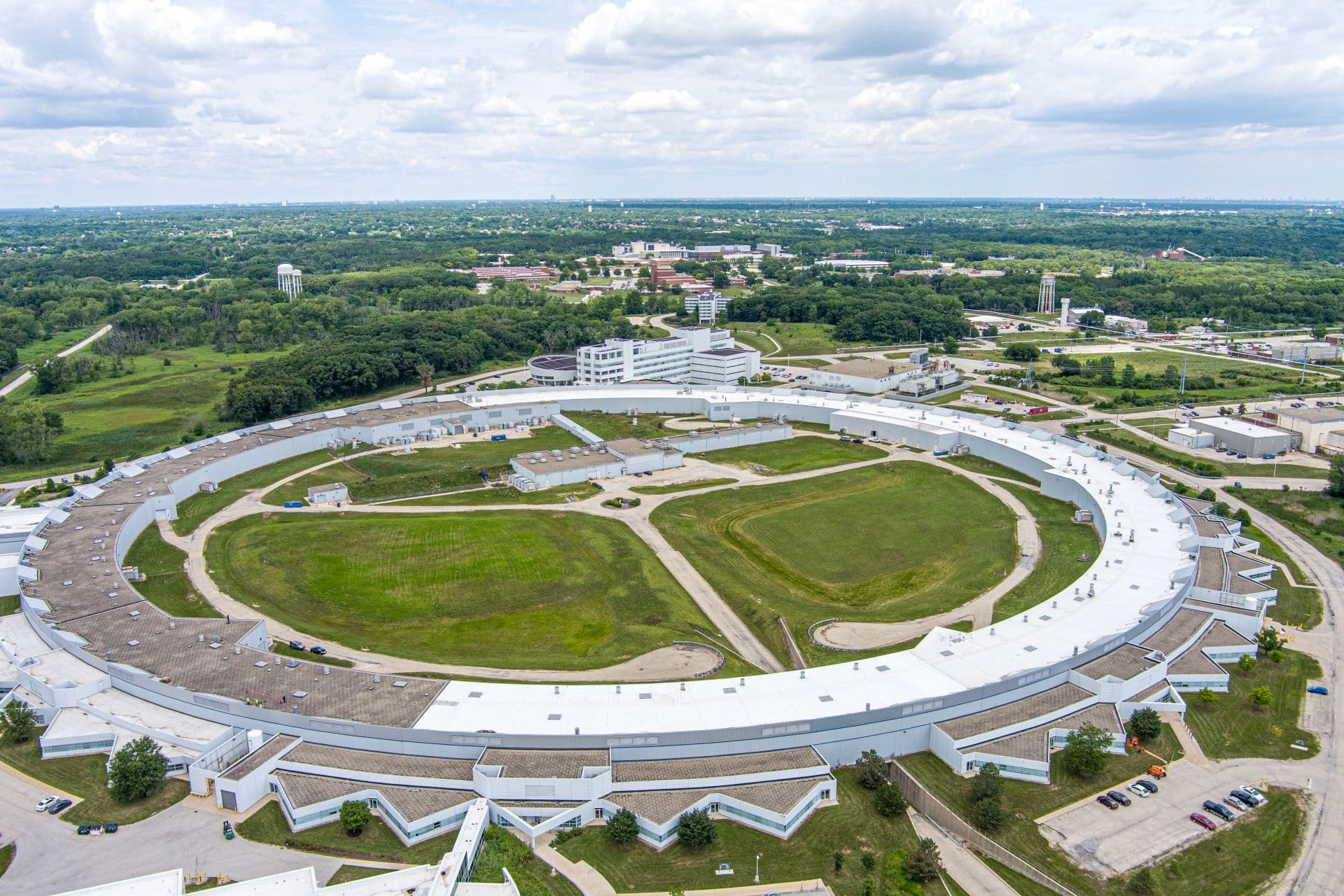
Argonne National Laboratory’s new ATLANTIS beamline produced extremely precise measurements of nine radioactive ruthenium isotopes, 106–114Ru, extracting charge radii that are in excellent agreement with the Brussels-Skyrme-on-a-Grid (BSkG) family of nuclear models. The work used collinear laser spectroscopy at the Argonne Tandem Linac Accelerator System and reached deep into the mid-shell region for these neutron-rich refractory metals.
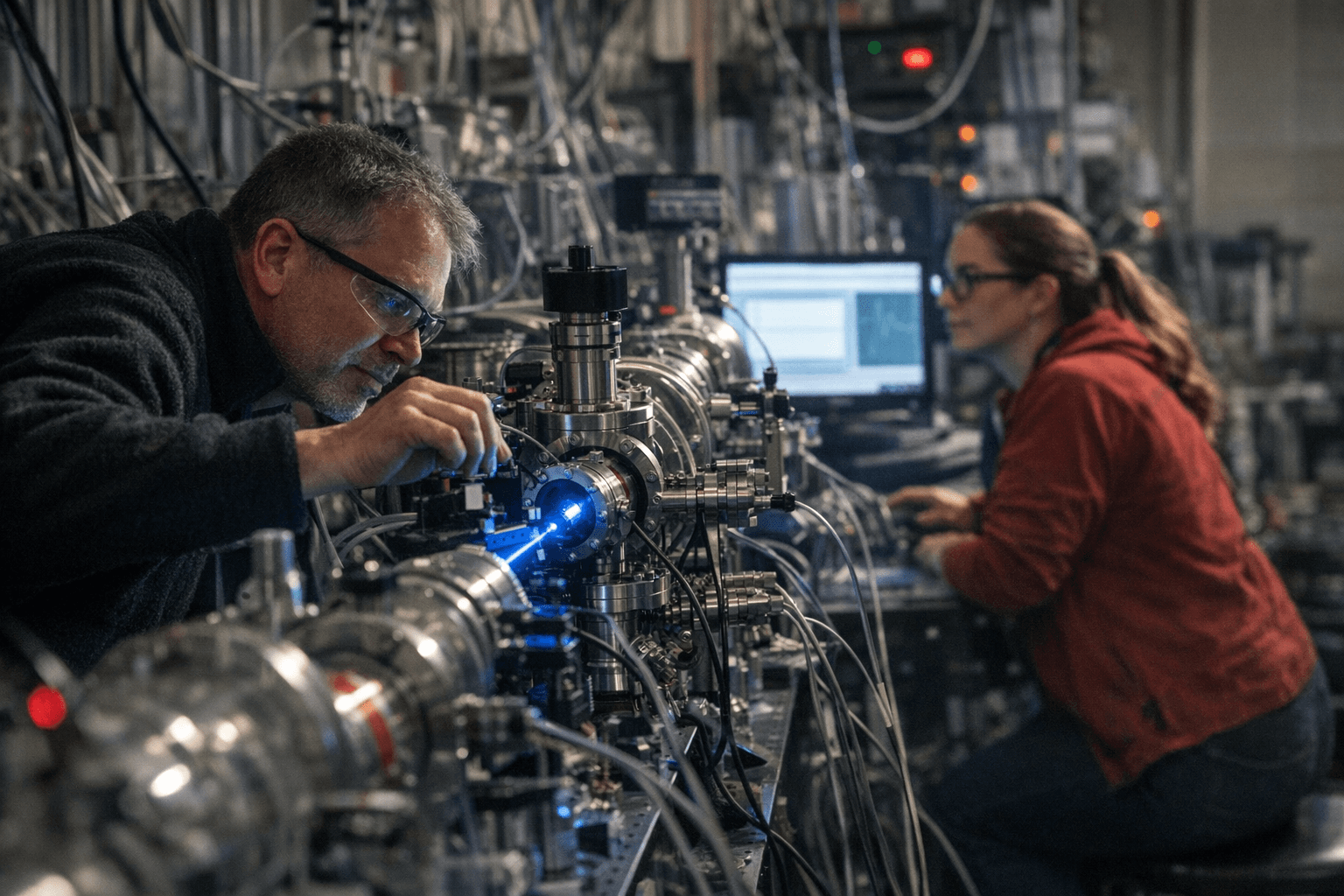
The experiment was the first run at the Argonne Tandem Hall Laser Beamline for Atom and Ion Spectroscopy (ATLANTIS), a setup specifically designed to target neutron-rich isotopes produced by the Californium Rare Isotope Breeder Upgrade (CARIBU) 252Cf spontaneous fission source. Researchers measured isotope shifts from optical spectra and then extracted charge radii, overcoming a key technical hurdle: refractory metals like ruthenium are difficult to extract from ISOL-type targets and required a buffer-gas-based extraction technique to deliver analyzable ion beams to ATLANTIS.
The comparison with theory used the BSkG modeling approach and dedicated computational tools. BSkG describes each nucleus with a single Bogoliubov quasiparticle vacuum whose ground state is determined variationally to maximize binding energy, thereby fixing nuclear shape and radius; calculations were performed with the MOCCa code under the numerical conditions of the BSkGxx parameter adjustment. The experimental charge radii match BSkG predictions that account for triaxial deformation of nuclear ground states, showing that triaxiality affects charge radii in shell-aware models in contrast to conclusions drawn from a liquid drop analysis.
Ruthenium was chosen because its unstable isotopes are believed to exhibit complex, triaxial shapes often described in popular terms as almond-shaped or coffee-bean-shaped. The agreement between ATLANTIS data and BSkG calculations represents a validation of a class of advanced models for complex, unstable nuclei and strengthens confidence in using those models to probe nuclear structure farther from stability. Press coverage and the research team note potential downstream value for astrophysical questions, including stellar formation, nucleosynthesis, and matter behavior in the early universe, as validated models are applied to exotic nuclei.
Bernhard Maass, an assistant physicist at Argonne and the study’s lead author, put the result plainly: “It’s very difficult for theoretical models to predict the properties of complex, unstable nuclei. We have demonstrated that a class of advanced models can do this accurately. Our results help to validate the models.” The ATLANTIS plus CARIBU capability, paired with buffer-gas extraction and high-precision collinear laser spectroscopy, marks a milestone that paves the way for further studies of refractory elements and future collaborations aimed at mapping nuclear shapes and radii across the chart of nuclides.
Know something we missed? Have a correction or additional information?
Submit a Tip