Arizona Sonoran Desert City Dazzles With Owls, Oases, and Starry Skies
Tucson sits in the world's lushest desert with 300 dark-sky nights, elf owls, and a national observatory, delivering big wilderness without the gateway-town price tag.
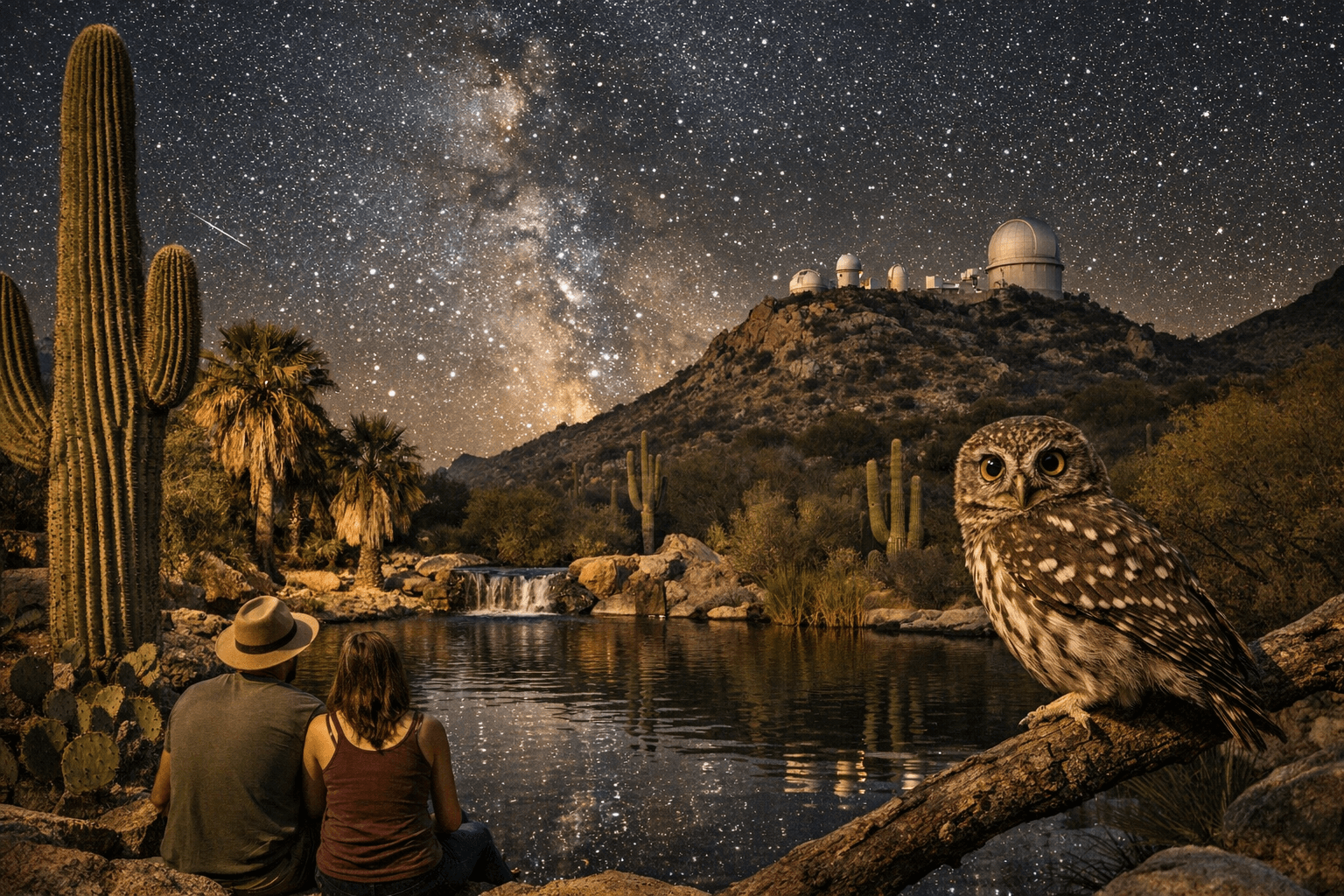
Where the Desert Earns Its Stars
Tucson is not a city you merely pass through on the way to somewhere wilder. Sitting at the heart of the Sonoran Desert in southern Arizona, it is somewhere wilder, a mid-size city of roughly half a million people that delivers dark-sky astronomy, exceptional wildlife watching, and miles of public-land trails with a fraction of the crowds and costs that cluster around marquee national parks. The pitch is simple: this is adventure you can actually afford, plan, and complete in a long weekend, with experiences ranging from spotting the world's smallest owl to standing under a Milky Way arch above 7,000 feet.
A City Serious About Its Darkness
Tucson's commitment to the night sky is institutional, not incidental. DarkSky International, the global nonprofit that certifies dark-sky preserves and advocates against light pollution, was founded here in 1988 and has since certified more than 200 Dark Sky Places across 22 countries on six continents. The city leverages its higher altitude, low humidity, and close to 300 clear, dark-sky nights annually to deliver conditions that rival far more remote destinations. Tucson's Astro Trail ties the ecosystem together, linking five observatories, a planetarium, a laboratory, an aviation and space museum, two state parks, and one national park into a self-guided network that gives visitors a logical itinerary rather than a scattershot list of sites.
Saguaro National Park was certified as the newest Urban Night Sky Place in late 2023, a distinction given to sites near large urban areas whose planning actively promotes authentic nighttime experiences. That certification means the park's iconic saguaro-studded ridgelines are legally protected from light encroachment and provide a genuinely dark foreground for astrophotography within the city limits.
Kitt Peak: The Northern Hemisphere's Premier Observatory
Kitt Peak National Observatory sits 55 miles west-southwest of Tucson, atop the Quinlan Mountains on the Tohono O'odham Nation. With 23 optical and two radio telescopes, it is the largest, most diverse gathering of astronomical instruments in the northern hemisphere. The site sits at nearly 7,000 feet, which means the drive up alone delivers sweeping desert panoramas before a single telescope is pointed skyward.
The Kitt Peak Visitor Center is open daily and offers daytime guided tours and a variety of evening stargazing programs. The Nightly Observing Program lets visitors arrive in the late afternoon to watch the sunset, then use binoculars and telescopes for a guided tour of deep-sky objects. For a more immersive commitment, the Overnight Telescope Observing Program accommodates up to four guests for a full observatory experience. Established in 1964, the Kitt Peak Visitor Center has welcomed more than two million visitors across six decades of operations.
Astrophotographer BettyMaya Foott, who has shot the Sonoran night sky extensively, captures what draws people here: "Tucson is a magical place to see the stars. When I'm out wandering the Sonoran Desert at night, I feel at peace. The towering saguaros under the stars feel like ancient guardians, guiding us through the darkness."
Madera Canyon: A Birding Oasis in the Sky Islands
Thirty miles south of Tucson, Madera Canyon sits on the northwest face of the Santa Rita Mountains in the Coronado National Forest, a mesquite, juniper-oak, and pine woodland that offers some of the world's best bird watching. The road to Madera Canyon enters through desert grasslands and ends in juniper-oak woodland, where hiking trails lead up through pine-oak woodland to montane conifer forest and the summit of Mt. Wrightson at 9,453 feet. The elevation gain transforms the ecology completely: you begin in classic Sonoran Desert and climb into cool conifer forest within a few miles of trail.
Over 250 species of birds have been identified in Madera Canyon, with celebrity sightings including the Elegant Trogon, Elf Owl, Sulphur-Bellied Flycatcher, and Painted Redstart. The Santa Rita Lodge is one of the best locations in the canyon to view up to 15 species of hummingbirds. The elf owl, a primarily summer resident, is easiest to detect from March to June when it makes a distinctive laughing call, and is common in Madera Canyon, Catalina State Park, and Sabino Canyon. May is peak season for the Elegant Trogon, the bird so rare and coveted that birders travel from across the country for a single confirmed sighting.
The canyon has 14 different hiking trails, ranging from short jaunts with minor elevation gains to 10-plus-mile hikes with more than 4,000 feet of elevation gain. Casual walkers can stay near the lower riparian corridor, where birding is densest, while stronger hikers push toward the exposed upper ridgelines of Mt. Wrightson.
Sabino Canyon: The Accessible Oasis
Back in the city, Sabino Canyon Recreation Area functions as Tucson's backyard wilderness, a riparian corridor of waterfalls, native vegetation, and resident wildlife tucked into the Santa Catalina Mountains. The Tucson Audubon Society organizes free birdwatching trips to Sabino Canyon with a focus on respecting the birds in their habitat. For those who cannot manage a long walk, a shuttle tram takes visitors to the top of the canyon, which is a great option for those who cannot walk for long distances. In addition to birds, the canyon delivers the visual drama of desert waterfalls and cottonwood-lined pools that feel genuinely oasis-like against the surrounding saguaro flats.
Timing, Heat Safety, and Practical Planning
The Sonoran Desert does not bluff about its summers. The best time to visit for hiking is from October to April, when temperatures are mild, daytime highs average in the 60s to 70s°F, and the risk of extreme heat is low. If an April or early May trip is on the calendar, conditions are ideal: the elf owls are calling, the Elegant Trogons are moving through Madera Canyon, wildflowers are out, and the nights at Kitt Peak are reliably clear.
For summer visits, the rules are non-negotiable:
- Start hikes before 10 a.m. and return well before midday; avoid being on exposed trails between 10 a.m. and 4 p.m.
- Carry more water than you think you need; dehydration in dry desert air is faster than most people expect.
- Stay on marked trails; the desert at dusk, however beautiful, can disorient quickly.
- Dress in lightweight, moisture-wicking, UV-protective layers.
The astronomical sites offer a natural workaround for heat-averse summer visitors: Kitt Peak's mountain elevation keeps temperatures meaningfully cooler than the valley floor, and evening programs begin after the worst heat has passed.
The Accessible-Wild Advantage
What distinguishes Tucson from gateway towns serving single marquee parks is the density of distinct experiences within a tight geographic radius. Saguaro National Park's dark-sky viewing is free at the park's standard entry rate. Madera Canyon trailheads sit inside Coronado National Forest, accessible without a separate fee. The Audubon Society's Sabino Canyon trips cost nothing. Kitt Peak charges for its evening programs but operates at a scale, and with a level of telescope access, that no private observatory can match. The city itself offers food, lodging, and logistics without the inflated prices that cluster around single-gateway destinations.
The Sonoran Desert is, by ecological measure, the most biodiverse desert on Earth. Tucson is its urban hub, and it has spent decades building the infrastructure, the light-pollution ordinances, and the public-land access to make that biodiversity available to anyone who shows up with a headlamp, a pair of binoculars, and a willingness to be out before sunrise.
This article was produced by Prism’s automated news system from verified source data, official records, and press releases, then run through automated quality and moderation checks before publishing. The system is built and supervised by the people who set the standards it runs under. Read our full AI policy.
Did this article answer your question?

