Floating Nutella Jar Steals the Show Moments Before Artemis II Breaks Distance Record
A jar of Nutella upstaged history, drifting label-first past astronaut Christina Koch on live broadcast just four minutes before Artemis II shattered a 55-year distance record.
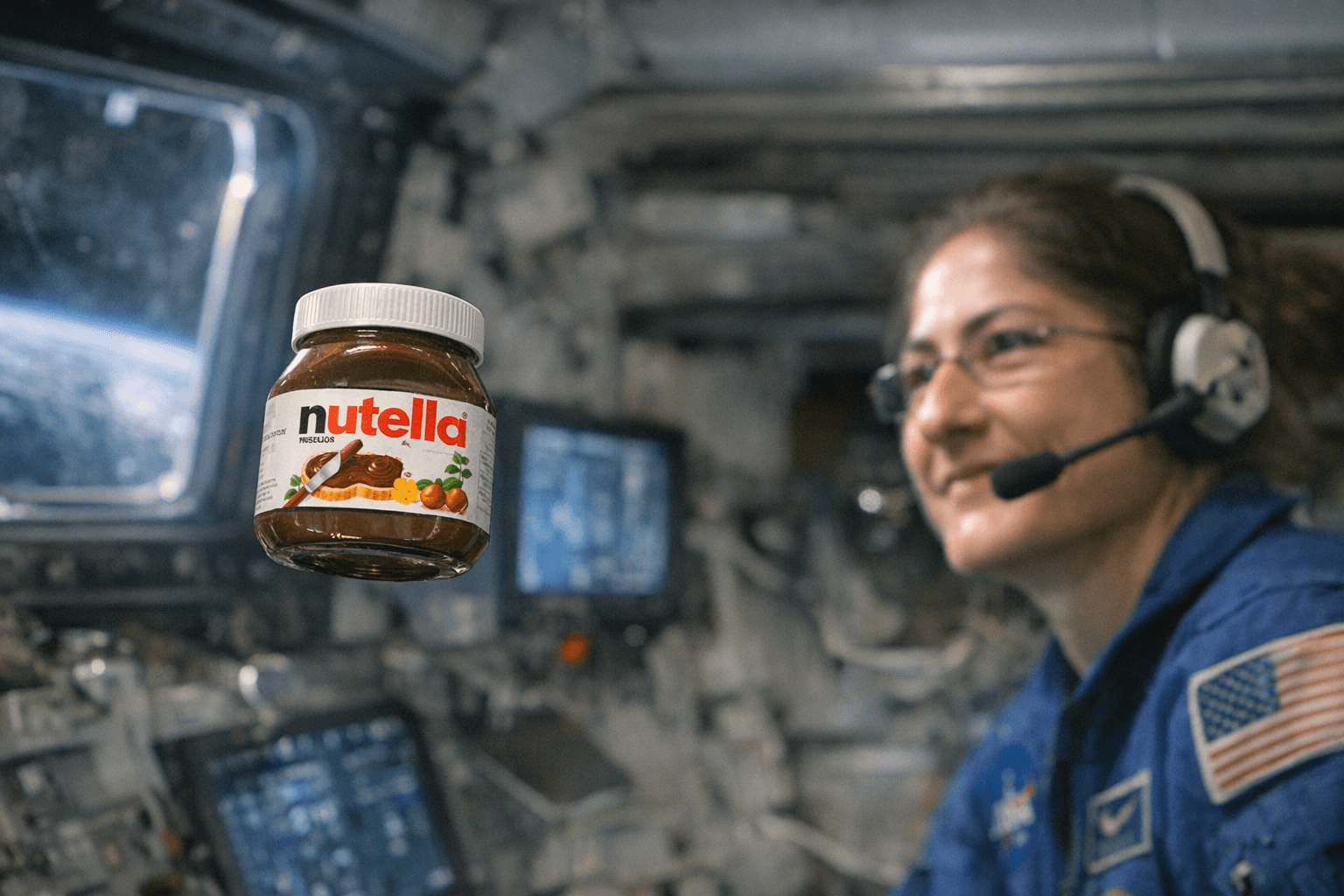
Four minutes separated one of humanity's greatest spaceflight milestones and an unsecured jar of hazelnut spread casually tumbling through the Orion spacecraft's cabin in full view of a global audience.
On April 6, 2026, at 1:57 p.m. ET, the Artemis II crew broke the record for the farthest distance any humans have ever traveled from Earth, reaching 252,752 miles, surpassing the 248,655-mile mark set by the Apollo 13 crew in April 1970. But roughly four minutes before that moment, a jar of Nutella drifted loose inside the capsule, spinning slowly until its label faced the camera in what viewers almost immediately dubbed the most expensive free advertisement in history.
Footage captured the jar drifting, turning, and twirling mid-air to land in a perfectly framed, label-forward shot so pristine it looked storyboarded. Mission Specialist Christina Koch had to dodge it as it floated past her on the live broadcast. Within hours, the clip spread across social media. "Nutella just got the ultimate Space Ad provided by the Artemis 2 crew," one user posted on X. Another quipped: "NASA spent $93 billion and Nutella got a free ad out of it."
The visuals prompted widespread speculation about a deliberate brand deal between NASA and Ferrero, the Italian company that makes Nutella. NASA was quick to shut it down. Agency press secretary Bethany Stevens told Futurism in a statement: "NASA does not select crew meals or food in association with brand partnerships. This was not a product placement." Ferrero has not issued a public response.
The distance record itself carries significant weight. Artemis II, NASA's first crewed lunar flyby in more than 50 years, lifted off from Launch Complex 39B at Kennedy Space Center in Florida on April 1, 2026, at 6:35 p.m. ET. Commander Reid Wiseman, Pilot Victor Glover, Mission Specialist Koch, and Mission Specialist Jeremy Hansen of the Canadian Space Agency are on a 685,000-mile, approximately 10-day journey around the Moon and back. The mission employs the same free-return trajectory Apollo 13 used: a celestial figure-eight path that leverages Earth and the Moon's gravity to reduce fuel consumption. Artemis II's closest approach to the Moon's surface was roughly 4,057 miles.
After the record-breaking pass, Orion entered a planned 40-minute communications blackout beginning at 6:44 p.m. ET as the spacecraft moved behind the Moon's far side. The crew reestablished contact with mission control at approximately 7:25 p.m. ET and subsequently observed a rare solar eclipse from near the Moon, capturing images of the Sun's corona. Before the flyby, Wiseman had referenced an Apollo 8 silk patch the crew brought aboard: "It's just a real honor to have that on board with us. Let's go have a great day."
The Nutella jar may have been the only food to drift across a live broadcast, but it was not an arbitrary choice for a deep-space pantry. The spread requires no refrigeration, carries a shelf life of more than two years, poses no crumb risk in microgravity, and its high viscosity means it is unlikely to damage equipment if the jar breaks. The crew's broader menu includes beef brisket, mac and cheese, broccoli au gratin, scrambled eggs, and hot sauce, along with lemonade, green tea, and chocolate, vanilla, and strawberry breakfast drinks. The crew also reportedly has 58 tortillas on board, a natural pairing for the jar that has now logged more than 252,000 miles from home.
Splashdown is expected in the Pacific Ocean off the coast of California roughly 10 days after the April 1 launch.
This article was produced by Prism’s automated news system from verified source data, official records, and press releases, then run through automated quality and moderation checks before publishing. The system is built and supervised by the people who set the standards it runs under. Read our full AI policy.
Did this article answer your question?