Supreme Court Declines Tribal Tax Case, Leaving Oklahoma Income Tax Rule in Place
A Muscogee Nation employee's lost tax fight means tribal workers on Oklahoma reservation land now owe state income taxes once shielded by 50-year-old federal precedent.
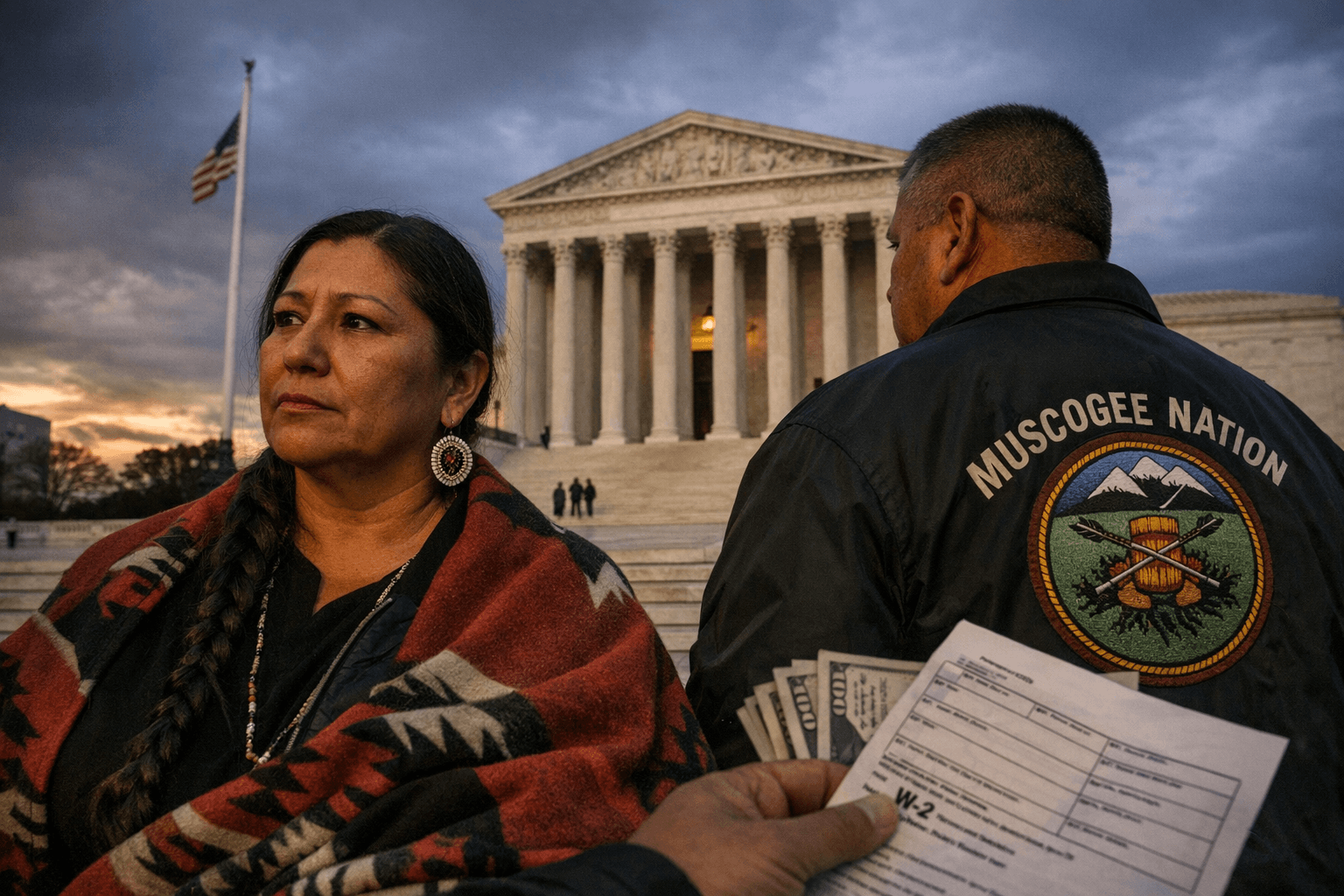
For a Muscogee Nation employee earning $50,000 a year working for the tribe on reservation land, the U.S. Supreme Court's decision this week carries a direct dollar cost: an Oklahoma state income tax bill that a half-century of federal case law had long prevented the state from collecting. The high court declined on April 6 to review Stroble v. Oklahoma Tax Commission, letting stand a state ruling that strips tribal citizens in that situation of a tax exemption and forces the question of who, exactly, has jurisdiction over the paychecks of people living and working at the intersection of two sovereigns.
The case turned on Alicia Stroble, a Muscogee Nation citizen and tribal council secretary who sought an exemption from state income tax for wages earned in 2017 through 2019 while working for her tribe on fee simple land within the Muscogee Reservation's boundaries. Fee simple land, often purchased originally from non-Indian owners, sits inside reservation borders but outside traditional trust land, creating precisely the kind of overlapping jurisdictional ambiguity that has produced litigation across eastern Oklahoma since 2020. Stroble argued that Oklahoma's own administrative code, which allows tribal citizens living within and working for their tribes to avoid state taxation, entitled her to the exemption. The Oklahoma Tax Commission disagreed, and on July 1, 2025, the Oklahoma Supreme Court affirmed that position 6-3. The majority ruled that the U.S. Supreme Court's 2020 McGirt v. Oklahoma decision, which established that eastern Oklahoma reservations were never formally disestablished for purposes of federal criminal jurisdiction, did not reach into civil and regulatory law. "Stroble is asking this court to extend McGirt to civil and regulatory law," the majority wrote, "to find the state is without jurisdiction to tax the income of a tribal member living and working on the tribe's reservation. This we cannot do."
That holding sits in direct tension with McClanahan v. Arizona State Tax Commission, the 1972 Supreme Court precedent that categorically barred states from taxing tribal citizens who live on their reservation and earn income from tribal sources. Stroble's attorneys argued that without Supreme Court review, the door opened for other states to follow Oklahoma's lead. The Cherokee, Choctaw, Chickasaw, Muscogee, and Seminole nations, the Five Tribes of eastern Oklahoma, all joined Stroble's certiorari petition. The high court declined without comment, as is standard.
Muscogee Nation Principal Chief David Hill drew a sharp line between the legal outcome and the legal question. "We had hoped the U.S. Supreme Court would step in to address an egregiously wrong Oklahoma Supreme Court decision that disregards decades of settled federal law," Hill wrote. "While the Court declined review, this matter is far from resolved." He warned that Oklahoma's selective posture toward federal precedent extends beyond tribal interests: "The State of Oklahoma's ongoing pattern of selectively complying with settled law poses a danger to all Oklahomans. The rule of law cannot be optional." Hill indicated the tribe is evaluating options that include further litigation in federal district court.
Gov. Kevin Stitt framed the denial as judicial confirmation of his administration's position. "Time and time again, the courts have limited the McGirt decision, rightfully upholding state jurisdiction," Stitt said. "This decision made it clear that someone's tax bill will not be based on their race." Tribal leaders rejected that framing, arguing that tribal citizenship is a political classification grounded in treaty relationships, not a racial one, a distinction the Supreme Court has consistently recognized.
The Stroble fight is one corridor of a much wider post-McGirt clash. Since the 2020 decision reconfigured roughly the eastern half of Oklahoma as Indian Country for criminal law purposes, disputes have erupted over hunting and fishing authority, zoning, civil court jurisdiction, and now taxation. Each case forces courts to answer the same foundational question: does McGirt's reservation recognition carry consequences only inside courtrooms handling violent felonies, or does it reshape the everyday regulatory relationship between the state and the people living on that land?
With certiorari off the table for now, the Muscogee Nation's realistic paths forward include federal district court litigation challenging the state's taxing authority on constitutional grounds, a negotiated intergovernmental compact with Oklahoma that addresses revenue-sharing and tax treatment for tribal employees in the mold of existing gaming agreements, or a push for congressional legislation reaffirming McClanahan-style protections in explicit statutory terms. A cert denial does not settle the underlying constitutional dispute; it leaves the question available for parallel federal litigation, administrative proceedings, and legislative action. Whether that pressure eventually produces a durable resolution, or simply moves the same sovereignty conflict into different forums, will determine the size of the tax bill that tribal employees across eastern Oklahoma face for years to come.
This article was produced by Prism’s automated news system from verified source data, official records, and press releases, then run through automated quality and moderation checks before publishing. The system is built and supervised by the people who set the standards it runs under. Read our full AI policy.
Did this article answer your question?