Artemis II Crew Captures Stunning Earth Photos En Route to the Moon
Artemis II astronauts photographed Earth from deep space, capturing polar auroras and zodiacal light on the first crewed moon voyage since Apollo 17.

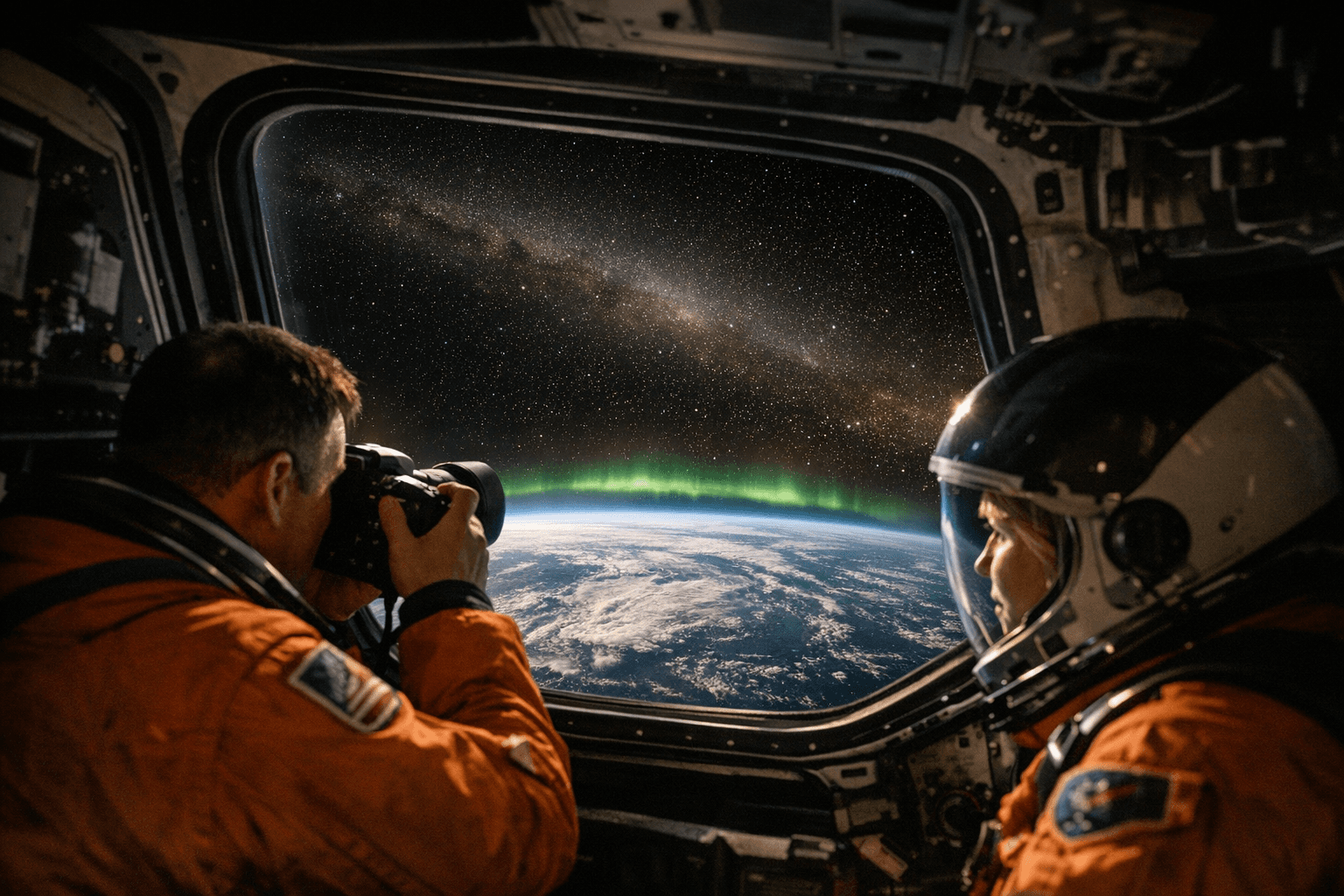
The first high-resolution images of Earth captured by the Artemis II crew show the entire planet bathed in blues and browns, with both Northern and Southern auroras glowing over the poles and zodiacal light, produced by sunlight scattering off solar system dust, visible in the lower right corner of the frame. Commander Reid Wiseman photographed the scene from Orion's window on April 2, hours after the crew completed their translunar injection burn, the last major propulsive maneuver of the 10-day flight. NASA titled the first image "Hello, World."
The photographs arrived as the four-person crew pressed deeper into cislunar space on a trajectory no humans have followed since the final Apollo mission more than five decades ago. Pilot Victor Glover, viewing the globe from pole to pole, offered the most direct reaction: "Trust us, you look amazing. You look beautiful." Mission Specialist Christina Koch described the view as a preview of what was coming: "Knowing that we're about to have some similar views of the moon in that same way is definitely getting [exciting]."
NASA official Lori Glaze put the milestone in stark terms at a press conference: "For the first time since 1972 during Apollo 17, human beings have left Earth orbit."
Artemis II launched April 1, 2026, at 6:35 p.m. EDT from Launch Complex 39B at Kennedy Space Center in Florida aboard the Space Launch System rocket, only the vehicle's second flight. The Lockheed Martin-built Orion spacecraft carried Wiseman, Glover, Koch, and Canadian Space Agency Mission Specialist Jeremy Hansen, the first Canadian astronaut to travel toward the moon, into an initial Earth orbit before the Thursday evening burn sent Orion on course for the moon.
The mission follows a free-return trajectory, using the Moon's gravity to slingshot the spacecraft around the lunar far side before heading back to Earth without additional propulsion. Orion is expected to fly by the moon around midday on Monday, April 6. On flight day six, the crew will sail roughly 5,000 miles beyond the moon, reaching an estimated maximum distance of 252,021 miles from Earth, surpassing the record set by the Apollo 13 crew in 1970 by approximately 3,366 miles and making Wiseman, Glover, Koch, and Hansen the farthest-traveled humans in history.
None of the four crew members were alive when Apollo 17 launched on December 7, 1972, the last time humans ventured toward the moon. Unlike those Apollo missions, Artemis II carries no landing plan; the crew will not orbit or touch the lunar surface. This is a shakedown test flight designed to validate the planning, flight control procedures, and life-support systems that will support crewed landings near the Moon's south pole, currently targeted for 2028.
With a return to Earth scheduled around April 10, the mission's greatest scientific dividend may ultimately be procedural: proving that the full Orion system works with humans aboard. But the images Wiseman captured from the spacecraft's window, showing auroras arcing over both poles, South America's eastern coast partially veiled by clouds, and the Iberian Peninsula in daylight at left, carry an older, more immediate kind of power, one last felt when Apollo 17's crew photographed the "Blue Marble" from a similar vantage point 54 years ago.
Sources:
Know something we missed? Have a correction or additional information?
Submit a Tip