Artemis II Crew Clears Key Day 1 Milestones on Historic Lunar Flyby Mission
The Orion spacecraft 'Integrity' survived its first gauntlet: three Day 1 orbital maneuvers and a TLI burn committing four astronauts to the first crewed lunar journey since Apollo 17.
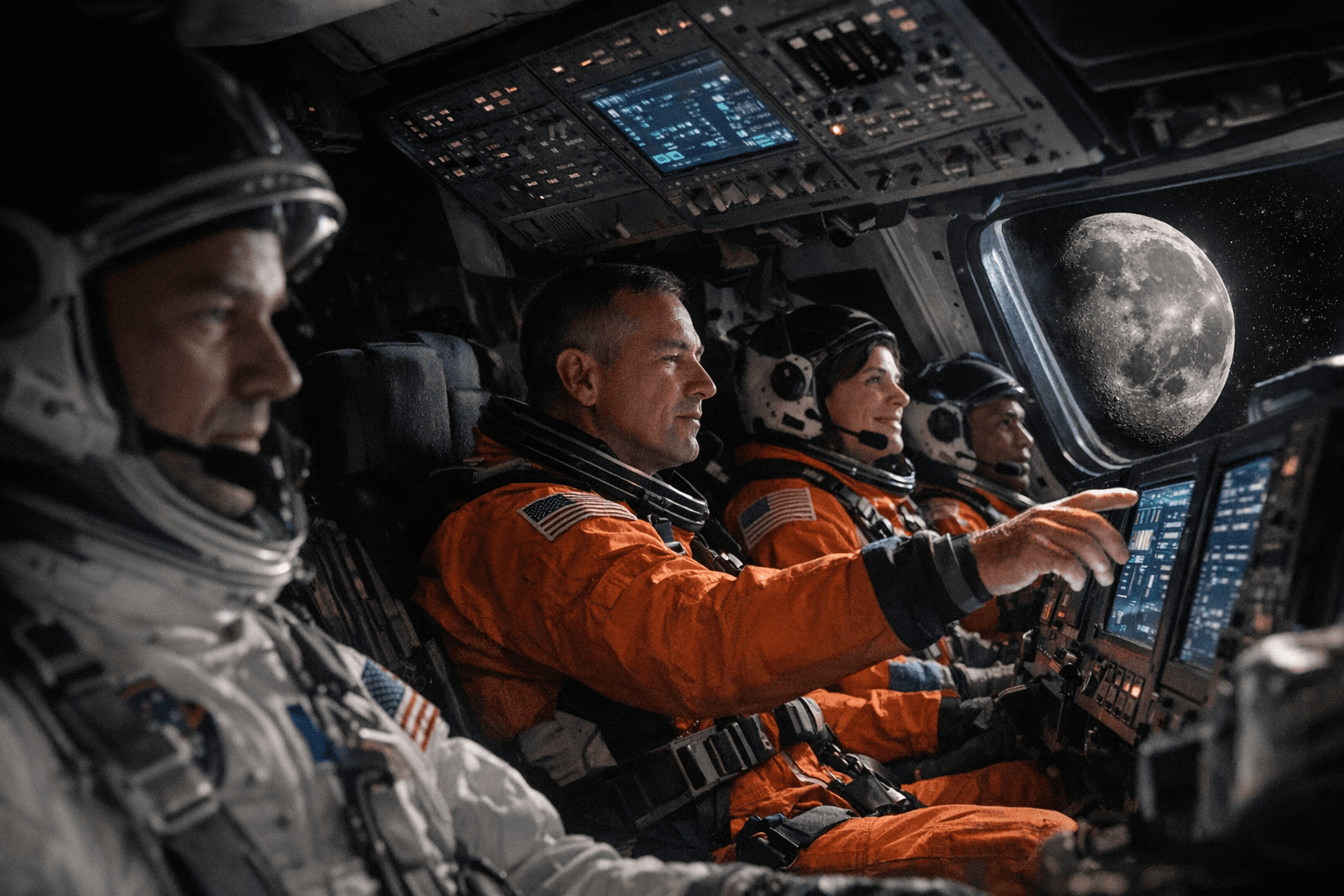
With the Orion spacecraft "Integrity" now locked onto a free-return trajectory toward the Moon, NASA's Artemis II mission has cleared its earliest and most critical checkpoints, and the next phase of scrutiny is about to begin.
The four-member crew launched from Kennedy Space Center in Florida on April 1 at 6:35 p.m. EDT aboard NASA's Space Launch System rocket, kicking off the first crewed lunar flyby in more than 50 years. Three consecutive maneuvers during the first hours of flight validated systems that have never carried astronauts this far from Earth. A perigee raise maneuver, executed roughly 49 minutes after liftoff by the rocket's Interim Cryogenic Propulsion Stage, lifted Orion's lowest orbital point to a safe altitude. An apogee raise burn then placed the spacecraft in a 23.5-hour high Earth orbit with an apogee of 38,000 nautical miles, or 44,000 miles above the planet.
The most demanding Day 1 test came at 11:37 p.m. EDT, when Pilot Victor Glover completed a roughly 70-minute proximity operations demonstration, manually flying Orion toward and around the detached ICPS upper stage and using it as a simulated docking target. The exercise stress-tested the manual handling qualities of the spacecraft, a capability Artemis III will require when it attempts to dock with a lunar lander near the Moon.
On Flight Day 2, April 2 at 7:49 p.m. EDT, Orion's engine fired for 5 minutes and 50 seconds, adding approximately 867 mph to the spacecraft's velocity. That trans-lunar injection burn was the last major engine firing of the mission and committed Commander Reid Wiseman, Glover, Mission Specialists Christina Koch and Jeremy Hansen to their lunar journey. The ICPS, its work complete, performed a disposal burn and re-entered Earth's atmosphere over a remote region of the Pacific Ocean; four small CubeSats were deployed from the SLS rocket's Orion stage before the upper stage's departure.
The next critical gate is the lunar flyby itself. Orion will arc around the Moon's far side, briefly out of radio contact with Earth, which is a planned and expected loss of signal. What mission controllers will be watching for on the other side: Orion emerging on the correct homeward trajectory with all systems nominal. Any deviation in that exit path would signal a problem, not the silence itself.
After the flyby, the mission's final and most violent test awaits. Orion will return to Earth's atmosphere at velocities not seen in a crewed American spacecraft since the Apollo era, generating heat that will subject the capsule's heat shield to its first fully crewed stress test. Splashdown, targeted approximately 10 days after the April 1 launch, is the last proof point before Artemis III aims for an actual lunar landing, currently scheduled for 2028.
The crew embodies how much has changed since Apollo 17 set humanity's last boots on the Moon in December 1972. Glover became the first person of color to travel beyond low Earth orbit; Koch the first woman; Wiseman, born November 11, 1975, the oldest person to do so; and Hansen, representing the Canadian Space Agency, the first non-U.S. citizen to venture past Earth orbit. Each milestone deepens the political and symbolic stakes of a program now within reach of the Moon, with Mars already on the horizon.
Know something we missed? Have a correction or additional information?
Submit a Tip