Artemis II Crew Returns Home After Historic First Crewed Lunar Flyby in 50 Years
Four astronauts broke humanity's distance record at 252,760 miles from Earth after the first crewed lunar flyby since 1972. Reentry on April 10 will deliver the mission's final technical verdict.
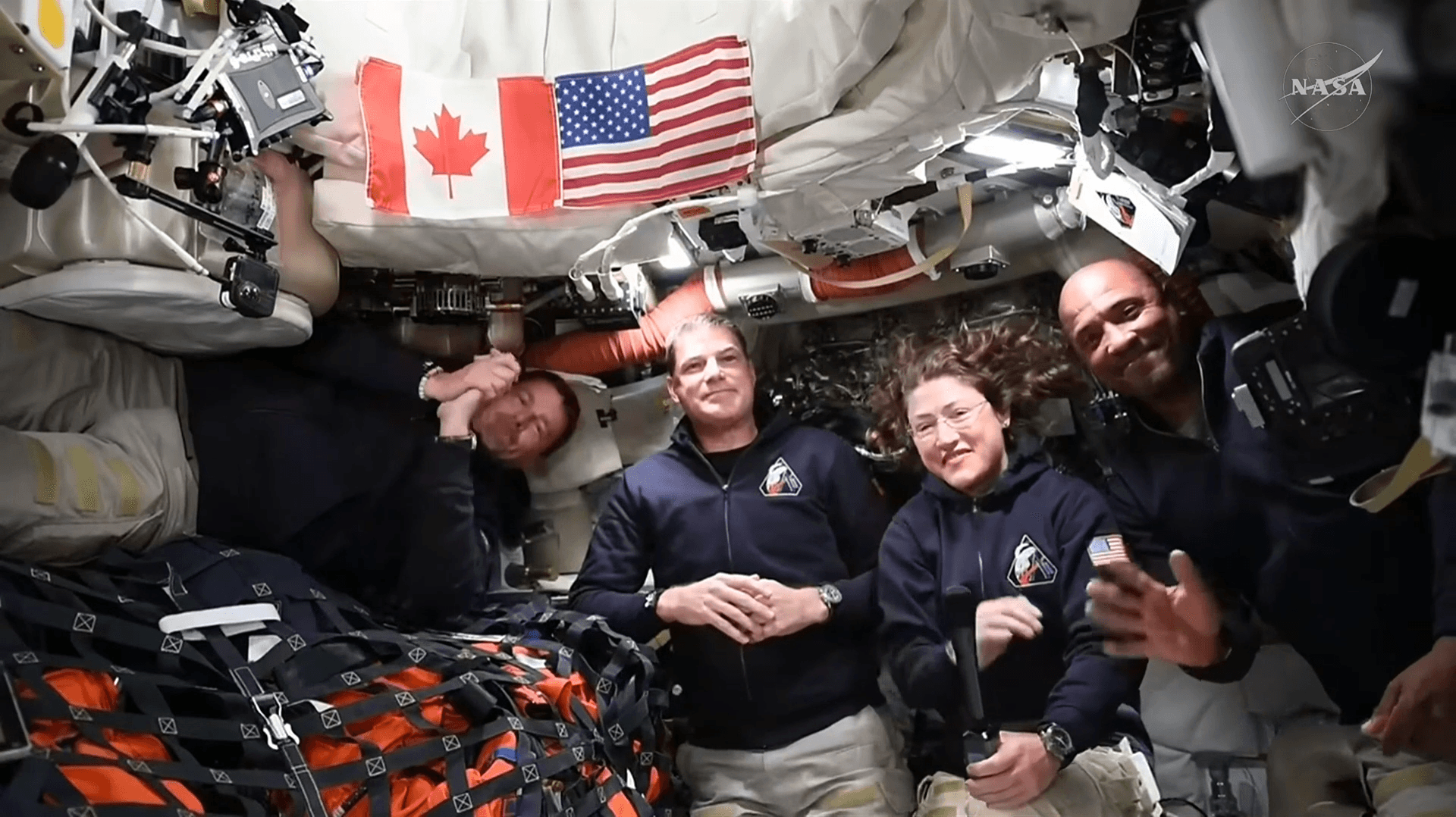
The crew of Artemis II is making its way back to Earth having logged a record-breaking 252,760-mile separation from the planet, completed the first crewed lunar flyby in more than 50 years, and produced a data set that NASA will spend months analyzing before it commits humans to an actual lunar landing. The mission's most consequential test, however, has not happened yet.
Artemis II was designed from the outset as a comprehensive crewed stress test of the Orion spacecraft in deep space: life support, navigation, crew operations, and two-way communications across a quarter-million-mile chain to Mission Control at Johnson Space Center in Houston. Launched April 1 from Kennedy Space Center's Launch Complex 39B on the Space Launch System rocket, Orion orbited Earth twice for systems verification before a Day 2 translunar injection burn committed the crew to deep space. The mission used a free-return trajectory, the same figure-eight path around the Moon that saved the Apollo 13 crew during their 1970 emergency abort, and every phase through the lunar flyby performed as designed.
The record-breaking moment arrived April 6 at 1:57 p.m. ET, when Commander Reid Wiseman, Pilot Victor Glover, and Mission Specialists Christina Koch and Jeremy Hansen crossed 248,655 miles from Earth, erasing the distance record Apollo 13 set 56 years ago during its oxygen-tank crisis. Orion, named Integrity by its crew, ultimately reached 252,760 miles (406,771 km), some 4,105 miles beyond any human being in history. During the flyby window that afternoon, Orion made its closest lunar approach at approximately 4,067 miles from the surface. The four crew members became the first humans to directly observe portions of the lunar far side with the naked eye, regions that no Apollo astronaut had ever seen at close range. At 8:35 p.m. EDT, the Moon passed between Orion and the Sun, and the crew watched a total solar eclipse from space for nearly an hour.
Hansen, representing the Canadian Space Agency and marking his own milestone as the first Canadian ever to travel to deep space, relayed a statement at the record-breaking moment: "From the cabin of Integrity, as we surpass the furthest distance humans have ever traveled from planet Earth, we do so honoring the extraordinary efforts and feats of our predecessors in human space exploration." Koch, the first woman to fly in the vicinity of the Moon, described the journey to NBC News as "emotional, full of joy, happiness and disbelief." The crew also named a crater on the boundary between the Moon's near and far side after Wiseman. NASA Artemis Science Flight Operations Lead Kelsey Young told the crew: "I can't say enough how much science we've already learned, and how much inspiration you've provided to our entire team, the lunar science community and the entire world."

What the mission has not yet tested is the system that partially failed on Artemis I. After that 2022 uncrewed flight, NASA discovered unexpected erosion in the Avcoat ablative material on Orion's heat shield, a problem that delayed Artemis II by more than a year and forced engineers to modify the reentry profile. NASA confirmed the capsule's underlying structure would withstand conditions exceeding expected parameters, but the full lunar-return reentry profile executes only once: during splashdown. Scheduled for approximately 8:07 p.m. EDT on April 10 in the Pacific Ocean off San Diego, that descent into the atmosphere is the mission's final and most watched data point. The USS John P. Murtha will stand by as recovery ship, with helicopters transferring the crew for medical evaluation.
The crew's return arrives against a complicated political backdrop. The White House proposed cutting NASA's budget by approximately $5.6 billion, a reduction of roughly 23 percent that would have terminated key Artemis architecture. Congress pushed back, with a reconciliation package adding approximately $9.9 billion back into NASA programs, explicitly allocating funds for SLS, Orion, Gateway, and Artemis IV and V infrastructure. That political standoff has already reshaped the mission sequence: Artemis III, scheduled for 2027, is set to test an HLS lunar lander in Earth orbit; it was planned as the first lunar landing of the program until 2026, when the landing was pushed to Artemis IV, targeted for 2028.
The SLS rocket that launched this crew carries an estimated per-flight cost that exceeds $4 billion. Against that expenditure, NASA can now document that four humans operated the Orion life-support system at lunar distances, that navigation held across a free-return arc threading within 4,067 miles of the lunar surface, and that deep-space communications functioned throughout. Whether the heat shield data from April 10 clears the runway or introduces new constraints will set the terms of every budget argument and every congressional hearing between now and Artemis IV. A post-splashdown press conference is scheduled at Johnson Space Center for 10:35 p.m. EDT that night.
Know something we missed? Have a correction or additional information?
Submit a Tip