Artemis II Crew Set to Break 55-Year Human Spaceflight Distance Record
NASA's Artemis II crew broke Apollo 13's 55-year distance record Sunday, reaching 252,757 miles from Earth as four astronauts swept around the Moon's far side.

The longest-standing record in human spaceflight history fell Sunday, as NASA's Orion spacecraft carried the Artemis II crew to 252,757 miles from Earth, surpassing the mark set by Apollo 13 in April 1970 by more than 4,100 miles. The milestone arrived at 1:56 p.m. Eastern, and 55 years of precedent made it no less striking.
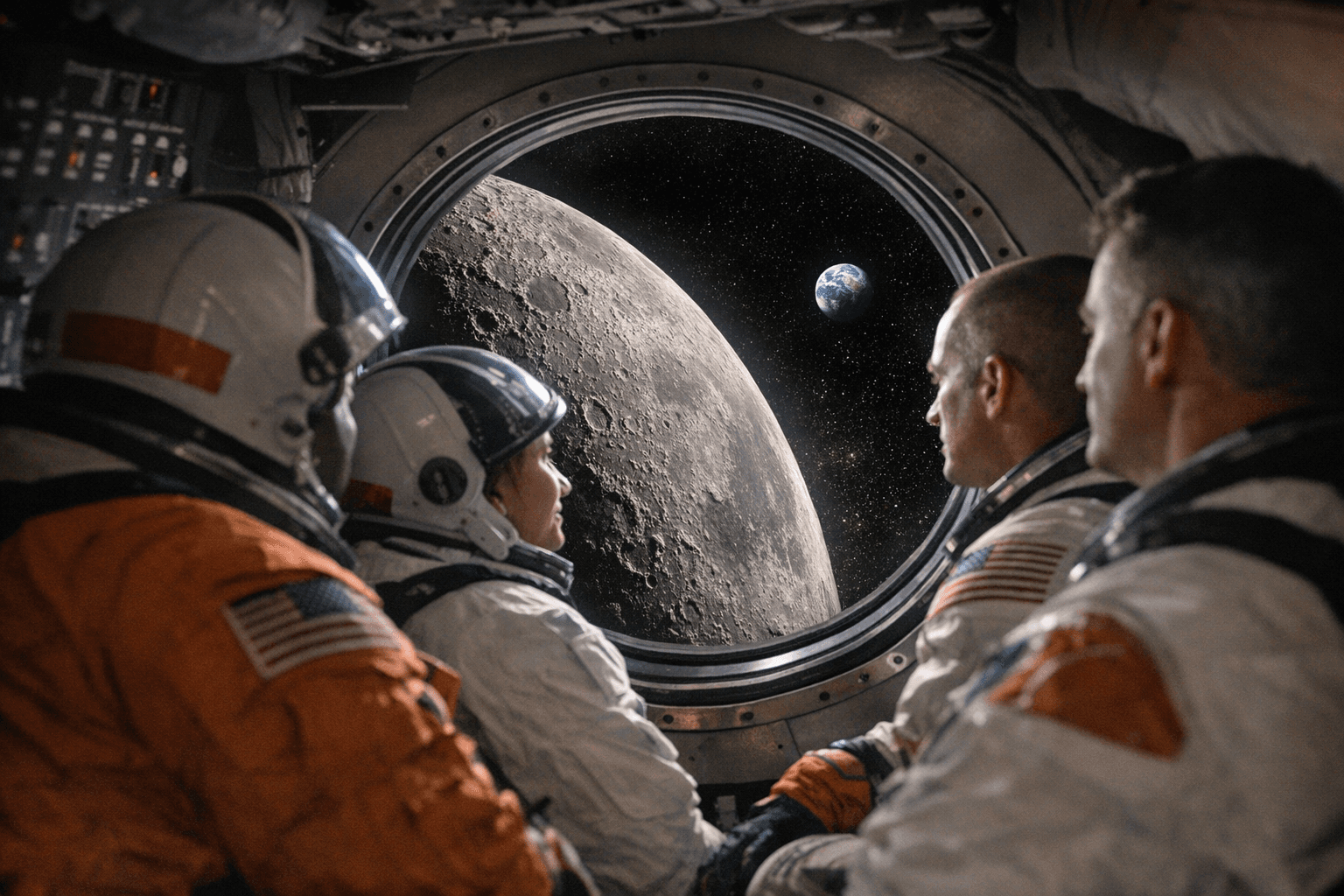
Commander Reid Wiseman, Pilot Victor Glover, Mission Specialist Christina Hammock Koch, and Canadian Space Agency astronaut Jeremy Hansen are the four crew members aboard the Orion capsule. Koch and Hansen each broke additional ground: Koch is the first woman, and Hansen is the first Canadian, to travel to the vicinity of the Moon.
The record fell on Day 6 of what NASA designed as a critical rehearsal, not a landing. Artemis II launched April 1 from Kennedy Space Center aboard the Space Launch System rocket, only the second flight of that vehicle, on a 10-day circumlunar flyby built to stress-test Orion's deep-space systems before NASA commits to setting astronauts on the lunar surface. It is the first crewed lunar mission in more than half a century.
The flight path that delivered the crew to the record was almost flawlessly precise. Mission controllers reported that Orion's trajectory required none of the first two planned course-correction maneuvers, with a single 14-second engine firing the only adjustment needed to keep the spacecraft locked onto its lunar flyby track.
The deeper test came later Sunday. As Orion transited the lunar far side, a region permanently invisible from Earth, ground controllers lost all contact with the four astronauts for approximately 40 minutes beginning around 5:47 p.m. Eastern. The blackout was planned and prepared for extensively, but it placed the crew fully beyond reach at the most remote point of the mission.
Science ran alongside the navigation milestones. The AVATAR experiment, A Virtual Astronaut Tissue Analog Response, uses organ-on-a-chip devices roughly the size of a USB drive to study the effects of deep-space radiation and microgravity on human tissue. The data targets a specific knowledge gap: how the body responds to deep space, essential preparation for the long-duration Mars missions the Artemis program is ultimately meant to enable.
Artemis II built on the 2022 uncrewed Artemis I test flight, which proved the SLS and Orion systems without crew aboard. Retired NASA astronaut Chris Cassidy, a former U.S. Navy SEAL and NASA's Chief of the Astronaut Office from 2015 to 2017, provided live mission commentary for CBS News throughout the flight.
Apollo 13's distance record outlasted the Space Race, the Shuttle era, and more than two decades of International Space Station operations. That it took more than five decades to surpass reflects the extraordinary nature of that 1970 trajectory and the long arc between humanity's first reach toward the Moon and this one.
Know something we missed? Have a correction or additional information?
Submit a Tip