As Cuba struggles, long-unsettled U.S. property claims resurface for resolution
Nearly 6,000 U.S. claimants still seek about $9 billion for property Cuba seized after 1959, and the island’s crisis has revived a fight that never ended.
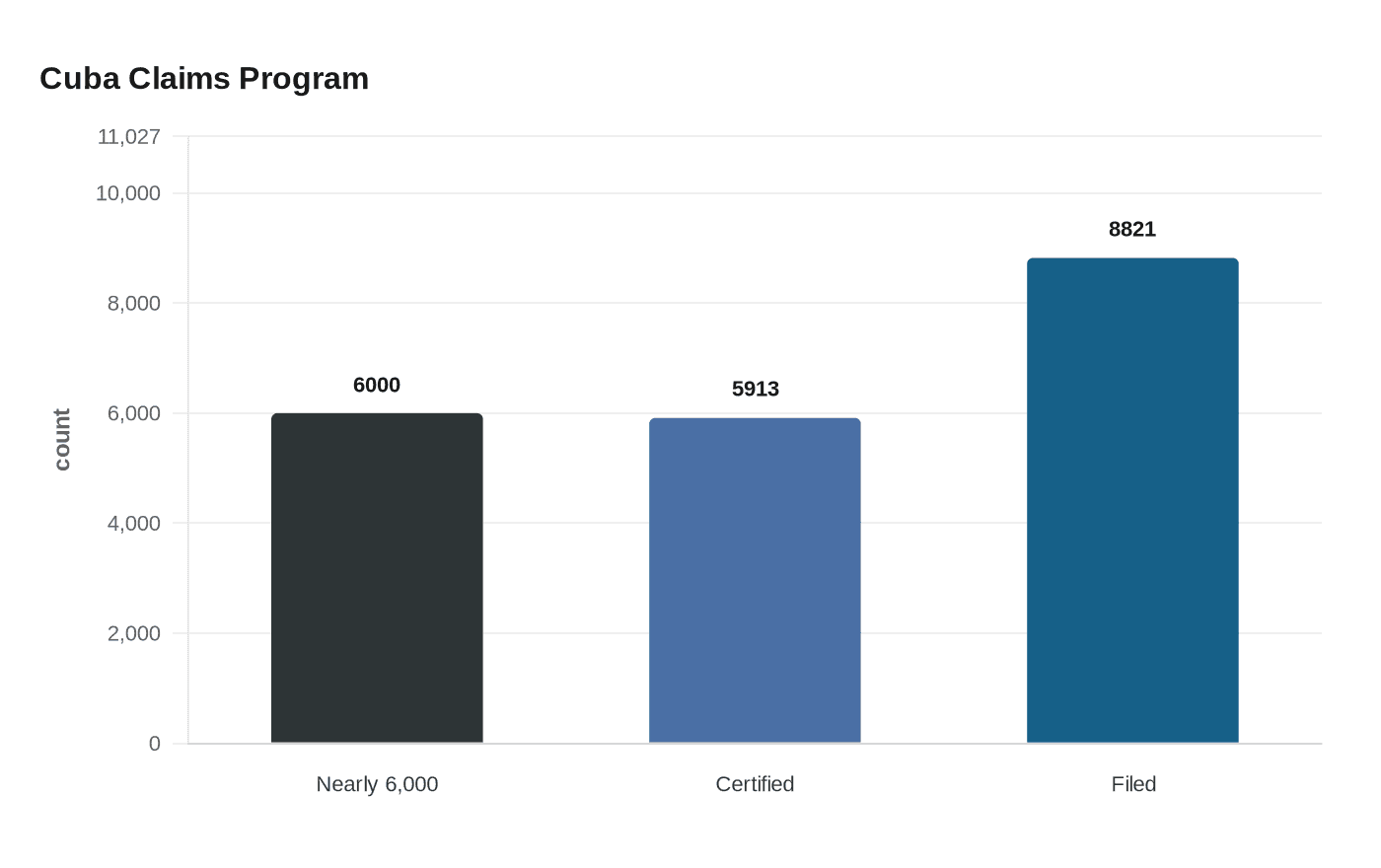
A half-century after Fidel Castro’s government began taking over farms, cattle ranches and other property, nearly 6,000 U.S. individuals and companies still hold certified claims against Cuba, and the island’s worsening economic crisis has pushed those losses back into the center of legal and diplomatic debate. The claims trace to the Agrarian Reform Law in 1959, expanded expropriations in July 1960 under Law 851, and additional nationalizations through 1963.
The Foreign Claims Settlement Commission certified 5,913 claims out of 8,821 filed in its Cuba Claims Program, with principal awards totaling $1,902,202,284.95. The U.S. government says those claims remain unsettled with Havana. With interest, current estimates place the total at about $9 billion, a figure that has made the issue more than a family grievance. It is also a continuing obstacle to foreign investment and real-estate development in Cuba, where unresolved title disputes cloud ownership and deter capital.
For families in Miami, Coral Gables and elsewhere in exile, the fight is personal as well as financial. Some heirs have spent decades preserving deeds, photographs and old business records as proof of what was taken. The claim files pass from one generation to the next, carrying not just lost land or buildings but the memory of a forced rupture that reshaped Cuban American life. Raul Valdes-Fauli is among the names tied to that long-running community pressure, while Nick Gutiérrez and Robert Muse have also remained part of the broader legal and political conversation surrounding restitution.
The dispute has regained urgency because the legal terrain has changed. The U.S. Department of State says Helms-Burton Act Title III was activated in 2019, opening the door to lawsuits over trafficked confiscated property. In 2026, the Supreme Court heard arguments in Cuba property-confiscation cases involving ExxonMobil and major cruise lines, including Carnival, Royal Caribbean, Norwegian Cruise Line and MSC Cruises, underscoring that Cold War-era property fights remain active financial risks for companies doing business tied to Cuba.
Havana has said in recent years that it may be open to discussing compensation as part of broader talks with Washington, but Cuban Americans remain skeptical that any deal would protect claimants or avoid rewarding those who benefited from the seizures. Cuba has precedent with other countries, settling expropriation claims with France, Spain and Switzerland in 1967, and Canada later negotiated its own settlement framework. For aging claimants and younger heirs alike, the central question is the same: whether Cuba’s economic pressure will finally force a resolution, or whether these claims will remain one more inheritance of the revolution.
This article was produced by Prism’s automated news system from verified source data, official records, and press releases, then run through automated quality and moderation checks before publishing. The system is built and supervised by the people who set the standards it runs under. Read our full AI policy.
Did this article answer your question?