As trust in national news falls, readers seek answers
Readers are not just losing trust. They are asking for the missing context, and the numbers show a widening gap between national and local news.

Why the trust gap matters now
Reader skepticism is no longer a side note in political coverage. It is the story behind the story, with Americans increasingly asking not only what happened, but who can explain it clearly and what can actually be verified. That pressure lands hardest on national news, where trust has fallen even as the demand for context has risen.
The clearest answer from the data is that audiences are not rejecting all news equally. They are making a distinction between national outlets, local outlets, and the flood of political coverage that now competes for attention every day. The result is a trust gap that changes how readers consume information and how newsrooms have to explain it.
What readers are telling pollsters
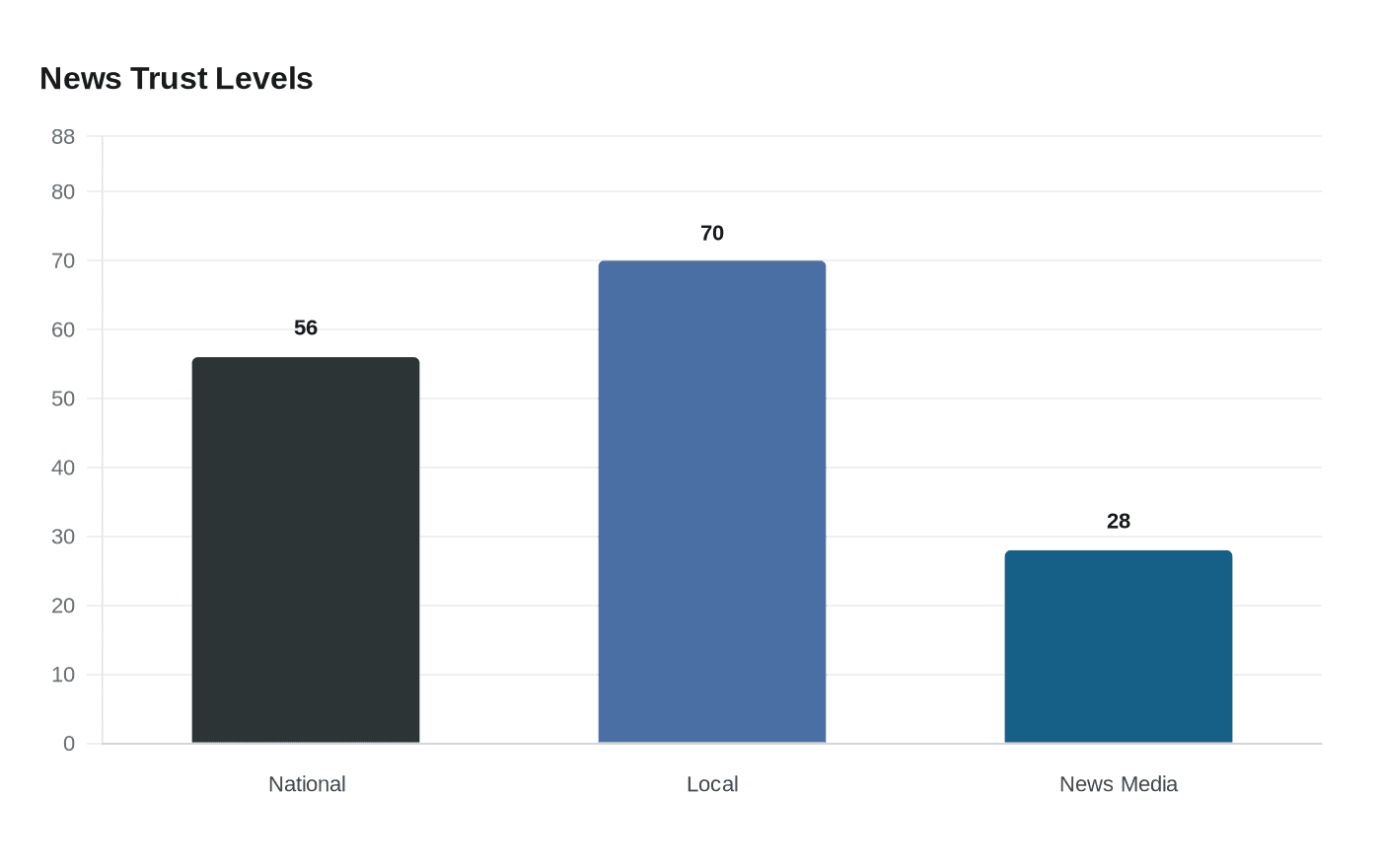
The numbers point in the same direction across multiple surveys. In October 2025, Pew Research Center found that 56% of U.S. adults said they had a lot of or some trust in information from national news organizations. That was down 11 percentage points from March 2025 and 20 points from 2016.
Local news still fares better. Pew found that 70% of U.S. adults said they had at least some trust in local news organizations in October 2025. That gap matters because it suggests many readers are not turning away from journalism itself, but from the way national politics is framed, repeated, and filtered through the day’s headlines.
Other polling shows a similar strain. Gallup reported in October 2025 that trust in newspapers, television and radio to report the news fully, accurately and fairly fell to 28%, a record low. AP-NORC polling also found that nearly two-thirds of Americans recently felt the need to cut down on political and government news consumption.
Why the confusion persists
The confusion is not simply about facts. It is about overload, repetition, and the feeling that the same political fight is being described from the same angles without enough context to show what changed, what did not, and what still cannot be known. When people say they want more transparency, they are often asking for the chain of evidence, the difference between reporting and interpretation, and the historical baseline that shows whether a claim is unusual or routine.
That is where distrust grows. A story can be technically accurate and still leave readers unsure about why it matters, what is confirmed, or how much of the narrative rests on hard evidence versus informed judgment. The result is a credibility problem that is as much about clarity as it is about partisanship.
What the reporting process can verify
The strongest reporting answers reader questions by grounding them in data, records, and long-running institutional memory. The AP-NORC Center for Public Affairs Research says its polling provides timely, independent, issue-based data and analysis for citizens, journalists, business leaders, and elected officials. That matters because public opinion is often discussed loosely, while survey data can show exactly what people said, when they said it, and how large the sample was.
The Associated Press also points readers to tools that make verification more concrete. AP VoteCast, used in the 2024 election, surveyed more than 120,000 registered voters in all 50 states. That kind of scale helps reporters map voting patterns, compare states, and see how turnout and attitudes differed across the country rather than relying on a single national snapshot.
Why archives and historical context matter
If trust is falling, historical context becomes more valuable, not less. The Associated Press says its archive reaches from 1895 to today, and that archive includes over 2 million global news and entertainment video stories dating back to 1895. That scope gives reporters a way to answer a basic reader question: has this happened before, or are we watching something new?
Historical context does more than fill space. It helps separate a genuine break from a recycled panic, and it gives the audience a way to see how institutions, elections, and public attitudes have changed over time. When newsrooms fail to show that context, readers are left to guess whether they are seeing a turning point or just another cycle of political noise.
What readers should expect from accountable coverage
A serious guide to the trust gap should make one thing plain: not every question has the same kind of answer. Polling can measure trust, fatigue, and political mood. Archives can show how events unfolded before. Election data can reveal voting patterns and turnout. None of those tools can fully explain every reader’s experience of frustration, or prove exactly why one person stopped believing a headline while another kept reading.
That is why transparency matters as much as speed. Readers deserve to know what is established, what is inferred, and what remains open. They also deserve to see the evidence behind major claims, especially when coverage touches elections, governance, or public trust in institutions.
The real takeaway for newsrooms and readers
The falling trust figures are not just a warning about journalism. They are a reminder that audiences are asking for more evidence, more context, and fewer assumptions. National news organizations now face a simple test: show your work clearly enough that readers can see how the conclusion was reached.
Local trust remains higher, national trust has weakened, and political news fatigue is real. The path back runs through verification, history, and plain language that makes the reporting process legible to the public.
This article was produced by Prism’s automated news system from verified source data, official records, and press releases, then run through automated quality and moderation checks before publishing. The system is built and supervised by the people who set the standards it runs under. Read our full AI policy.
Did this article answer your question?

