Astronaut Chris Williams, Two Cosmonauts Join International Space Station Crew
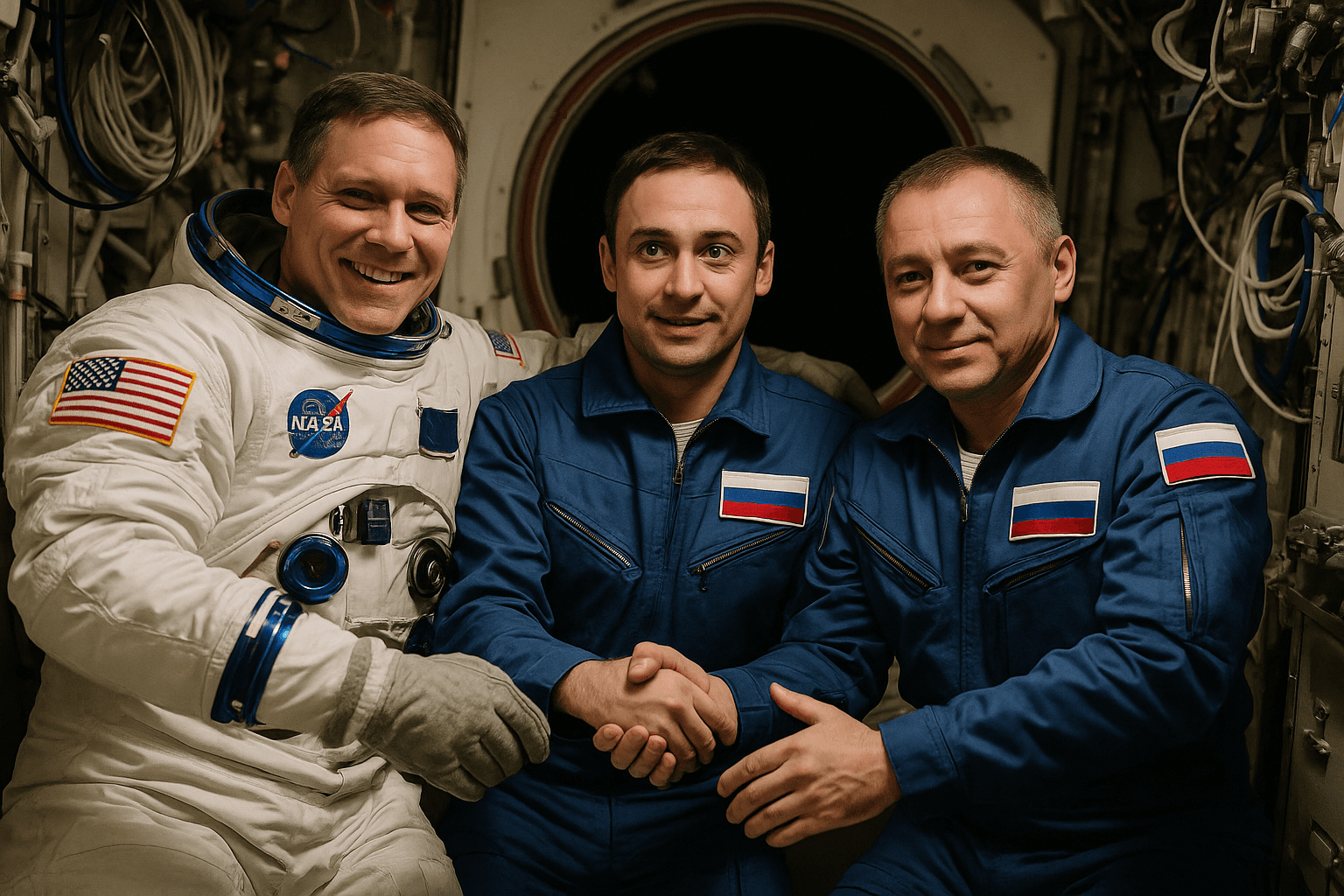
NASA confirmed that astronaut Chris Williams and Roscosmos cosmonauts Sergey Kud Sverchkov and Sergei Mikaev arrived at the International Space Station after a roughly three hour, two orbit flight from Baikonur, temporarily expanding the station crew to 10. The short term bump in personnel will support experiments ranging from cryogenic fuel efficiency to semiconductor crystal growth, and underscores continued U.S. Russian cooperation in human spaceflight.

NASA announced that Chris Williams of the United States and Roscosmos cosmonauts Sergey Kud Sverchkov and Sergei Mikaev docked with the International Space Station on November 27, arriving late Thanksgiving morning after launching from the Baikonur Cosmodrome and completing a roughly three hour, two orbit trip aboard Soyuz MS 28. The agency said the arrival was nominal and that the newcomers were welcomed aboard by the station Expedition crew.
The addition of the three crewmembers temporarily raised the station population to 10 for roughly two weeks while other crew rotations proceed. NASA provided mission timing, launch details including lift off and docking, and imagery of the handover. The agency also outlined mission priorities for the new arrivals, which include testing a new modular exercise device and conducting experiments on cryogenic fuel efficiency and semiconductor crystal growth. The release noted procedures will be followed for medical checks of crew who are due to return to Earth in the coming weeks.
The mission highlights the sustained operational rhythm of the space station as a platform for international science and engineering. The experiments that Williams and the cosmonauts will perform are intended to improve long duration crew health and to refine technologies that could be central to future orbital logistics and materials manufacturing. Cryogenic fuel efficiency work bears on the logistics of refueling and orbital maneuvering, while semiconductor crystal growth in microgravity may advance high end electronics and photonics research.
Beyond the scientific calendar, the flight carries diplomatic weight. Human spaceflight has long functioned as an arena for practical cooperation under the legal framework that governs the station, even as terrestrial relations between the United States and Russia have been strained at times. The steady flow of joint missions, shared facilities, and coordinated operations on orbit illustrates a continued commitment by space agencies to maintain institutional ties and the scientific enterprise that depends on them.
The timing of the docking on an American holiday served as a reminder of the station’s multinational character, where national calendars and cultures converge around sustained scientific work. The international roster aboard the station includes crew members from multiple partner agencies, and the rotation schedule that will reduce the complement back to the usual level in coming weeks reflects careful logistical planning.
NASA said the new crew will begin their assigned tasks immediately, integrating into the Expedition schedule and supporting ongoing experiments and station maintenance. As the incoming team settles in, engineers and flight surgeons on the ground will monitor health and systems performance, ensuring that the brief expansion of personnel contributes efficiently to research goals and to the continuity of operations in low Earth orbit.
This article was produced by Prism’s automated news system from verified source data, official records, and press releases, then run through automated quality and moderation checks before publishing. The system is built and supervised by the people who set the standards it runs under. Read our full AI policy.
Did this article answer your question?