Auston Matthews credits American chemistry for U.S. Olympic hockey surge
Auston Matthews says strong team chemistry is powering the U.S. men's Olympic hockey campaign in Milan, built on continuity, the Tkachuk brothers and deep NHL talent.
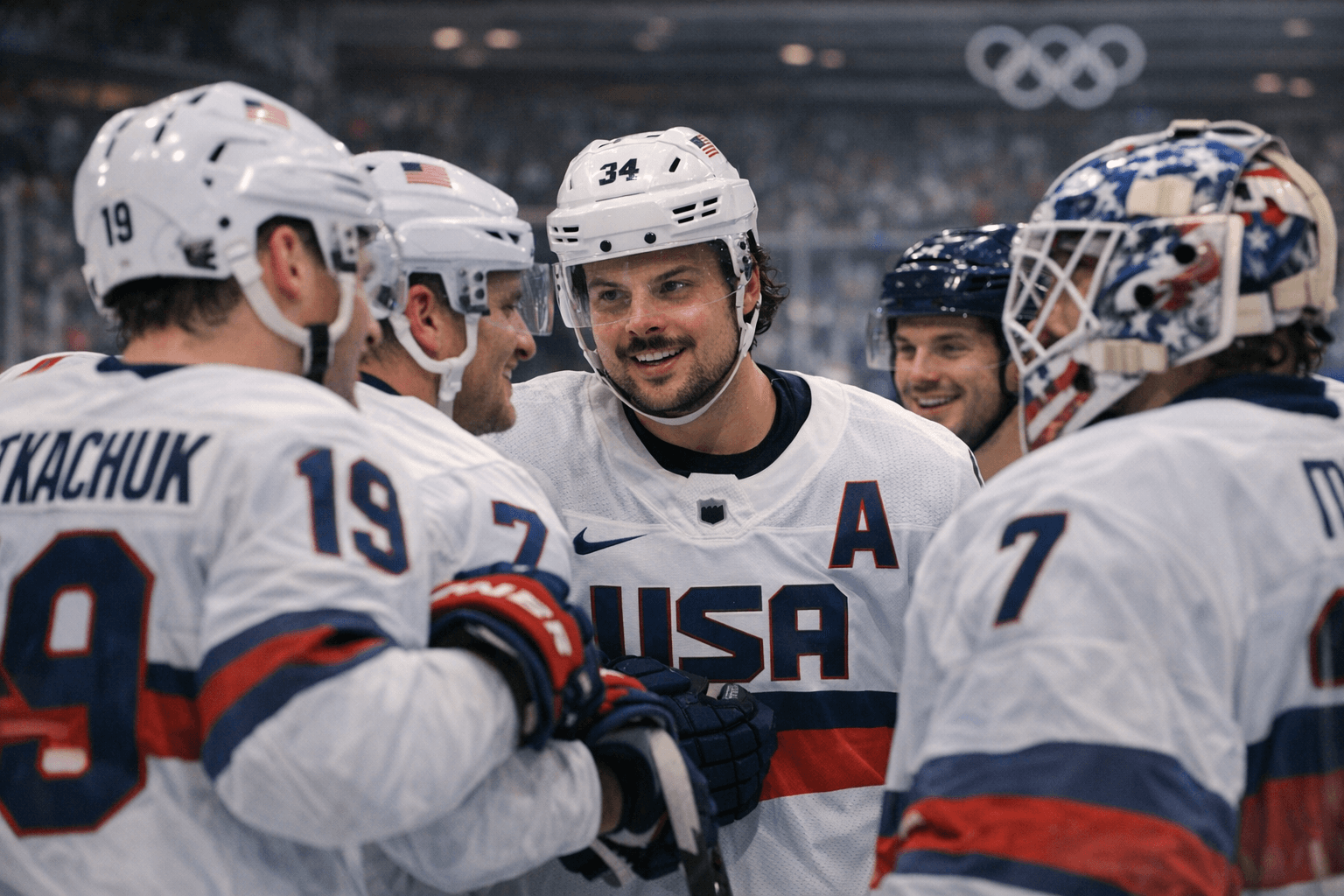
Captain Auston Matthews said "strong team chemistry has been a cornerstone of the U.S. men's ice hockey campaign at the Milan-Cortina Olympics," a theme that has guided roster choices, line construction and off-ice bonding for a team aiming past expectation and toward a medal run.
The Americans arrived in Milan with a 25-player roster that preserves continuity: 21 of those players competed at the Four Nations tournament and the leadership group remains intact with Matthews as captain and Matthew Tkachuk and Charlie McAvoy as alternate captains. General manager Bill Guerin made few changes from the Four Nations squad that finished second to Canada, signaling a belief that cohesion is more valuable than wholesale tinkering.
Coaching and players have pointed to specific evidence of that chemistry. At the Four Nations the brothers pairing of Matthew and Brady Tkachuk alongside Jack Eichel was credited with sparking a 6-1 win over Finland and a 3-1 victory over Canada, results that have carried into Milan. Coach Mike Sullivan framed the brothers as central to the team's identity: "We liked the Tkachuk brothers when we put them together…We thought they're heart-and-soul guys. In a lot of ways, they personify what it means to be an American with their fierce competitive spirit, and so I thought that they were the catalyst for our team becoming a team in the true sense of the word."
Players welcome the continuity. Matthew Tkachuk said, "I really just think what I saw at the 4 Nations has just carried on to this, how proud we are all to wear the red, white and blue… That hasn't changed at all for this. It's maybe even taken a step up, so it's been great." His brother Brady added perspective on the group's versatility and character: "For me, individually, it's not going to really change much. Just going to go out there and play how I need to play," and "I don't think our team is just physical. I think our team can play any aspect that the game provides. We have some of the generational skill with some guys and the compete and the character in our room is the highest I've ever been around. I think that's what's going to make us special, is the versatility of whatever the game provides, knowing that's the way we need to play."
Projected deployments show the coaching staff balancing star power and depth. One top line is expected to feature the Tkachuk brothers with Jack Eichel at center while Auston Matthews should center a line flanked by Matt Boldy and Jake Guentzel. Other projected forward groupings include Kyle Connor with Dylan Larkin and Tage Thompson, and a fourth line of Jack Hughes, Brock Nelson and J.T. Miller with Vincent Trocheck rotating in. Olympic dress rules allow 13 forwards and seven defensemen, and Noah Hanifin is listed as the seventh defenseman and likely to see limited time.
Defensive alignments have shown slight variation in practice, with Quinn Hughes skating with Charlie McAvoy while Brock Faber worked with Jaccob Slavin, even as coaching plans appear to preserve a shutdown pairing of Slavin and Faber from Four Nations. The flexibility hints at tactical adjustments meant to match opponent strengths while preserving the core that has gelled in recent weeks.
Beyond tactics, the U.S. program has leveraged off-ice moments to solidify identity and broaden appeal: three practices in Milan have been supplemented by team-bonding events that ranged from a hang session with Snoop Dogg to an outing supporting the U.S. women's team. That mix of celebrity crossover, national pride and star-studded NHL talent elevates the Olympic product for broadcasters and sponsors while amplifying a broader cultural narrative about American competitiveness on ice.
As the tournament unfolds, the United States carries momentum built on chemistry, continuity and high-end skill. That combination has commercial and social implications, boosting viewer interest, merchandising and the sport's profile domestically, while offering a credible path to upset hockey's heavy favorites.
This article was produced by Prism’s automated news system from verified source data, official records, and press releases, then run through automated quality and moderation checks before publishing. The system is built and supervised by the people who set the standards it runs under. Read our full AI policy.
Did this article answer your question?
.jpg&w=1920&q=75)