Australia, Japan sign $7 billion frigate deal to bolster Pacific security
Australia and Japan locked in a A$10 billion frigate pact in Melbourne, cementing a new defense-industrial tie and signaling a sharper regional response to China.
Australia and Japan turned a long-running security courtship into a signed industrial partnership on Saturday, locking in a A$10 billion deal for upgraded Mogami-class frigates that will reshape both navies and send a clear signal across the Indo-Pacific.
In Melbourne, Defence Minister Richard Marles and Japan’s Shinjiro Koizumi signed contracts for Australia’s first three general purpose frigates, with Mitsubishi Heavy Industries set to build those ships in Japan. The first vessel is due to be delivered to the Royal Australian Navy in 2029 and enter service in 2030, a timetable that gives Canberra an earlier path to replacing its aging surface fleet while deepening defense ties with Tokyo.
The agreement goes well beyond a single weapons purchase. Australia will eventually receive 11 frigates under the SEA 3000 program, with later ships slated for construction at Henderson Defence Precinct near Perth if the Western Australian shipbuilding site is consolidated. The government says the program could support about 10,000 high-skilled jobs over two decades, underscoring how closely national security and industrial policy are now linked.
The upgraded Mogami-class frigates are built for long-range maritime warfare. Australia says the ships can sail up to 10,000 nautical miles, carry a 32-cell vertical launch system, launch surface-to-air and anti-ship missiles, and operate an MH-60R Seahawk maritime combat helicopter. With crews of 92 sailors and officers, the vessels are intended to hunt submarines, strike surface targets and provide air defense across the Indian Ocean and Pacific Ocean approaches.
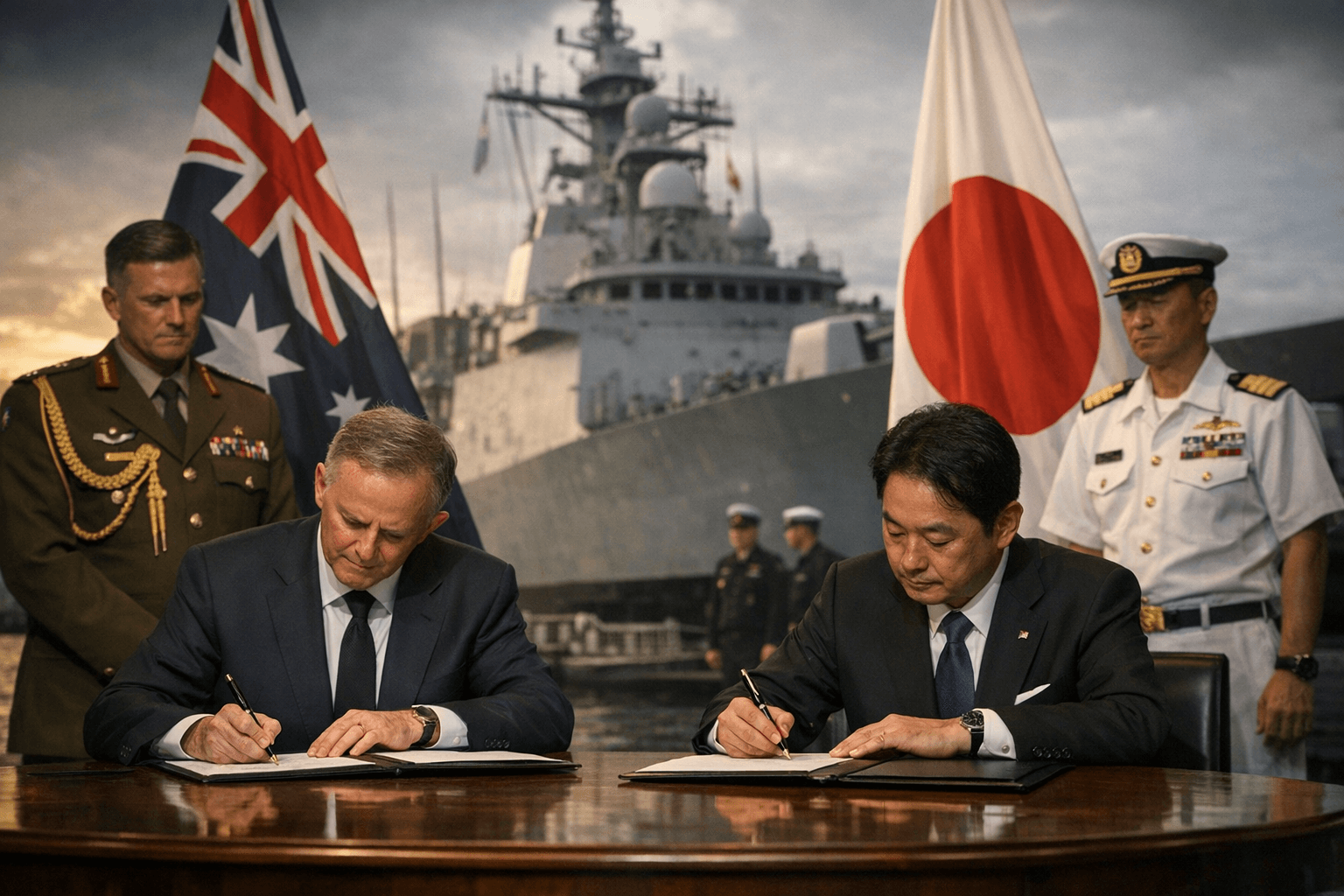
The deal also marks a milestone for Japan. It is Tokyo’s most consequential military sale since Japan ended its defense export ban in 2014, after new rules allowed transfers of defense equipment and technology under a revised policy framework. Japan and Australia had already signed a defense equipment and technology transfer agreement in 2014, and the frigate contract shows how far that relationship has advanced since then.
For Canberra, the new ships are meant to replace the Royal Australian Navy’s eight Anzac-class frigates, commissioned between 1996 and 2006. The Australian National Audit Office said in 2019 that the class was already halfway through its original service life and that sustainment costs were significant, a warning that has become more urgent as replacement timelines stretched.
The politics are just as important as the hardware. Officials in both capitals have cast the program as part of a broader response to China’s expanding military footprint and as a way to protect the sea lanes on which Australia depends for trade. The agreement also strengthens interoperability between the two navies, which have already trained together aboard JS Kumano during its transit to Australia for Exercise Kakadu. In strategic terms, the frigate pact is a message that Australia is broadening its security partnerships, and that Japan is stepping into a larger military-industrial role in the region.
This article was produced by Prism’s automated news system from verified source data, official records, and press releases, then run through automated quality and moderation checks before publishing. The system is built and supervised by the people who set the standards it runs under. Read our full AI policy.
Did this article answer your question?