Baby Food Heavy Metal MDL Reaches Pivotal Daubert Rulings on Expert Testimony
Judge Corley's February ruling knocked out nearly all plaintiffs' causation experts in the 389-case baby food heavy metals MDL, making what counts as scientific proof the pivotal question.
The federal baby food heavy metals litigation crossed a critical threshold when U.S. District Judge Jacqueline Scott Corley issued a February 27 opinion in MDL No. 3101 that effectively dismantled the plaintiffs' expert framework for general causation. In a ruling that reverberated through the nearly 389 consolidated cases pending as of March 2, all but one of the plaintiffs' general causation experts were excluded from testifying that arsenic, lead, cadmium, and mercury in commercial baby food products caused children to develop autism spectrum disorder or ADHD.
"Plaintiffs have not identified any scientific studies of whether baby food, let alone defendants' baby food, can cause ASD or ADHD," Judge Corley wrote in her February 27 opinion. The core methodological failure, according to the ruling, was exposure math: the court determined that the expert opinions relied on flawed exposure assumptions regarding the amount of baby food consumed by children, concluding that the methodology used to estimate heavy metal exposure lacked scientific reliability.
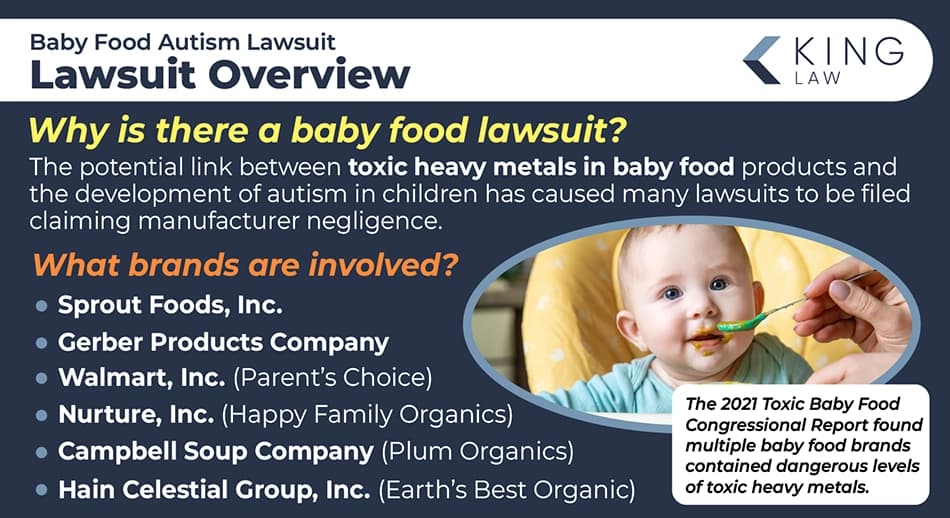
That is the Daubert standard operating precisely as designed. In product liability MDLs, a Daubert hearing functions as a gatekeeping proceeding where the judge evaluates whether an expert's reasoning is scientifically reliable before any jury sees it. Judge Corley previously dismissed the foreign parent companies of Nestlé, Danone, and Hero from the MDL but allowed claims to continue against their U.S.-based subsidiaries and other domestic companies. The litigation now focuses on Gerber, Beech-Nut, Nurture, Plum Organics, Sprout, Walmart, and others.
Attorneys at Wisner Baum and co-counsel presented four expert witnesses who testified that heavy metals in baby food products can harm children's developing brains; the defense presented one expert witness at the December 8, 2025 hearings that preceded the ruling. The exclusion of nearly all of those plaintiff witnesses leaves only Dr. Kevin Shapiro's medical testimony standing, a drastically narrowed record for the cases still headed toward bellwether trials.

Judge Corley set an April 2 hearing to discuss the "next steps" in the baby food litigation following the ruling. Plaintiff teams have signaled they intend to challenge the decision and explore supplemental testing and alternative expert approaches, but the evidentiary bar is now substantially higher for any federal case that reaches a jury.
For parents using third-party baby food test reports to make registry or shopping decisions, this ruling is actually instructive. What counts as proof in a courtroom and what counts as a reason to shop carefully are not the same question. The court noted that even in an area of epidemiology marked by hundreds of studies, none had developed the data needed to support the causation conclusions plaintiffs' experts asserted. The ruling does not apply to Dr. Kevin Shapiro, the plaintiffs' medical expert. The science on low-level cumulative metal exposure in infants remains actively contested, which means published third-party testing results, particularly those measuring arsenic and lead in rice-based purees and grain cereals, carry more consumer relevance than the MDL outcome alone suggests.
On the regulatory side, the FDA's "Closer to Zero" guidance continues to set the directional framework for acceptable heavy metal limits in infant and toddler foods, independent of how the MDL resolves. Brands that publish their own heavy-metal testing data and source from lower-risk agricultural inputs have a clear advantage in the current environment, where registry curators and pediatric professionals are asking sharper sourcing questions than they were before this litigation began. The April 2 status hearing before Judge Corley will determine whether the remaining cases are restructured, remanded, or placed on a revised bellwether schedule.
Sources:
Know something we missed? Have a correction or additional information?
Submit a Tip