Battle-Tested Ukraine Drone Software Ignites One of America's Hottest IPOs in Years
Swarmer's stock surged nearly 1,000% in its first trading sessions, turning a modest $15M IPO into one of the biggest U.S. market debuts in nearly a year.

Swarmer Inc. raised a modest $15 million when it priced its initial public offering at $5 per share. Within days, its stock had surged nearly 1,000%, turning a small defense-tech listing into the hottest IPO of the year.
The Austin, Texas-based company, which makes software that coordinates large numbers of low-cost drones to operate as a cohesive system, debuted on Tuesday to extraordinary demand. Shares closed at $31 on the first day of trading, a gain of 520%. They then jumped as high as $65.04 on Wednesday before settling around $53 on Thursday, leaving the new issue up roughly 950% from its $5 offering price. Bloomberg reported gains exceeding 1,200% within two days of listing.
The only comparable recent precedent is Newsmax Inc., which recorded a 2,230% two-day surge in its own debut roughly a year ago. That comparison carries a cautionary edge: Newsmax's shares lost nearly 80% of their value on the third day of trading and now trade below their $10 IPO price, around $7, far below the $233 peak they reached at the height of the frenzy.
What separates Swarmer from a pure momentum play, at least in the eyes of some investors, is the underlying technology. Founded in 2023 by Serhii Kupriienko and Alex Fink, the company has teams operating in Ukraine, Poland, and Estonia alongside its Texas headquarters. Its software, it says, has been deployed on Ukrainian battlefields for nearly two years and has completed more than 100,000 combat missions. Data generated by those missions feeds back into Swarmer's machine-learning models, with the stated goal of replicating the decision-making skills of experienced drone pilots so that a small number of operators can manage large numbers of autonomous systems simultaneously.
The technology addresses a strategic priority reshaping defense procurement globally: using swarms of inexpensive drones to overwhelm conventional defenses while reducing the human operators required to run them. Market watchers have framed the rally in that context, noting that conflicts in Ukraine and Iran have accelerated government demand for precisely this kind of autonomous capability.
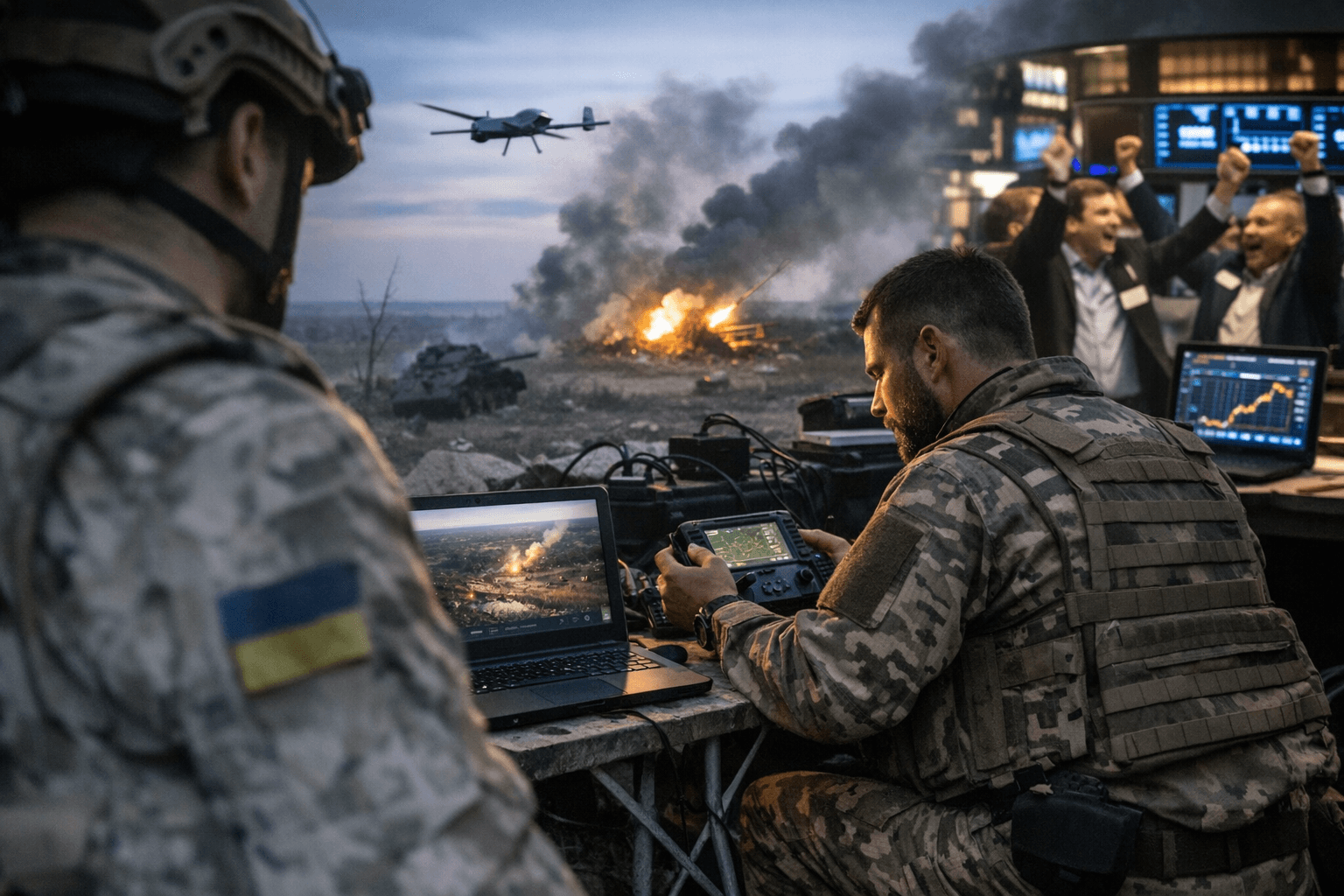
The financial reality behind the debut is considerably more modest. Swarmer's prospectus disclosed a loss of more than $2 million in 2024, widening to approximately $8.5 million last year, against revenues of $329,410 and $309,920 for those respective years. The company has just 62 employees. Its sole underwriter was Lucid Capital Markets, a lesser-known firm.
The company's prospectus does project a more substantive near-term pipeline: firm sales commitments of $16.3 million over the next 12 to 24 months, plus an additional $16.8 million in expected but unconfirmed deals with existing customers.
Miller Tabak analyst Maley noted that even if initial enthusiasm fades, Swarmer's underlying business may offer more fundamental support than previous meme-stock phenomena provided.
That distinction matters because the pattern is familiar. A small company with a geopolitically resonant story prices a modest offering, retail investors pile in, and the stock rockets before anyone has fully examined the financials. The difference this time is that Swarmer's software has a verifiable operational history in one of the world's most technically demanding active conflict zones. Whether that battlefield pedigree justifies a near-billion-dollar market capitalization on $300,000 in annual revenue is a question the coming weeks will answer in the market rather than in any prospectus.
Know something we missed? Have a correction or additional information?
Submit a Tip