Berkshire shareholders reject workforce report, back executive pay plan
Shareholders rejected Berkshire’s workforce report, then backed pay and re-elected all 13 directors at Greg Abel’s first annual meeting as CEO.
Berkshire Hathaway shareholders rejected a proposal to publish a report on workforce oversight and human-capital management, then backed the company’s executive-pay framework and re-elected all 13 directors at the annual meeting in Omaha. The result underscored how much deference Berkshire still commands, even as Greg Abel began his tenure as chief executive and investors confronted a post-Buffett governance era at one of America’s most watched conglomerates.
The workforce proposal, put forward by shareholder Myra Young, asked Berkshire to explain how its board oversees labor practices across subsidiaries. Berkshire said its operating businesses employed more than 387,000 people across nearly 200 businesses, but the board unanimously urged investors to vote against the measure. Young argued that Berkshire’s decentralized structure had produced uneven human-capital oversight, pointing to concerns raised by NetJets pilots about safety, training and maintenance culture. She also cited the 2021 Lubrizol plant fire in Illinois, which caused $380 million in property damage.
Berkshire rejected the idea that headquarters should impose a more centralized labor review. The company said its operating units were best positioned to manage their own affairs under a structure that has long favored autonomy, local decision-making and trust in subsidiary managers. Shareholders agreed, sending a clear signal that they were not eager to impose a more intrusive governance model on a company whose reputation has been built on light-touch oversight from Omaha.
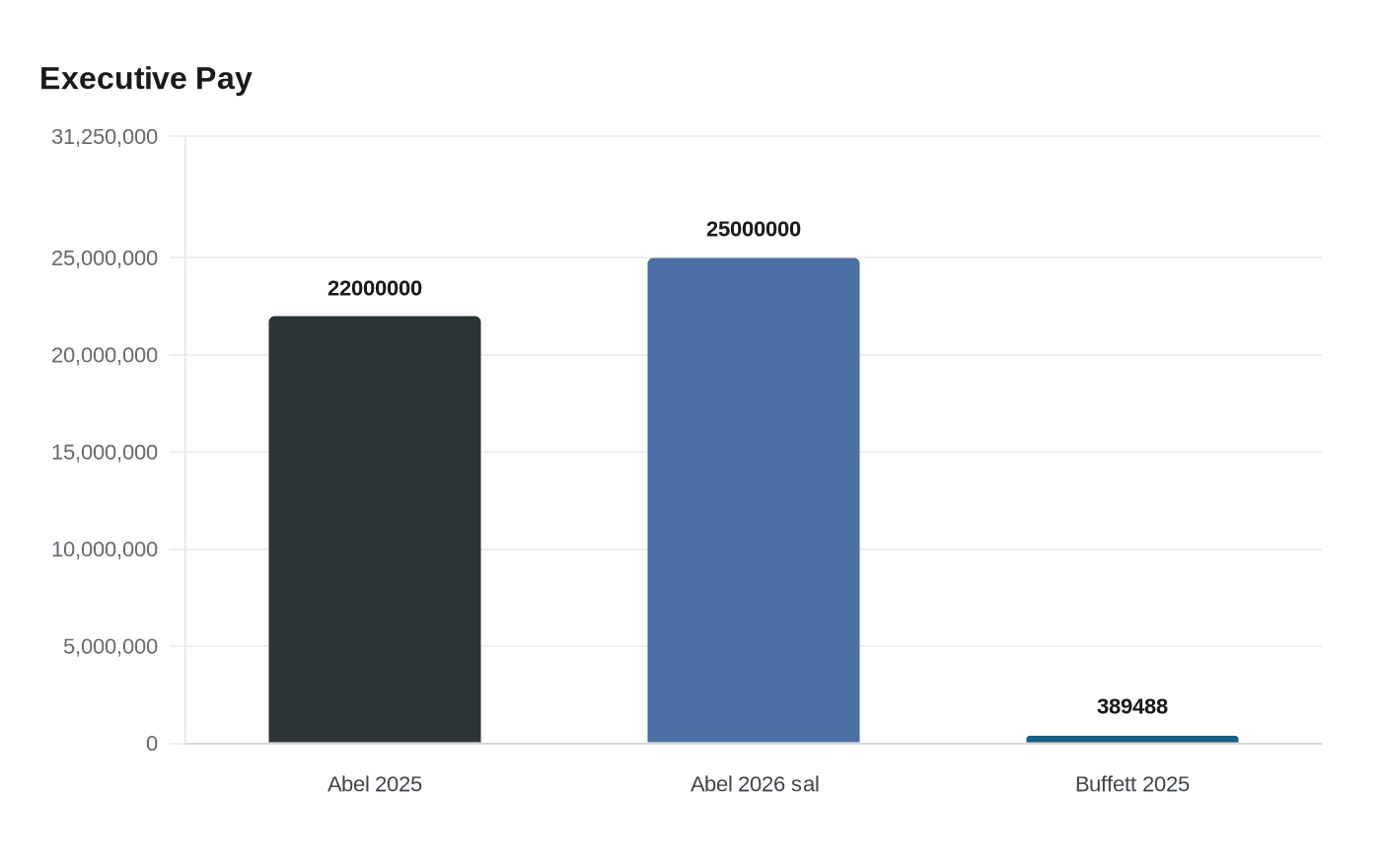
Investors also approved the board-backed say-on-pay resolution, which gave non-binding support to Berkshire’s pay framework and preserved the three-year cycle for future advisory votes on compensation. Berkshire disclosed in March that Abel received $22 million in compensation for 2025, while his 2026 salary was set at $25 million. Warren Buffett’s 2025 compensation totaled $389,488, including his $100,000 salary and personal and home security costs. All 13 directors, including Abel and Buffett, were reelected.
The meeting carried extra weight because it was the first since Buffett stepped down as chief executive after six decades. Buffett, 95, remains chairman and said he does not expect Berkshire to break itself up or divest subsidiaries, reinforcing the structure that has long defined the company. Berkshire’s own figures showed why investors may still be willing to grant that latitude: total shareholder return reached 117.0% over five years, net operating earnings climbed from $27.6 billion in 2021 to $44.4 billion in 2025, and cash and equivalents topped $373 billion at year-end, a war chest that had approached $400 billion before the meeting.
This article was produced by Prism’s automated news system from verified source data, official records, and press releases, then run through automated quality and moderation checks before publishing. The system is built and supervised by the people who set the standards it runs under. Read our full AI policy.
Did this article answer your question?