Bombing and Shooting Ambush Kills Five Police in Karak
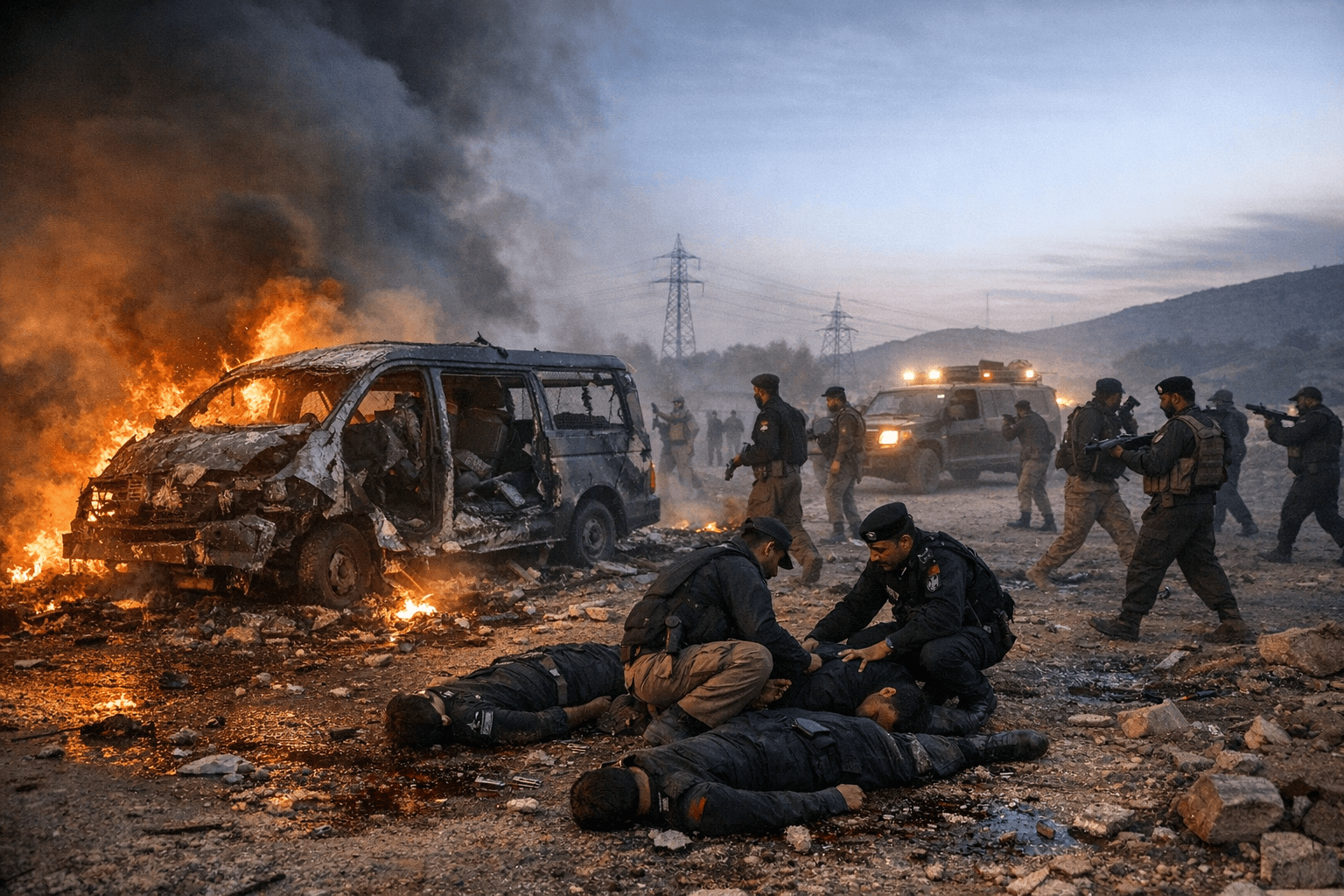
A combined IED and gun attack on a police van in Karak district killed five police personnel on December 23, raising fresh concerns about a resurgence of militant violence in Pakistan. The assault, near an energy installation, and subsequent clashes that reportedly left eight militants dead underscore security risks that could heighten local instability and increase costs for public safety and investment.

At least five Pakistani police personnel were killed on December 23 when their van was struck by an improvised explosive device and then came under fire in Karak district of Khyber Pakhtunkhwa, provincial police said. Officials identified the dead as four officers and the driver. The attack occurred on a road close to an energy installation, local authorities said, heightening fears of threats to critical infrastructure in a district that has seen fewer major militant incidents than other parts of the province.
Police chief Noor Wali said the attackers fled the scene immediately after the assault and that security forces quickly sealed off nearby roads and launched search operations. In subsequent operations in the surrounding area, authorities later said security forces killed eight militants who were said to have been involved in the ambush. Those later engagements were presented by officials as part of an immediate effort to pursue suspects and secure the area.
The Pakistani Taliban, known as Tehreek-e-Taliban Pakistan, later claimed responsibility for the attack, consistent with the group’s two decade insurgency against the state. Prime Minister Shehbaz Sharif condemned the assault and paid tribute to the police, saying, “Police have always played a frontline role in the war against terrorism.” Interior Minister Mohsin Naqvi pledged that those responsible would be brought to justice, and Khyber Pakhtunkhwa’s chief minister issued condolences to the families of the slain officers and praised their service.
The assault is notable both for its method and for its location. Authorities described the sequence as an initial IED strike followed by direct gunfire, a combined tactic that aims to maximize casualties and complicate immediate medical and tactical response. The proximity to an energy facility elevates the incident beyond a local policing tragedy, because attacks near critical infrastructure can disrupt operations, raise security premiums for energy firms, and amplify investor concerns about regional stability.
For policymakers the attack poses immediate operational questions and broader strategic challenges. Officials have mobilized clearance and search operations to apprehend suspects and secure transport routes, but the episode highlights persistent gaps in intelligence and protective measures outside traditionally high threat corridors. The reported killings of eight militants in follow up operations present a compressed timeline in which perpetrators initially escaped and were later engaged, a pattern that will require independent verification and detail from military and law enforcement investigators.
Economically, repeated attacks of this kind can increase public expenditure on security, divert resources from development priorities, and influence perceptions of country risk that shape foreign direct investment and lending costs. At the local level communities near energy installations could face temporary shutdowns and heightened patrols, while firms may seek to renegotiate security arrangements and insurance terms.
Key follow up items for reporting include independent confirmation of the identities of the slain militants and police personnel, the exact timeline and locations of the follow up operations that produced militant fatalities, and substantiation from the group that claimed responsibility. The incident also renews the political pressure on Islamabad to demonstrate that security gains can be sustained beyond the traditional conflict zones in Khyber Pakhtunkhwa.
This article was produced by Prism’s automated news system from verified source data, official records, and press releases, then run through automated quality and moderation checks before publishing. The system is built and supervised by the people who set the standards it runs under. Read our full AI policy.
Did this article answer your question?


