Bowline Knot: How, Why and Where to Use It on Your Boat
Learn the bowline, the reliable fixed loop every boater should know: easy to tie and untie, versatile for sheets, towing, and rescue, but back it up on slippery modern rope.
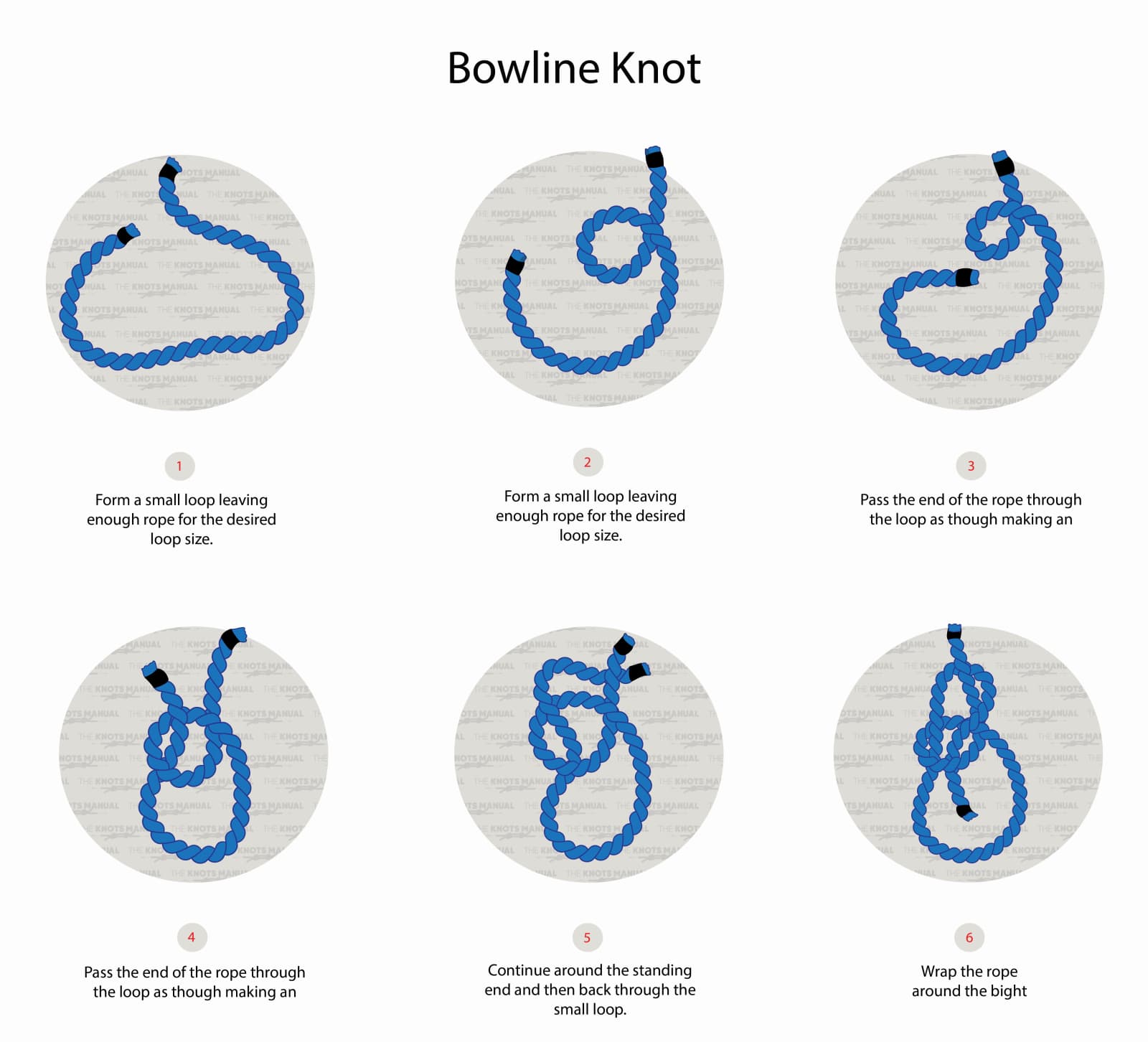
If you only master one loop knot for your boat, make it the bowline; Wikipedia even calls it "king of the knots" for its importance. The bowline is an ancient and simple knot used to form a fixed loop at the end of a rope, tied with the rope's working end, also known as the "tail" or "end", and it tightens when loaded by the standing part of the line.
Why this matters right now PMR Sailing ran the bowline as its "Knot of the Week" on March 6, 2026, flagging it for club sailors, small boat owners, and DIYers who regularly rig and maintain lines. That decision matches how real sailors use it: Boat-ed lists it as a go-to for attaching sheets to a clew, securing to a ring or post while docking, and even towing another small boat because the loop will not cinch under load. In short, it is the workhorse loop for everyday boat work.
Where to use the bowline on your boat The bowline is practical across typical on-board tasks: fastening a halyard to a sail head, tying a jib sheet to a clew, creating a fixed loop to clip to a cleat, and forming the base for a rope-tackle to cinch down gear. Bullmoosepatrol calls out an explicit application as a "bowline rope tackle" to secure a wannigan or crank a cooler lid tight, then finish with a taut-line hitch for tension. Community posts also point to common pairings, such as using a bowline inside a trucker’s hitch to get a powerful purchase when lashing gear.
Rescue, aviation, and the out-of-boat uses The knot is famously useful outside routine rigging: Wikipedia notes the bowline is well known as a rescue knot because it can be tied one-handed, allowing a person to tie the loop around their waist while holding on with the other hand. Wikipedia also records that the Federal Aviation Administration recommends the bowline knot for tying down light aircraft, underscoring its acceptance for low-stakes aviation tie-downs. For wilderness and expedition work, Stephan Kesting calls the bowline "one of the most essential knots for camping, canoeing, kayaking, and living in the wilderness," and recounts using two bowlines to attach ropes to his canoe when tracking up the Reindeer River in northern Saskatchewan.
How to learn and teach it — avoid reinventing the wheel If you struggle to teach the knot, use the "rabbit and tree" method: Stephan Kesting recommends it as the simplest way to learn, noting it consists of four steps and that you then "tighten up the knot to make it pretty and – VOILA!" Kesting has a short video on his Essential Wilderness YouTube channel demonstrating the rabbit-and-tree method and two useful variations. Tutorials commonly remind you to "dress and set the knot properly" and to "leave an adequate tail" before loading the line.
- Double bowline, recommended by Boat-ed for situations with variable or cyclic loading as a more secure variation.
- Running bowline, handy for fixing a stationary end of a ridge line or clothesline, as Bullmoosepatrol describes.
- Bowline bend, where two interlinked bowlines join two ropes, useful when mating different rope sizes, though Bullmoosepatrol warns about wear where the ropes rub.
Variations and when to choose them
The bowline family includes several useful variants:
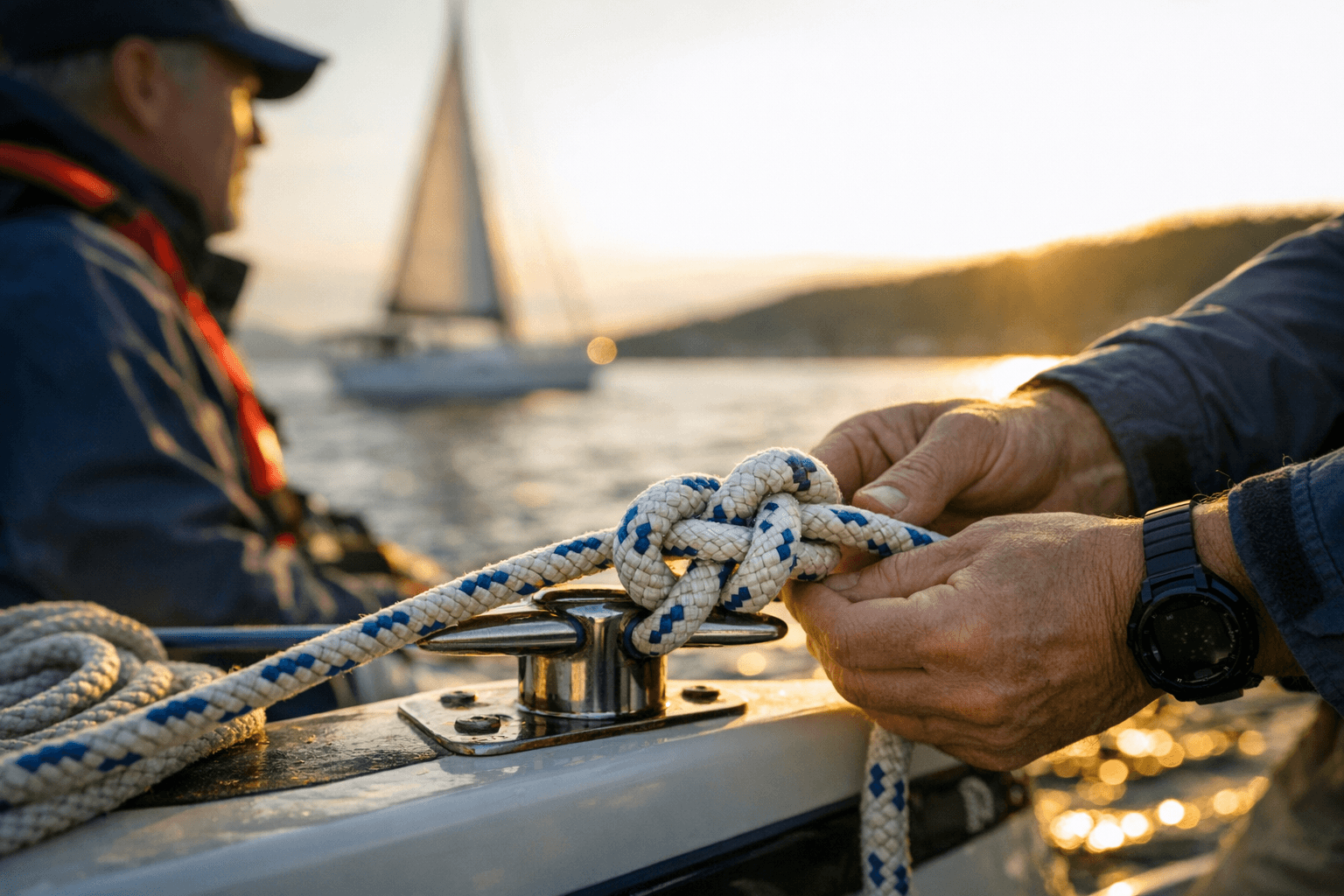
Safety, caveats, and material-specific limits The bowline's biggest virtues are ease of tying and untying — "A huge advantage of the bowline is that you can always get it undone," writes EssentialWilderness — but that same simplicity creates limits you must respect. EssentialWilderness explicitly warns that the knot "can come undone if you’re using very slippery synthetic rope in wet or icy conditions" and that it "bends the rope fairly sharply which reduces its strength." Because of that bend and shock-load concerns, climbers moved toward the figure-of-eight family for small-rope shock loads. Boat-ed stresses practical safety steps: "Before you put your bowline under any load, you must ensure it's appropriately tied. Double-checking the knot will help you avoid slippage and reduce risks," and recommends adding a stopper knot or using a double bowline when the load cycles.
- Always dress and set the knot properly; a sloppy bowline is where failures begin.
- Leave an adequate tail and inspect the knot regularly, especially in critical or life-saving applications.
- For variable, cyclic, or shock loading, use a double bowline or back the bowline with a stopper knot. Community wisdom from Reddit also reminds us: "If either knot were used in a life saving application, it should be backed up."
- Avoid relying on a naked bowline with very slippery modern synthetics in wet or icy conditions; try an alternate loop or backed bowline in those materials.
Practical work rules you can use today
Common mistakes and how they show up on the water The usual failure modes are a too-short tail, a poorly dressed knot that capsizes under load, and trusting the bowline on rope types or conditions where the knot tends to slip. On deck you’ll see people use square knots or improvised lashings to secure coolers or gear; Bullmoosepatrol calls that inferior, and shows how a bowline loop plus a taut-line hitch makes a neat, tight, adjustable system for cargo.
What to use instead, and when to swap knots For climbers and any situation where shock-load strength and predictable rope performance are paramount, use figure-of-eight knots as recommended in the climbing community. For joining ropes of different sizes, the sheet bend often outperforms a bowline-bend in wear and reliability. For life-saving contexts, back up the bowline or use a knot the rescue teams recommend for that exact rope and scenario.
Anecdotes that stick Two practical examples ground the theory: Kesting’s canoe tracking on the Reindeer River used two bowlines to solve a real expedition problem; Bullmoosepatrol uses a bowline rope tackle to secure a cooler lid and lantern case without slack. And the community sums it up: "Knowing how to tie knots and what their advantages and failures are is a very useful skill. You probably tie things more often than you think."
Final word The bowline earns its reputation because it does a wide range of jobs well: sheets, halyards, dock lines, towing, rope-tackle, and even one-handed rescues. Learn it via the rabbit-and-tree method, watch Kesting’s short video to lock the motion into muscle memory, and then apply simple safety rules — dress the knot, leave an adequate tail, and back it up with a stopper or double bowline when the situation demands. Mastering the bowline cuts rigging time, reduces fiddling, and keeps you safer on the water.
Know something we missed? Have a correction or additional information?
Submit a Tip