Brazil economy rebounds 1.1 percent, clouding interest rate cut hopes
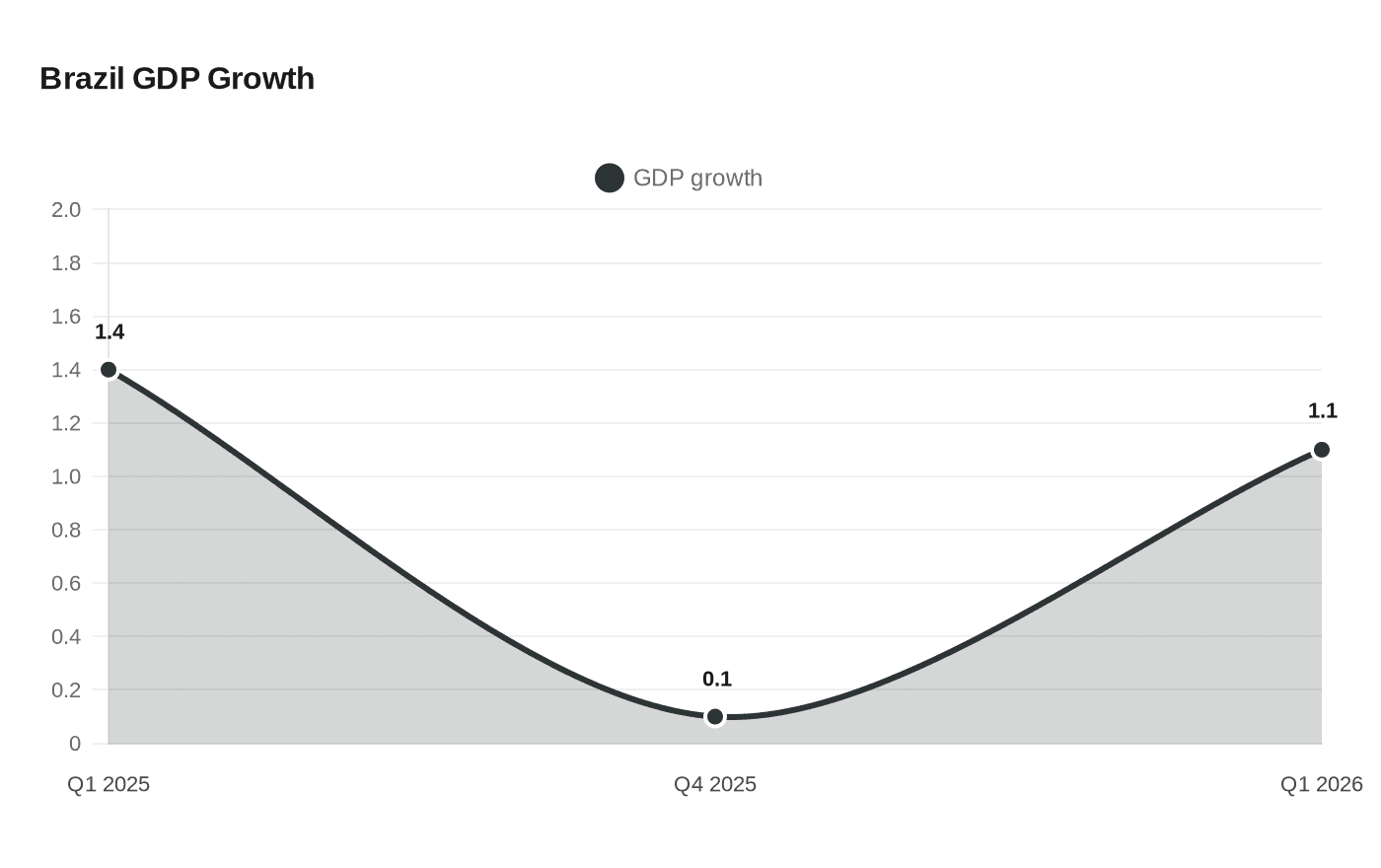
Brazil grew 1.1 percent in the first quarter, a stronger-than-expected rebound that makes deeper rate cuts harder to justify as inflation stays sticky.

Brazil’s economy picked up in the first quarter of 2026, growing 1.1 percent from the previous three months and beating the 1.0 percent pace economists had expected. The rebound was driven by household consumption and stronger investment, a combination that suggests domestic demand is still carrying the country even after a weak end to 2025.
That resilience complicates the central bank’s next move. Policymakers at Banco Central do Brasil have already lowered the Selic rate to 14.5 percent, after cutting it to 14.75 percent in March, but the latest growth reading gives officials less room to argue for rapid easing. If spending and investment keep firming while prices remain elevated, rate cuts become harder to defend.
The inflation backdrop is still the main obstacle. Copom said expectations for inflation in 2025 and 2026, as measured by the Focus survey, stood at 5.5 percent and 4.2 percent, respectively. Its reference scenario put inflation at 4.0 percent in the third quarter of 2026, with risks tilted to the upside. The weekly Focus survey for the week of May 25 showed the market’s 2026 inflation forecast at 5.04 percent, well above Brazil’s 3 percent target and outside the 1.5 percentage point tolerance band.
That makes the policy trade-off unusually tight. Brazil needs enough growth to support jobs, income and investment, but too much demand can keep inflation stubbornly high and delay any further drop in borrowing costs. Central bank monetary policy director Nilton David said the bank would not allow higher inflation expectations to become actual inflation, a warning that the battle to restore price stability still has priority.
The first-quarter rebound also stands in contrast with the country’s recent trajectory. GDP rose only 0.10 percent in the fourth quarter of 2025, showing how quickly momentum had faded before the latest pickup. In the first quarter of 2025, output had grown 1.4 percent, helped by a 12.2 percent jump in agriculture and a 0.3 percent rise in services. This year’s advance is less dramatic, but it shows that Brazil, Latin America’s largest economy, is still expanding enough to keep the central bank cautious and the rate-cut debate unresolved.
This article was produced by Prism’s automated news system from verified source data, official records, and press releases, then run through automated quality and moderation checks before publishing. The system is built and supervised by the people who set the standards it runs under. Read our full AI policy.
Did this article answer your question?