BTWB Percentile Analysis Shows Small Margins Decided Open 26.1 Leaderboard
BTWB’s Feb. 27, 2026 analysis shows a single 66-rep wall-ball set - mapped to 210 cumulative reps - split the middle of the Open 26.1 field, with “Half the field never escaped it.”

BTWB (Between the Whiteboards) published a data-driven post on February 27, 2026 that mapped percentiles and split distributions for Open 26.1 using aggregated submission times and rep counts. The site warned early that “CrossFit Open 26.1 looked simple on paper,” then showed a graphical table displaying prescribed percentiles for men and women from the 20th to the 99th, including performance metrics such as weights and step-overs.
The 66 Wall-Balls Were the Separator BTWB’s headline finding is blunt: “The 66 Wall-Balls Were the Separator.” The post pins that set to a cumulative marker: “The 66 wall-balls end at 210 reps.” BTWB shows that “the biggest cluster of athletes — both men and women — got stuck in the same place,” and it translates into a percentile effect: “That means from the 20th to the 50th percentile, the entire middle of the field is separated by how far athletes made it into that one set.” The analysis repeats the stark outcome: “Half the field never escaped it.” BTWB frames the mechanism succinctly: “This workout wasn’t decided in the opening rounds. It wasn’t even decided by transitions. It was decided by who could maintain composure and breathing deep into a high-volume wall-ball set under fatigue.”
The Real Acceleration Starts at 228 Reps BTWB identifies the next major breakpoint later in the workout: “Another major breakpoint appears at 228 reps — the end of the second step-over set.” The post then connects those cumulative markers to leaderboard movement: “That’s where leaderboard separation accelerates.” BTWB notes how the next wall-ball sequence functions as a second sieve: “Once athletes cleared the 66 wall-balls, the next wall-ball set created the next major sorting mechanism.” The data-driven post single-outs a men’s-specific pivot: “For men: That means the jump from 75th to 95th percentile is almost entirely about how well athletes handled the 40 wall-balls.”
The Top End: Who Made It Deep? On the elite side, BTWB titles the section “The Top End: Who Made It Deep?” and reports that “At the elite end, the story shifts slightly between men and women. [...] Very few athletes reached the final couplet. Even fewer made it deep.” The analysis ties those outcomes to the 12-minute time cap and a closing bottleneck: “The workout had a strong bottleneck effect — especially on the men’s side — where the time cap prevented large portions of the field from progressing past the final wall-ball segments.”
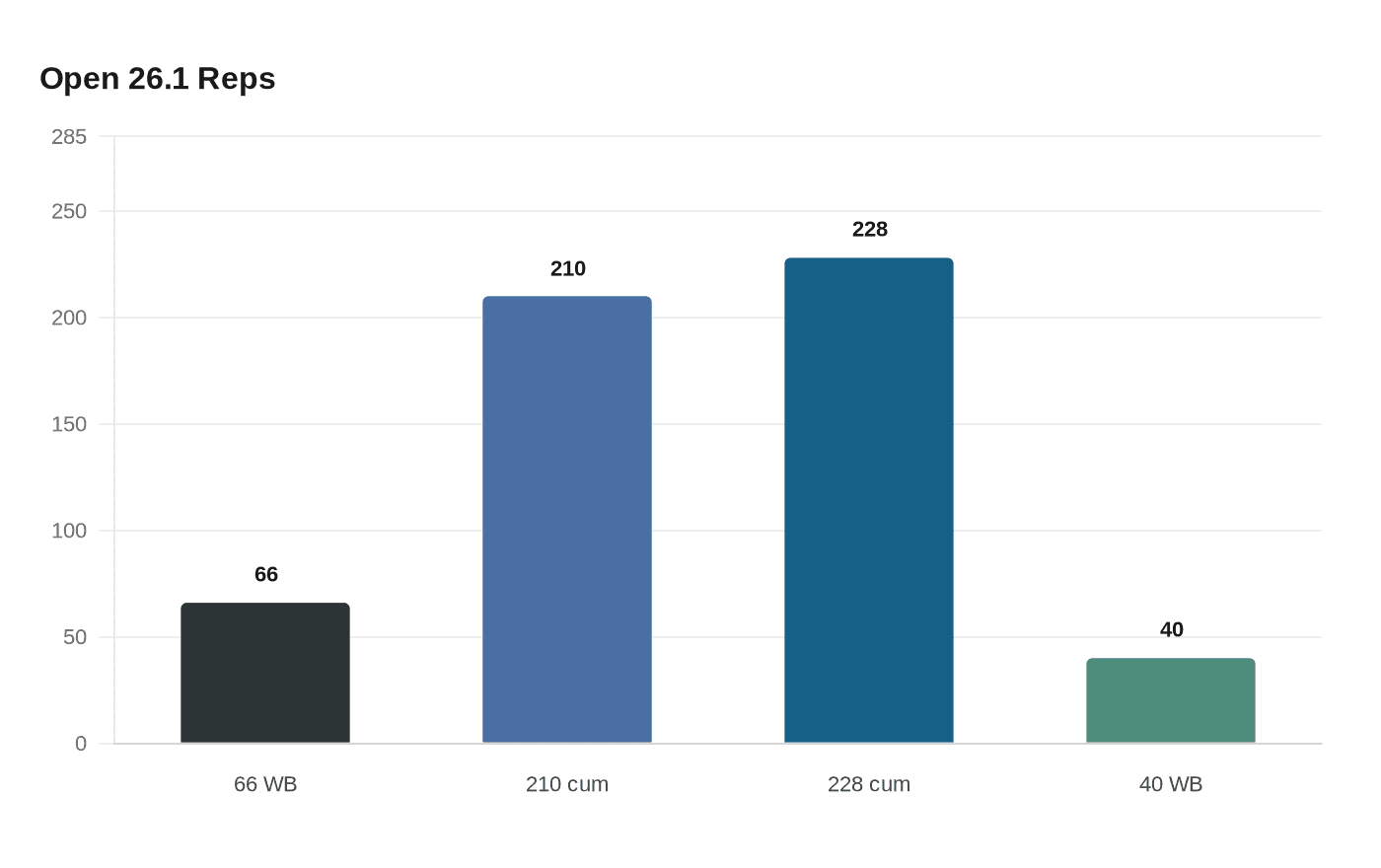
BTWB’s Feb. 27, 2026 percentile mapping makes the point plainly: small margins inside specific high-volume wall-ball sets - the 66-rep marker at 210 cumulative reps and the subsequent 228-rep breakpoint - determined movement across the 20th to 99th percentiles. The graphical table and percentile mapping suggest the Open 26.1 leaderboard was won and lost on volume endurance and composure rather than transitions or early pacing.
Know something we missed? Have a correction or additional information?
Submit a Tip