Bus driver charged after Virginia crash kills five on I-95
A motor coach failed to slow in a work zone, killing five and leaving prosecutors to test where a deadly crash becomes criminal negligence.

A motor coach that failed to slow for traffic in a construction zone on Interstate 95 left five people dead, 44 others in hospitals and its 48-year-old driver facing two counts of involuntary manslaughter, a charge that shifts the case from tragedy to the question of whether criminal negligence played a role.
Virginia State Police identified the driver as Jing S. Dong of Staten Island, New York, and said additional charges were pending. The crash happened at about 2:35 a.m. Friday, May 29, 2026, on southbound I-95 in Stafford County near Quantico, when the bus struck six vehicles after approaching slower-moving traffic backed up for an upcoming work zone.
The bus was carrying about 34 occupants, including the driver, and the toll spread quickly across the region’s trauma system. Authorities said 44 people were taken to hospitals, with three listed in critical condition. Mary Washington Healthcare said it received 19 patients from the crash, including seven treated at its trauma center in Fredericksburg and 12 taken to its Stafford hospital.
Four of the dead were inside a burning Acura: a 45-year-old man, a 44-year-old woman, a 13-year-old girl and a 7-year-old boy, all from Greenfield, Massachusetts. The fifth fatality was a 25-year-old woman from Worcester, Massachusetts, who was in a Chevy Suburban hit by the bus. The motor coach was operated by North Carolina-based E&P Travel and was traveling from New York City to Charlotte, North Carolina.
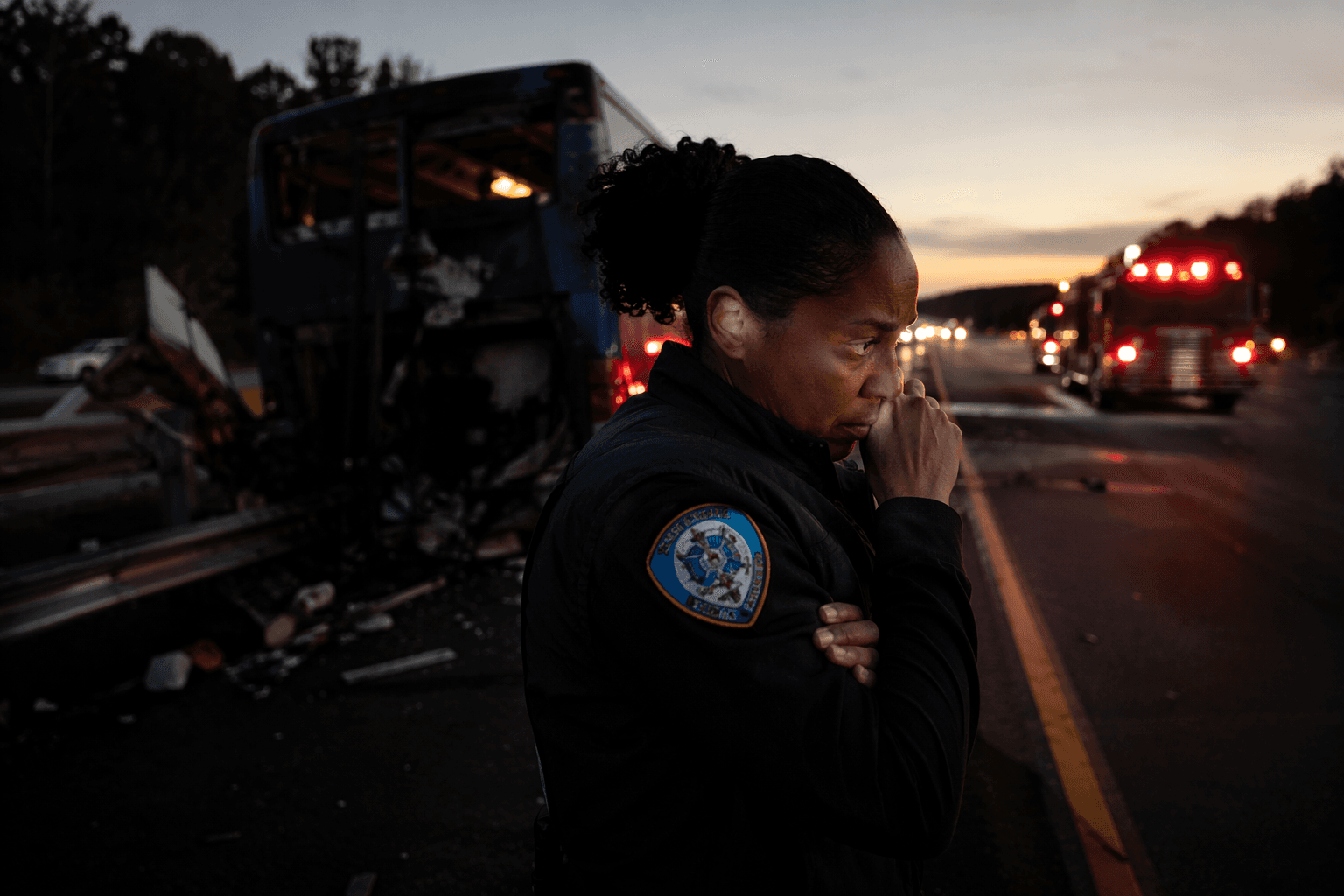
The manslaughter charges put a harsh legal spotlight on the mechanics of commercial passenger safety. Prosecutors will have to show more than a fatal collision. They will have to examine whether speed, braking, driver judgment, training, vehicle condition, work-zone warning systems and enforcement history amount to conduct that crossed the line from accident into criminal neglect. The National Transportation Safety Board said it was sending a go-team to investigate, and that review is likely to focus on how a highway convoy of slowing cars became a mass-casualty crash in the dark before dawn.
Two surviving passengers later told reporters the driver seemed reckless and said the bus was moving at extremely high speed before impact. Those accounts now sit beside the official inquiry, which will determine whether one driver’s choices, or a broader failure in commercial transport oversight, allowed a routine work-zone slowdown to become a fatal chain reaction.
This article was produced by Prism’s automated news system from verified source data, official records, and press releases, then run through automated quality and moderation checks before publishing. The system is built and supervised by the people who set the standards it runs under. Read our full AI policy.
Did this article answer your question?