Canada and China reach preliminary deal to cut EV and canola tariffs
Canada and China struck a preliminary trade understanding easing electric vehicle and canola duties, a move that could unlock billions in exports and reset bilateral economic ties.

Canada and China announced a preliminary trade understanding that will sharply ease barriers on Chinese electric vehicles entering Canada and roll back punitive Chinese duties on Canadian canola and other farm and seafood products. Prime Minister Mark Carney described the accord as “preliminary but landmark,” presenting it as a strategic reset in the two countries’ economic relationship.
Carney said Canada will initially allow up to 49,000 Chinese electric vehicles into the Canadian market at a most‑favoured‑nation tariff of 6.1 percent. The measure reverses a protective 100 percent tariff imposed in 2024 and could make a broader range of lower‑priced EVs available to Canadian consumers. China exported 41,678 EVs to Canada in 2023, underscoring the potential scale of renewed flows as the quota takes effect.
On agriculture, Chinese authorities agreed to roll back punitive duties on Canadian canola. Beijing is expected to cut canola seed duties to 15 percent by March 1, 2026, and to reduce or remove tariffs on canola meal, lobster, crab and peas from March 1 through at least the end of the year. Carney said the package of measures will unlock nearly US$3 billion in export orders for Canadian farmers, fish harvesters and processors, a significant boost for commodity exporters that faced sharp market disruptions since duties were first applied.
The understanding reached at the Great Hall of the People in Beijing also includes commitments to restart high‑level economic and financial dialogue and broaden cooperation across agriculture, oil and gas, and green energy. China’s state news agency said the two countries pledged renewed talks on trade and investment, and Carney indicated President Xi Jinping committed to visa‑free access for Canadians, though no implementation details were provided.
The announcement mixes concrete tariff levels with unresolved operational questions. Carney did not specify the time period covered by the 49,000‑vehicle allowance, and officials indicated longer‑term escalation of the EV quota remains subject to further negotiation. Implementation timetables, enforcement mechanisms and the full text of the understanding were not released, leaving industry participants to await formal agreements and regulatory rules.
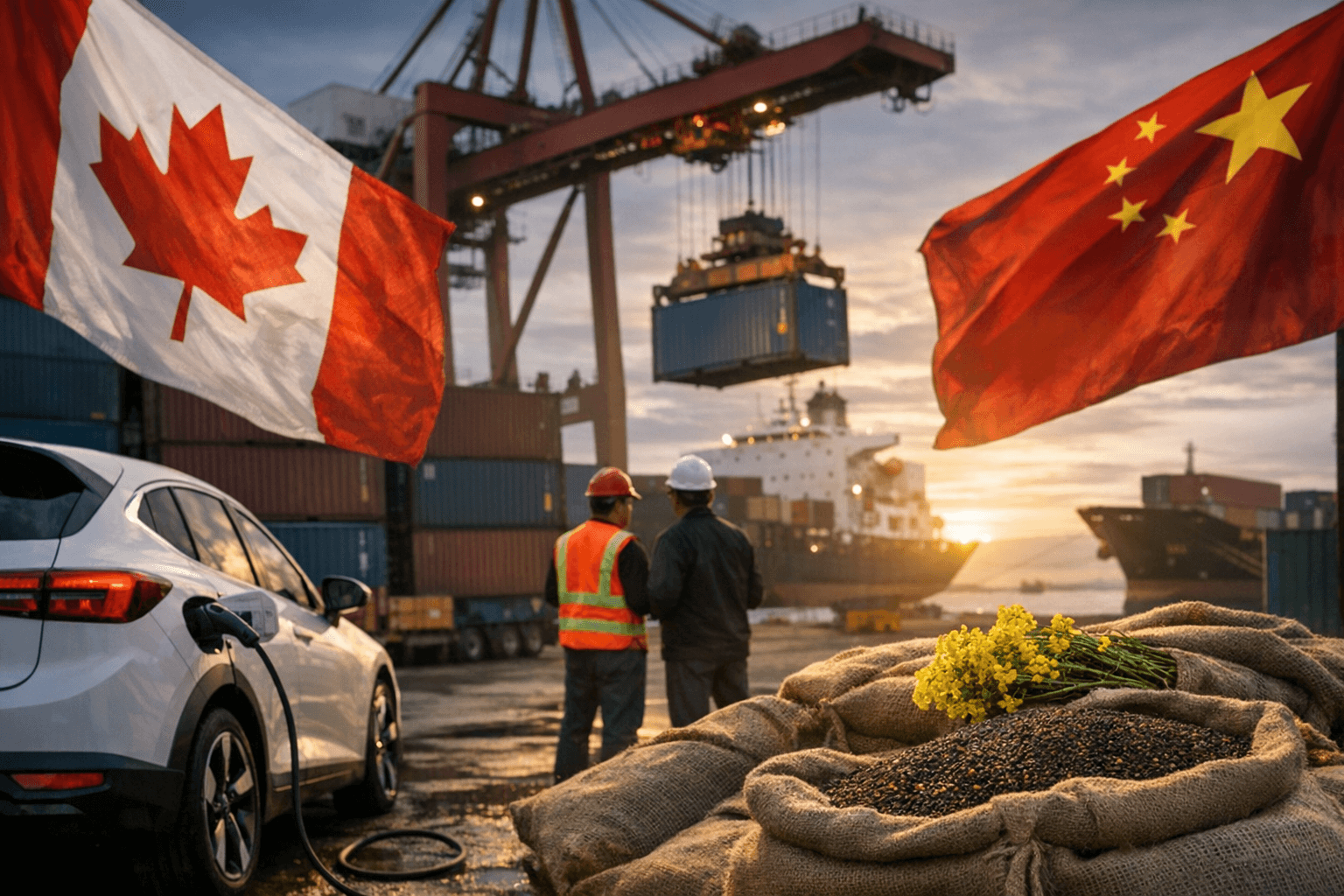
Market and political implications are already apparent. Lower tariffs on Chinese EVs could exert downward price pressure on electric vehicles across Canada, affecting auto dealers and North American manufacturers that have lobbied for continued protection. For farmers and processors, restored access to China would alleviate inventory pressures and help diversify export channels after a period of sharply reduced demand.
Responses within Canada were mixed. Some producers reacted with guarded approval. Farmer Stephen Vandervalk expressed “cautious optimism,” reflecting relief tempered by lingering uncertainty about timelines and the durability of the commitments.
Beyond immediate trade flows, the understanding signals a tactical turn toward interest‑driven engagement, with potential long‑term effects on investment and infrastructure planning. Carney linked the accord to domestic projects, including a pledge to double Canada’s energy grid over the next 15 years and opportunities for foreign partnership in offshore wind and other green investments. For now, however, markets and policymakers will watch the coming weeks for formal texts and the detailed rules that will determine whether this preliminary understanding yields the promised billions in exports and a durable rebalancing of Canada‑China economic ties.
This article was produced by Prism’s automated news system from verified source data, official records, and press releases, then run through automated quality and moderation checks before publishing. The system is built and supervised by the people who set the standards it runs under. Read our full AI policy.
Did this article answer your question?

