Canada’s digital safety plan targets kids, draws legal criticism
Canada wants to ban under-16 social media accounts and police AI chatbots, but critics say vague definitions and exemptions could leave major gaps.
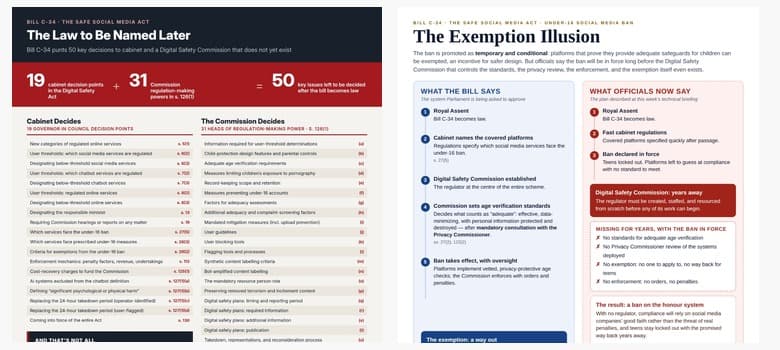
Canada is trying to turn a school tragedy into a new digital safety regime, but the fight is already shifting to whether the law can actually be enforced. Bill C-34 would bar children under 16 from social media unless a platform wins an exemption, and it would extend new rules to certain AI chatbot services, livestreaming platforms and adult-content services.
The proposal, introduced on June 10, would enact the Digital Safety Act and the Digital Safety Commission of Canada Act, creating an independent Digital Safety Commission of Canada to enforce the rules, ensure compliance and support victims of online harms. Government materials say the framework is built around three duties: protect children, act responsibly and be transparent.
The political urgency comes from a shooting that left nine people dead and from public anger after OpenAI acknowledged it had not reported troubling ChatGPT messages from the suspect in that February incident. Lawmakers want platforms to think about crisis intervention, harmful content and child protection before products reach users. The question now is whether the bill can do that in practice, or whether it will mostly give officials a response to a national outrage.

That is where critics see the enforcement gap. Reuters reported that academics and legal experts worry the timetable is slow and the definitions are vague, a combination that could make the law hard to apply as chatbot behavior and harmful content keep evolving. The exemption process for under-16 accounts is another pressure point: platforms could keep younger users in place if they persuade regulators that their safeguards are strong enough, which leaves the real-world reach of the ban dependent on how strict the commission becomes.
The government’s own language suggests a broad safety net, but not a total one. By covering only certain AI chatbot services, the bill leaves open what happens with tools that do not fit that definition. Critics also warn that tougher moderation and safety tools can require more monitoring of user activity, raising privacy concerns even as the law seeks to protect children.

The new bill also lands in a policy cycle that has already been running for years. Canada reconvened its expert advisory group on online safety on March 12, and Ottawa had previously introduced the Online Harms Act on February 26, 2024, without turning it into law. On June 4, Prime Minister Mark Carney announced “AI for All,” the country’s national artificial intelligence strategy, which promised modernized privacy and online safety laws.
That history matters because it shows the central test now facing Ottawa: whether it can regulate AI products faster than the technology changes, or whether the country will keep revisiting the same crisis after the damage is done.
This article was produced by Prism’s automated news system from verified source data, official records, and press releases, then run through automated quality and moderation checks before publishing. The system is built and supervised by the people who set the standards it runs under. Read our full AI policy.
Know something we missed? Have a correction or additional information?
Submit a Tip