Caracas macaws lose nesting palms, threatening city’s beloved flock
Caracas’ blue-and-gold macaws have become city mascots, but their nesting palms are being cut down, putting the flock’s future at risk.
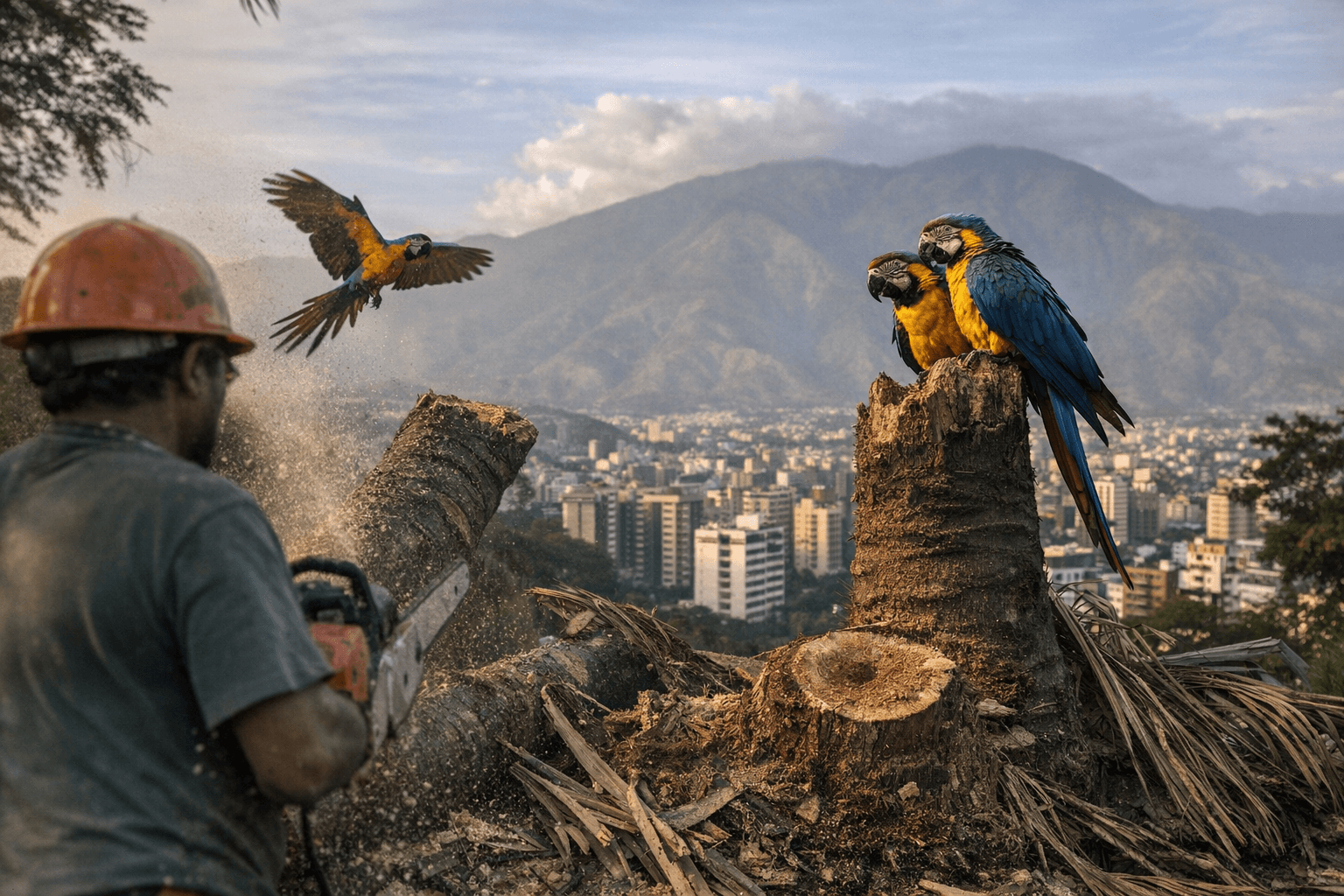
The bright blue-and-gold macaws that sweep over Caracas at dusk have become part of the city’s daily rhythm, but the palms they depend on are disappearing. As old royal palms are removed from parks and public spaces, biologist Maria Lourdes Gonzalez warns that the flock could shrink sharply because the birds have nowhere else to raise the next generation.
What began as a strange urban spectacle has turned into one of Caracas’ most recognizable wildlife scenes. The macaws are not native to the Venezuelan capital, yet their numbers have climbed into the hundreds over the past two decades. Residents feed them from balconies and gardens, and Karem Guevara says the birds visit her apartment every evening as the sun sets, a routine that has folded the flock into neighborhood life.
That bond was built in the city’s vertical spaces, where the birds learned to gather on rooftops and balconies in search of food. Photos and stories about the macaws now circulate among locals as if they were familiar neighbors. Caracas has long hosted a broader cast of urban parrots, macaws and parakeets, including four macaw species, but the blue-and-gold flock has become the most visible symbol of the city’s unusual relationship with wildlife.
Gonzalez, who studies the birds at Simón Bolívar University, says their survival depends on a narrow slice of habitat. The macaws only nest in chaguaramo palms, also known as royal palms, and even then only in old, leafless trees with decaying trunks hollowed by insects. Those aging palms have become a liability for city managers trying to reduce the danger of rotting trunks falling on people, so authorities have been cutting them down in the name of safety and beautification.
That trade-off exposes a larger urban fragility. The royal palm was introduced to Caracas during colonial times because of its graceful appearance, and the city’s lack of natural predators helped the macaws reproduce. The birds are also widely believed to have arrived in the 1970s through the pet trade, likely after escaped or released pets adapted to city life. Their presence now reflects how an introduced species can become woven into the identity of a metropolis, even as the built environment that sustained it starts to unravel.
Gonzalez says losing the blue-and-gold macaw would not affect the local ecosystem the way the loss of a native species would, but it would erase one of Caracas’ most familiar urban wildlife scenes. In a city where neglected trees are being removed before they fail, the fate of the macaws has become a warning about what else can disappear when urban ecosystems are managed for appearance and immediate risk, rather than long-term resilience.
This article was produced by Prism’s automated news system from verified source data, official records, and press releases, then run through automated quality and moderation checks before publishing. The system is built and supervised by the people who set the standards it runs under. Read our full AI policy.
Did this article answer your question?