Catholic Cardinal Blocked From Holy Sepulchre on Palm Sunday for First Time in Centuries
Israeli police turned away Cardinal Pierbattista Pizzaballa from the Church of the Holy Sepulchre on Palm Sunday, the first such exclusion in centuries.
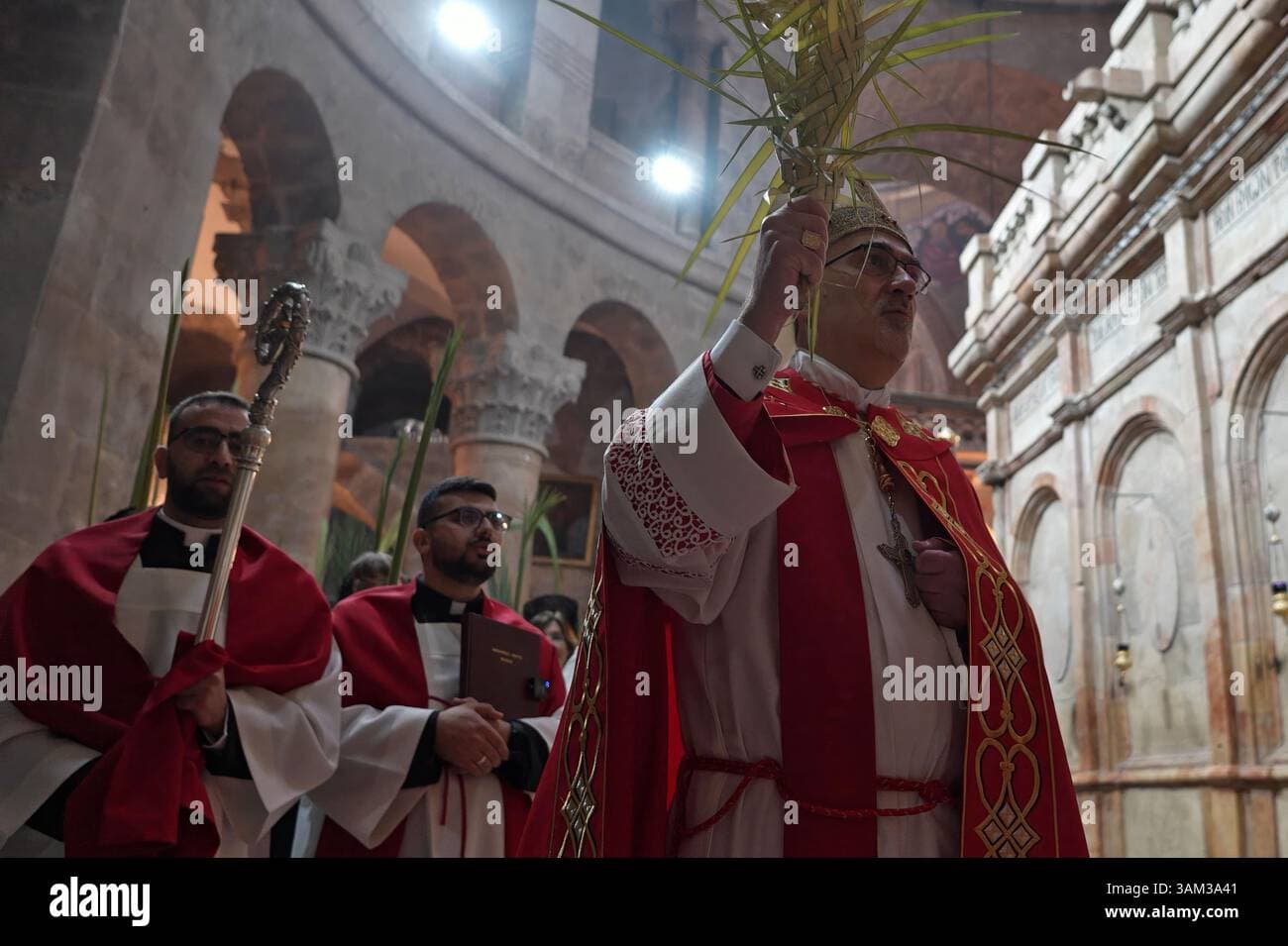
The Latin Patriarch of Jerusalem was not leading a procession. He carried no banners, commanded no ceremonial escort, and made no public spectacle of his approach. Cardinal Pierbattista Pizzaballa and Father Francesco Ielpo, the Custos of the Holy Land, were walking privately toward the Church of the Holy Sepulchre when Israeli police stopped them on Palm Sunday and compelled them to turn back.
The result, according to the Latin Patriarchate of Jerusalem, was historic in the starkest possible sense: for the first time in centuries, the heads of the Catholic Church in the Holy Land were prevented from celebrating Palm Sunday Mass at the site Christians revere as the place of Jesus' crucifixion and burial.
The Patriarchate issued a joint statement with the Custody of the Holy Land describing the police action as "a manifestly unreasonable and grossly disproportionate measure" and "a hasty and fundamentally flawed decision, tainted by improper considerations" that "represents an extreme departure from basic principles of reasonableness, freedom of worship, and respect for the status quo." No explanation from Israeli authorities accompanied the blockade.
The two church leaders had already abandoned plans for any public ceremonial entry. Their approach that morning came "while proceeding privately and without any characteristics of a procession or ceremonial act," the Patriarchate noted, underscoring that the blockade was not a response to a public gathering or security-visible event.
The incident unfolded against a backdrop of sweeping wartime restrictions on Jerusalem's Old City. The Church of the Holy Sepulchre was among several holy sites, including the Western Wall and the Temple Mount, closed since February 28 following the outbreak of the Israel-U.S. conflict with Iran, OSV News reported. Public gatherings citywide have been capped at around 50 people. The Latin Patriarchate had already cancelled the traditional Palm Sunday procession from the Mount of Olives into Jerusalem, a march that normally draws thousands of worshippers each year.
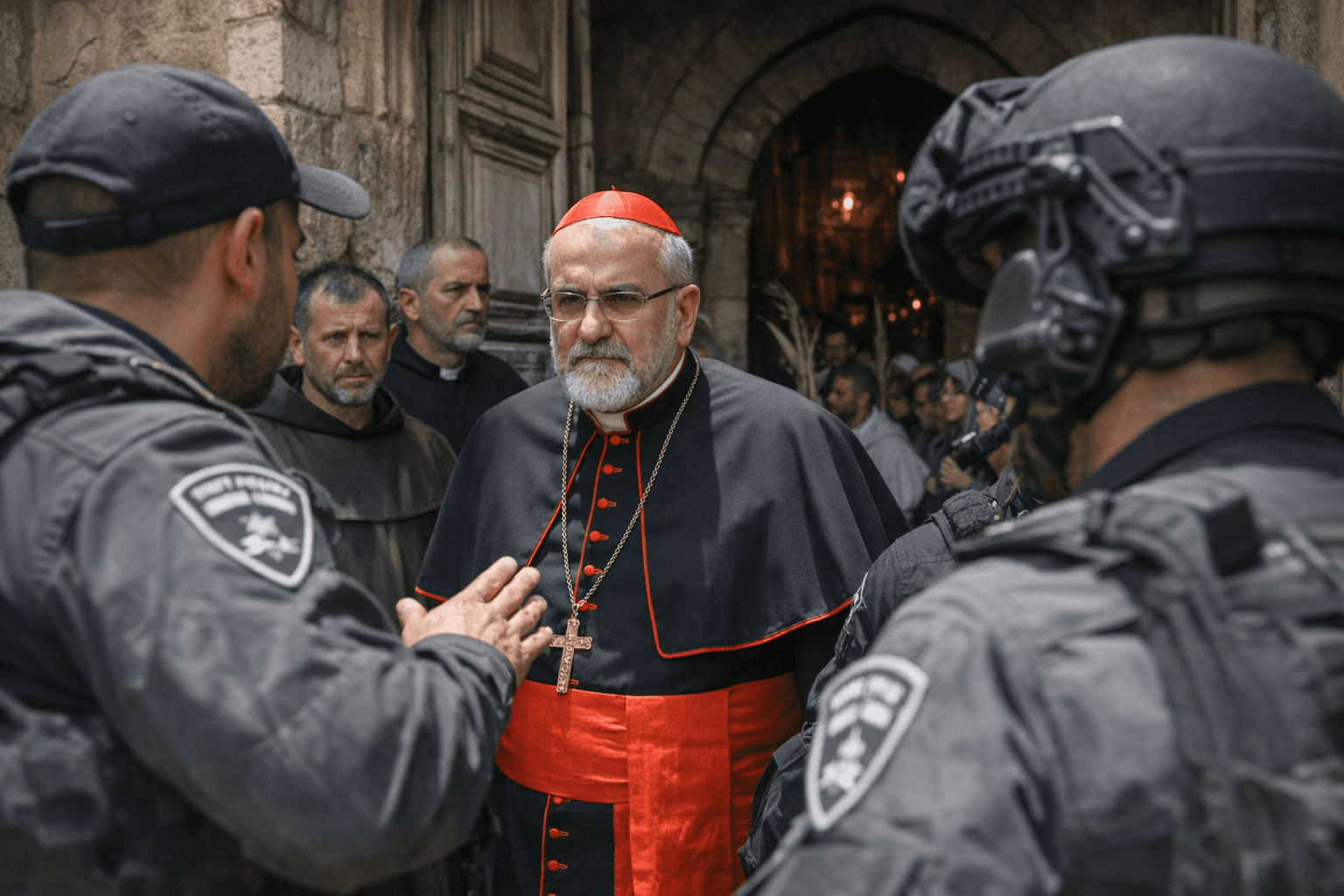
The Patriarchate acknowledged that church leaders had absorbed every prior restriction without public protest. "The heads of churches have acted with full responsibility and, since the outset of the war, have complied with all imposed restrictions," it said. The Custody of the Holy Land had been in dialogue with Israeli authorities as recently as March 21, awaiting "clear indications" about Holy Week celebrations. What it received instead was a locked door and a police line.
The joint statement characterized the moment as far more than a logistical grievance. "This incident is a grave precedent, and disregards the sensibilities of billions of people around the world who, during this week, look to Jerusalem," the Patriarchate and Custody said.
Cardinal Pizzaballa, speaking to the wider pastoral impact, described the cumulative effect of wartime restrictions as "a wound that adds to the many others inflicted by the conflict." The Church, he said, had been "unable to experience the traditional Lenten journey in Jerusalem, with the solemn celebrations at the Holy Sepulcher and in the Holy Places of the Passion." While the faithful "were able to pray and prepare personally," they "felt the loss of the community journey towards Easter." He proposed a "special day" when the faithful, though geographically separated, could "feel spiritually united in prayer to find comfort." Holy Week ceremonies are being adapted for broadcast given the gathering restrictions.
But broadcast cannot resolve the underlying question the Palm Sunday blockade makes unavoidable: what access rights attach to senior religious leaders at holy sites when wartime security measures override longstanding religious custom? The Patriarchate's explicit framing of the incident as a precedent signals that church leaders regard what happened on March 29 not as a one-day disruption, but as a threshold moment for the status of religious minorities in Jerusalem during periods of military escalation. With no Israeli police statement and no stated legal basis for the exclusion, that question remains open as Holy Week continues.
Know something we missed? Have a correction or additional information?
Submit a Tip