CES Experts Warn of Accuracy, Privacy Gaps in AI Health Gadgets
At the Consumer Electronics Show in Las Vegas, experts raised alarm about a new wave of AI-enabled consumer health devices that promise convenience but may lack clinical validation and basic privacy protections. The debate matters because these gadgets increasingly collect sensitive health data outside medical systems, potentially widening health inequities and exposing consumers to harm.
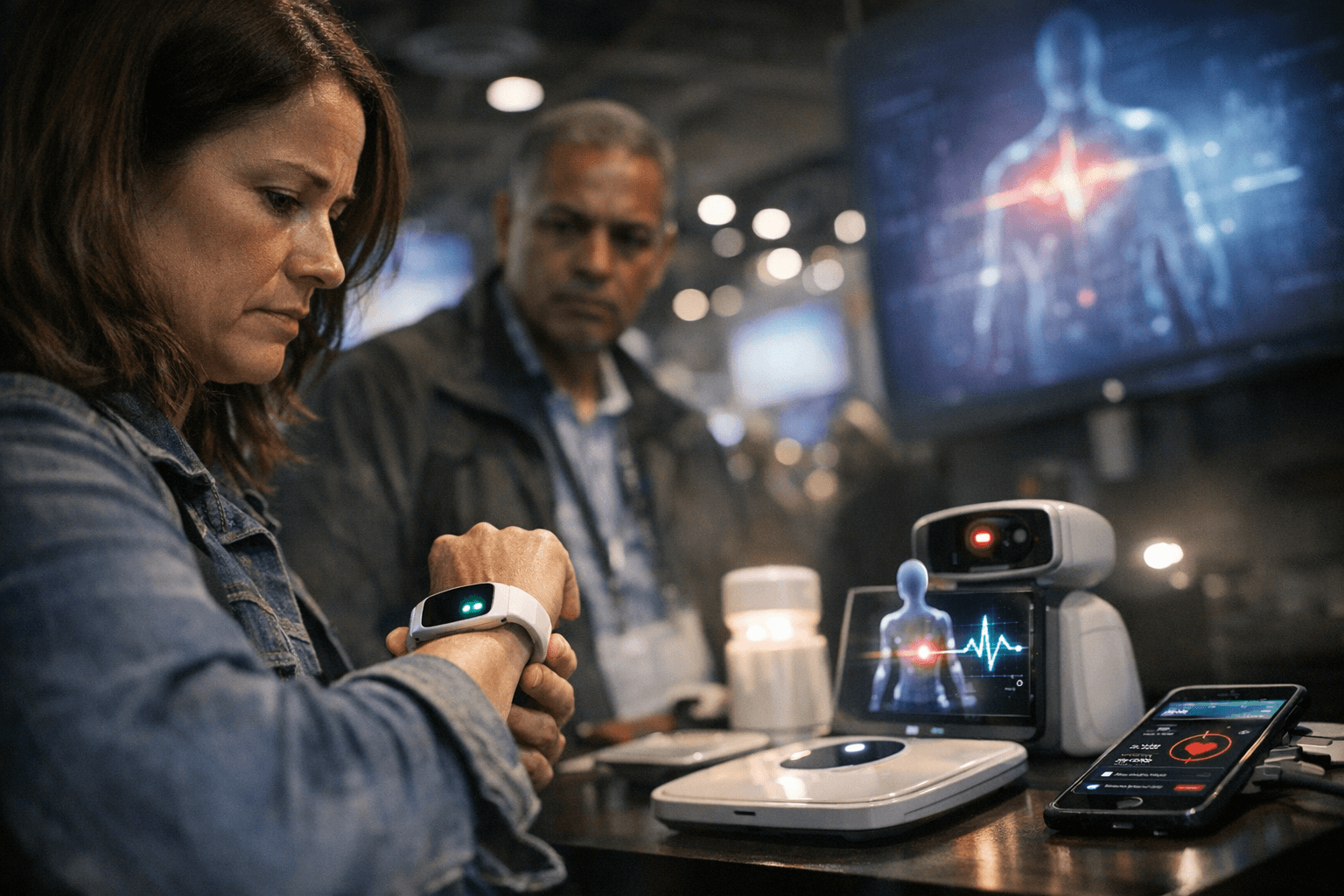
Exhibits at the Consumer Electronics Show on Jan. 7 displayed an array of AI-enabled health gadgets promising to bring medical insights into the home: a smart scale that scans feet to infer heart health, at-home diagnostic kits and an egg-shaped hormone tracker that analyzes urine and advises on conception timing. Vendors presented the products as filling long-standing gaps in menstrual and hormonal care, but physicians, privacy advocates and public-interest experts warned that convenience does not substitute for rigorous validation or legal safeguards.
Manufacturers defended their work. Sylvia Kang, founder and CEO of Mira, called her company’s egg-shaped device a “world’s mini hormone lab.” She described a process of dipping a wand in urine, inserting it into a monitor and viewing results in a companion app. Kang said Mira uses AI to analyze female hormone data, maintains “one of the world’s biggest hormonal health banks,” and that the cloud-stored data “is not shared with anyone.” Mira’s device was presented at the show with a retail price around $250.
Experts stressed potential benefits alongside risks. Marschall Runge, a professor of medical science at the University of Michigan, noted the scale of health care and the promise of AI to help analyze medical imaging and streamline clinicians’ schedules in a sector he placed at more than $4.3 trillion. He warned, however, that AI systems can embed biases and can “hallucinate,” meaning they may produce incorrect information presented as fact.
Those technical limits have real public health implications. Consumer devices often lack transparent clinical validation and are trained on limited or nonrepresentative data sets, raising the risk that outputs will not generalize to diverse populations. When users receive erroneous guidance and act without clinician input, there is potential for delayed diagnosis, inappropriate treatment choices and exacerbation of existing health disparities.
Privacy questions compounded those concerns. Advocates at the show reminded attendees that federal privacy protections such as the Health Insurance Portability and Accountability Act do not cover much of the data these consumer devices collect. Cindy Cohn of the Electronic Frontier Foundation cautioned, “I would urge people not to think that the technology is the same as a well‑resourced, thoughtful, research‑driven medical professional.” She warned companies could use consumer data to train models or sell it to third parties and said it is often “difficult to find out where your information is going.” Consumers are frequently forced to “dig down through the fine print” to learn what happens to their health information, a burden critics called unfair.
The trade show arrived amid a loosening regulatory backdrop. Federal agencies, including the Food and Drug Administration, have eased some rules that previously governed medical and diagnostic tools. Industry leaders argue that lighter oversight accelerates innovation; critics argue it reduces consumer safeguards. At CES, experts urged clearer oversight and enforceable transparency standards: explicit labeling of clinical validation, clearer disclosure of data-sharing practices and limits on commercial uses of sensitive health information originating outside traditional health-care settings.
For communities historically underrepresented in research, the stakes are high. Amy Divaraniya of Oova pointed to decades of research gaps, saying, “While not every woman will have a baby, all women go through menopause, and ‘yet we know nothing about it.’” As consumer devices proliferate, policymakers, clinicians and civil rights advocates face pressure to ensure that innovation does not outpace protections for accuracy, equity and privacy. In the meantime, experts recommend skepticism of bold marketing claims, careful review of privacy terms and consultation with health professionals before acting on device-generated advice.
This article was produced by Prism’s automated news system from verified source data, official records, and press releases, then run through automated quality and moderation checks before publishing. The system is built and supervised by the people who set the standards it runs under. Read our full AI policy.
Did this article answer your question?