Chile cancels Antofagasta green hydrogen project after astronomers' warning
Authorities halted a major green-hydrogen and ammonia plan after scientists warned it would harm Atacama astronomy.
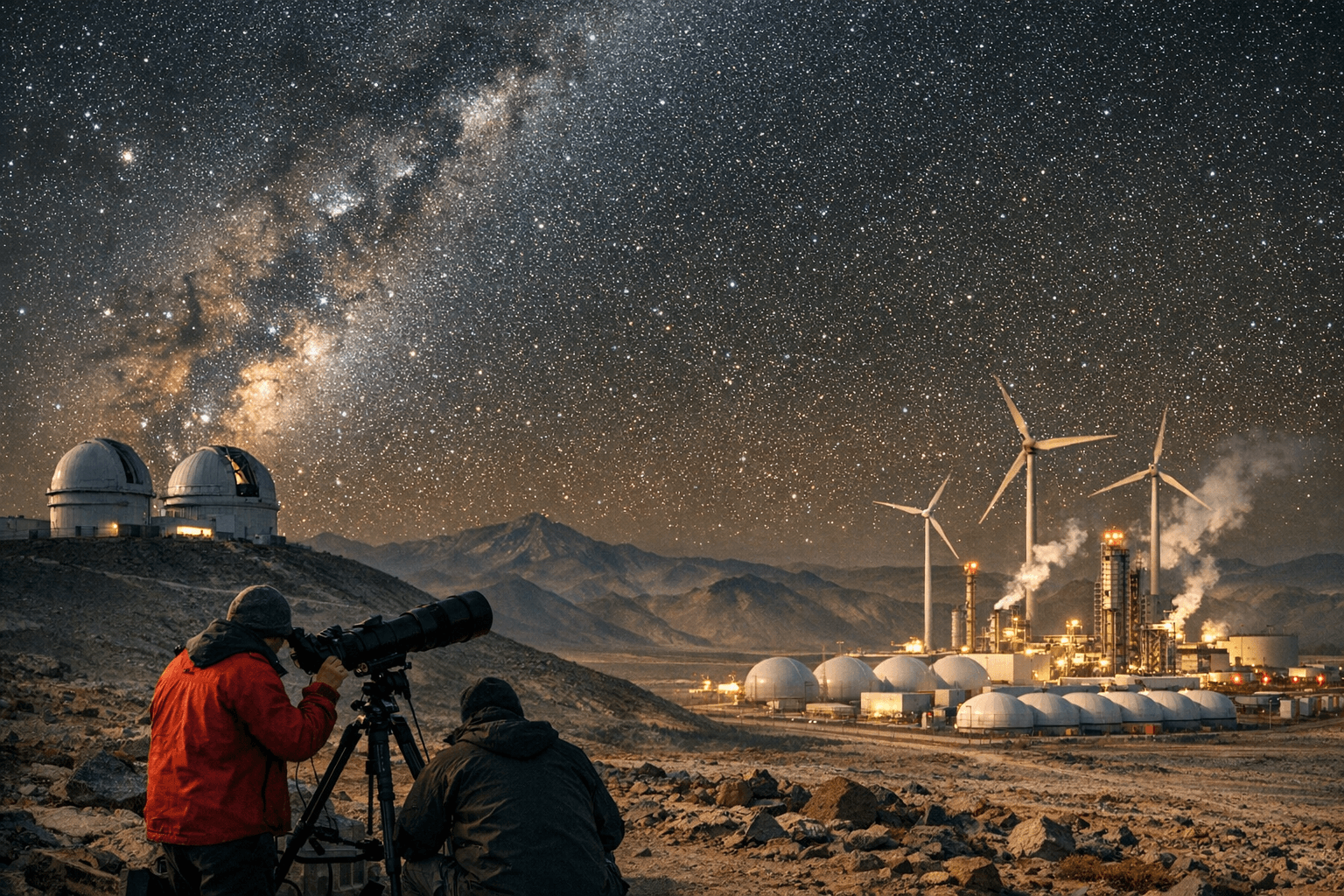
Regulators canceled a proposed green-hydrogen and ammonia production complex in Chile's Antofagasta region after scientists warned the development would pose risks to astronomical research in the Atacama Desert, the agency reported on Jan. 24, 2026. The move ends a high-profile proposal advanced by AES Andes under the name INNA in some reports and highlights a growing tension between clean-energy ambitions and scientific preservation.
The project had promised to tap the Atacama's exceptional solar and wind resources to produce low-carbon hydrogen and convert it to ammonia for export. Chile has positioned itself as a prospective global supplier of green hydrogen under its national strategy, citing among the world's best solar irradiance and cheap renewable power as comparative advantages. Investors and industry leaders had viewed Antofagasta as a prime site for large-scale electrolysis facilities that could feed international decarbonization markets.
Scientists raised concerns that industrial activity, including infrastructure, traffic, lighting and radio-frequency emissions, would degrade conditions at observatories in the Atacama, a desert region that hosts several of the world's leading optical and radio telescopes. Those facilities rely on dark skies, low atmospheric water vapor and electromagnetic quiet to operate at peak sensitivity. The scientific warnings prompted environmental authorities to reassess the project's potential impacts and, ultimately, to withdraw approval.
The cancellation carries immediate market implications. Green hydrogen and ammonia are central to industrial decarbonization scenarios for shipping, fertilizers and heavy industries. Removing a large-scale project from Chile's pipeline narrows near-term export capacity and may shift prospective supply to other countries or to different Chilean regions further from astronomical sites. For AES Andes, the setback requires recalibration of strategy for fossil-to-clean transitions and could delay corporate plans to monetize renewable power through hydrogen derivatives.
Beyond a single investment, the decision underscores the regulatory and reputational risks that accompany siting energy infrastructure in environmentally or scientifically sensitive areas. Analysts say developers now face a higher probability of project alteration or cancellation when projects intersect with protected ecosystems or global research assets. The outcome may increase the cost of capital for projects without clear social and environmental buffers and could encourage more rigorous spatial planning by regulators.
Policy implications are immediate. Chilean authorities will need to clarify buffer zones, emissions and lighting standards, and consultation frameworks to reduce future conflicts between green-energy development and science preservation. Clear site-selection rules would preserve investor confidence while protecting irreplaceable scientific infrastructure. The decision also offers a blueprint for other countries balancing renewable deployment with conservation of global public goods.
Longer term, the episode may accelerate investment in mitigation technologies and in alternative siting strategies such as offshore electrolysis or desert locations further from observatories. It also strengthens the case for integrated national planning that aligns climate goals, industrial policy and scientific stewardship. For now, Chile's cancellation signals that even projects framed as essential to the energy transition must meet strict environmental and scientific safeguards to proceed.
This article was produced by Prism’s automated news system from verified source data, official records, and press releases, then run through automated quality and moderation checks before publishing. The system is built and supervised by the people who set the standards it runs under. Read our full AI policy.
Did this article answer your question?

