China unveils five-year consumption drive focusing growth on services
Beijing launches a 2026-2030 blueprint and immediate measures to lift household spending and rebalance supply and demand.

China is rolling out a five-year policy package to boost domestic consumption and pivot growth toward services, officials said in Beijing, coupling a strategic blueprint for 2026-2030 with a cluster of near-term measures already deployed in early 2026. The National Development and Reform Commission (NDRC) framed the shift as a response to an economy with robust supply but tepid household demand.
Wang Changlin, vice head of the NDRC, said at a press briefing that “the issue of having strong supply but weak demand in the current economic operation is indeed a prominent problem.” Authorities are pressing to “significantly” raise the share of household consumption in GDP over the next five years and to reorient spending from basic purchases toward experience- and development-oriented consumption, with elderly care, healthcare and leisure singled out as priority service sectors.
The package combines medium-term structural goals with immediate financial supports. Officials announced earlier in the day the extension of interest subsidies through the end of 2026 for consumers, consumer-service firms and businesses undertaking equipment upgrades. New interest-subsidy support will also be available for loans to small and medium-sized private enterprises, covering up to two years for loans issued from 2026. Beijing will deploy a 500 billion yuan guarantee plan over two years to underwrite private investment, a sum officials say is intended to crowd in risk-averse investors; the State Council reported the equivalent at roughly $71.83 billion.
Vice Finance Minister Liao Min said the government will “direct more funds toward lifting consumption and improving people’s livelihoods this year,” though he did not specify a total allocation. The Commerce Ministry and other agencies have moved in stages since late 2025: an action plan released in November set intermediate targets by 2027 to optimize consumer-goods supply, to build three consumption sectors each valued near 1 trillion yuan and to create 10 consumption hot spots each exceeding 100 billion yuan. Authorities implemented trade-in policies on Jan. 4 and unveiled new service consumption measures on Jan. 16 to prime domestic demand.
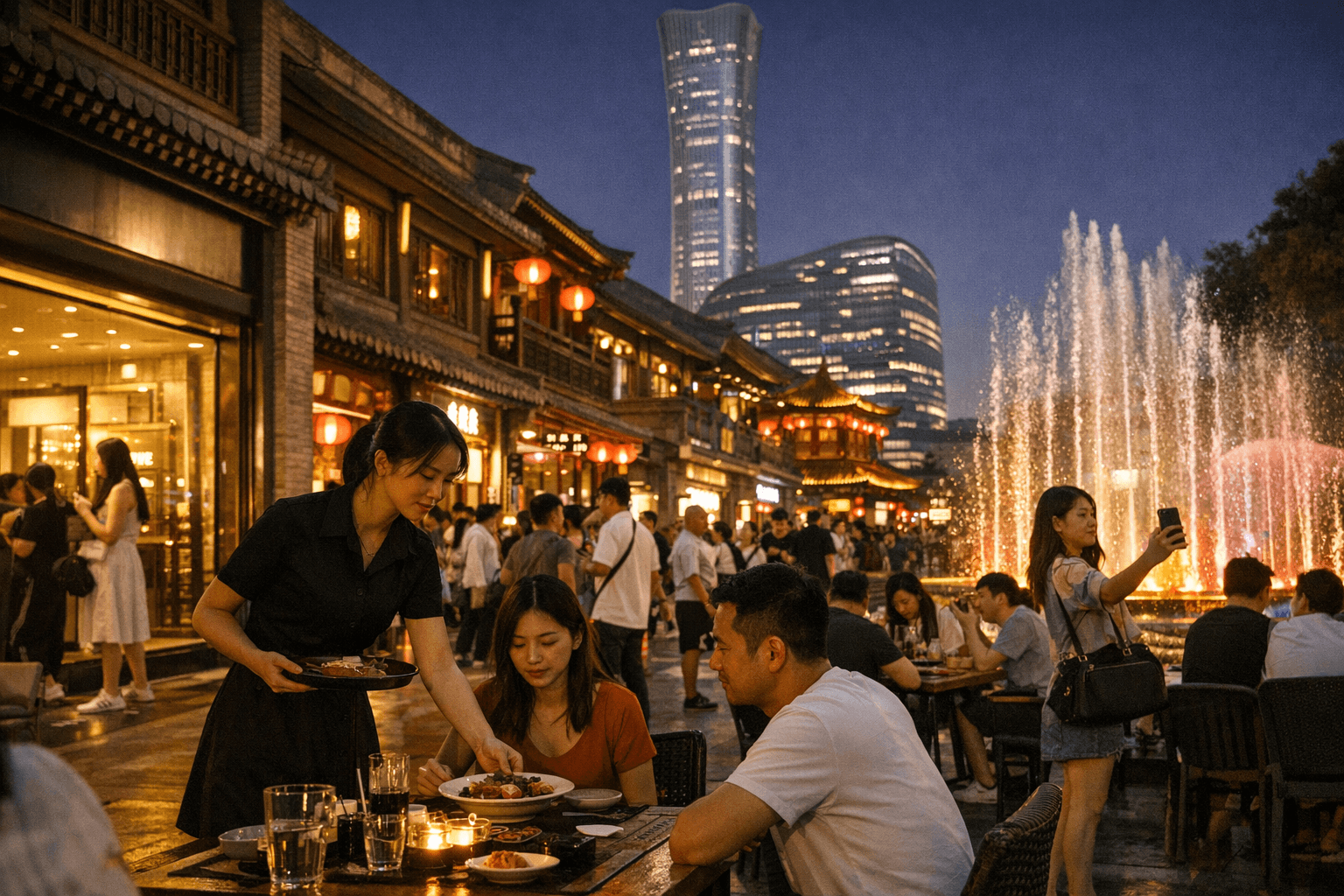
Practical implementation will rest on local governments and industry partners. The Commerce Ministry plans to support provinces in staging tailored shopping events and to run programs in 15 pilot cities this year to foster a more internationalized consumption environment. Initiatives include advancing the “Shopping in China” campaign, expanding digital service consumption, upgrading trade-in schemes, building 15-minute convenience shopping circles and accelerating rural e-commerce to broaden access.
Policymakers made the case against a backdrop of mixed 2025 data: the economy grew 5.0%, meeting Beijing’s target, but growth was export- and industry-led. Industrial output rose 5.9% while retail sales expanded just 3.7%, and total trade grew 2.1%, a notable deceleration that underscores the need to shore up domestic demand.
Analysts and business leaders welcomed the emphasis on services and higher-quality consumption while urging realism. Consultants said the measures could stimulate supply-side innovation and encourage experience-oriented spending. Multinational firms are adjusting investment and product strategies to capture evolving demand, increasing focus on greener manufacturing and China-specific products. Yet economists caution that raising consumption’s share without broader structural reforms and sustained demand-side incentives will be difficult, meaning Beijing’s combined medium-term and immediate steps must be delivered effectively at the local level to reshape household spending patterns.
This article was produced by Prism’s automated news system from verified source data, official records, and press releases, then run through automated quality and moderation checks before publishing. The system is built and supervised by the people who set the standards it runs under. Read our full AI policy.
Did this article answer your question?


