China's AI data centers face hurdles in shifting to renewables
China wants 80% of data-center power from renewables by 2030, but grid access, transmission and the AI load itself are slowing the shift.
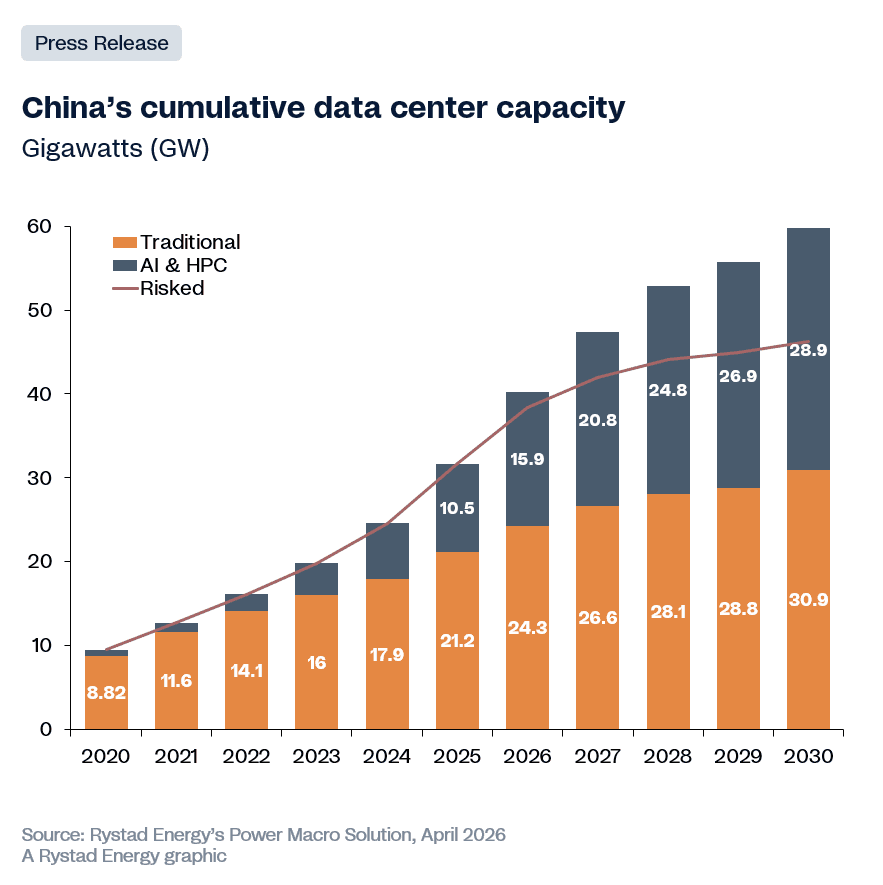
China’s push to make its fast-growing AI data centers cleaner is running into a hard reality: the power system is not yet built to feed huge, inflexible computing loads on the timetable Beijing wants. The government has elevated computing-power-electricity coordination to a strategic priority, but the sector still faces grid access problems, intermittent renewable output, land constraints, transmission buildout and rising costs.
The policy direction is clear. A July 24, 2024 action plan set a goal of lowering the average data-center power usage effectiveness, or PUE, to below 1.5 by the end of 2025 and increasing renewable-energy use in data centers by 10% a year. Another plan, unveiled on Aug. 6, 2024, laid out nine areas of work to speed construction of a new electricity system between 2024 and 2027. China is also aiming for renewables to supply 80% of data-center power by 2030, up from about 11% in 2023.
The problem is that data centers do not behave like a flexible industrial customer. Operators want to run expensive GPUs as intensively as possible, not throttle them back when wind or solar output falls. Pei Shanpeng of State Power Investment Corp. said China’s data-center electricity demand could rise by 300 billion to 500 billion kilowatt-hours from 2026 to 2030, a jump large enough to account for a meaningful share of national electricity-demand growth. The lower end of that range is roughly comparable to the United Kingdom’s annual electricity use, underscoring the scale of the load. Earlier public estimates cited by Carbon Brief put China’s data-center power demand at about 400 TWh by 2030.

China is not starting from a small base. CAICT-backed research cited by RMI put data-center electricity consumption at 150 TWh by the end of 2023, equal to about 1.6% of China’s total electricity use. At the same time, official data show renewable energy made up 56% of total installed power capacity at the end of 2024 and more than 60% in 2025, which suggests the bottleneck is shifting from generation alone to grid integration, market design and transmission.
The global stakes are just as large. The International Energy Agency says data centres and data transmission networks account for about 1% of energy-related greenhouse-gas emissions and 1% to 1.5% of global electricity use. Agora Energiewende says China’s energy transition is being reshaped by system integration, energy security and rising AI demand, a pressure point that now defines the challenge for China and the United States alike: AI is expanding faster than the clean-energy systems meant to power it.
This article was produced by Prism’s automated news system from verified source data, official records, and press releases, then run through automated quality and moderation checks before publishing. The system is built and supervised by the people who set the standards it runs under. Read our full AI policy.
Know something we missed? Have a correction or additional information?
Submit a Tip

