China's giant squid fleet off Argentina sparks overfishing fears
Roughly 200 Chinese boats now work just outside Argentina’s border, where squid lights can be seen from space and fishing hours jumped 85% in five years.
Roughly 200 Chinese fishing boats have turned the waters just beyond Argentina’s 200-nautical-mile line into a high-stakes enforcement zone, spending months each year there to catch squid for export markets. The fleet stays outside Argentina’s legal boundary, but its sheer size has intensified fears that migratory squid stocks are being squeezed at the edge of the country’s reach.
The pressure is concentrated in Mile 201, the high-seas strip immediately beyond the exclusive economic zone where no coordinated regional management governs the squid fishery. Environmental Justice Foundation research says Chinese squid vessels in the Southwest Atlantic increased their fishing hours by 85% between 2019 and 2024, even as landings showed signs of decline. The organization has also said the industrial fleets are so large their lights can be seen from space, a stark image of how visible this fishery has become from the air and at sea.

Argentina has responded by spending more on surveillance and maritime patrols to make sure foreign vessels do not cross into its waters. On December 2, 2025, the Prefectura Naval Argentina said it was intensifying monitoring of more than 500 foreign fishing vessels expected to gather at Mile 201 during the Illex season. The country is also receiving P-3C Orion maritime patrol aircraft to restore long-range monitoring capacity over its exclusive economic zone and the South Atlantic.
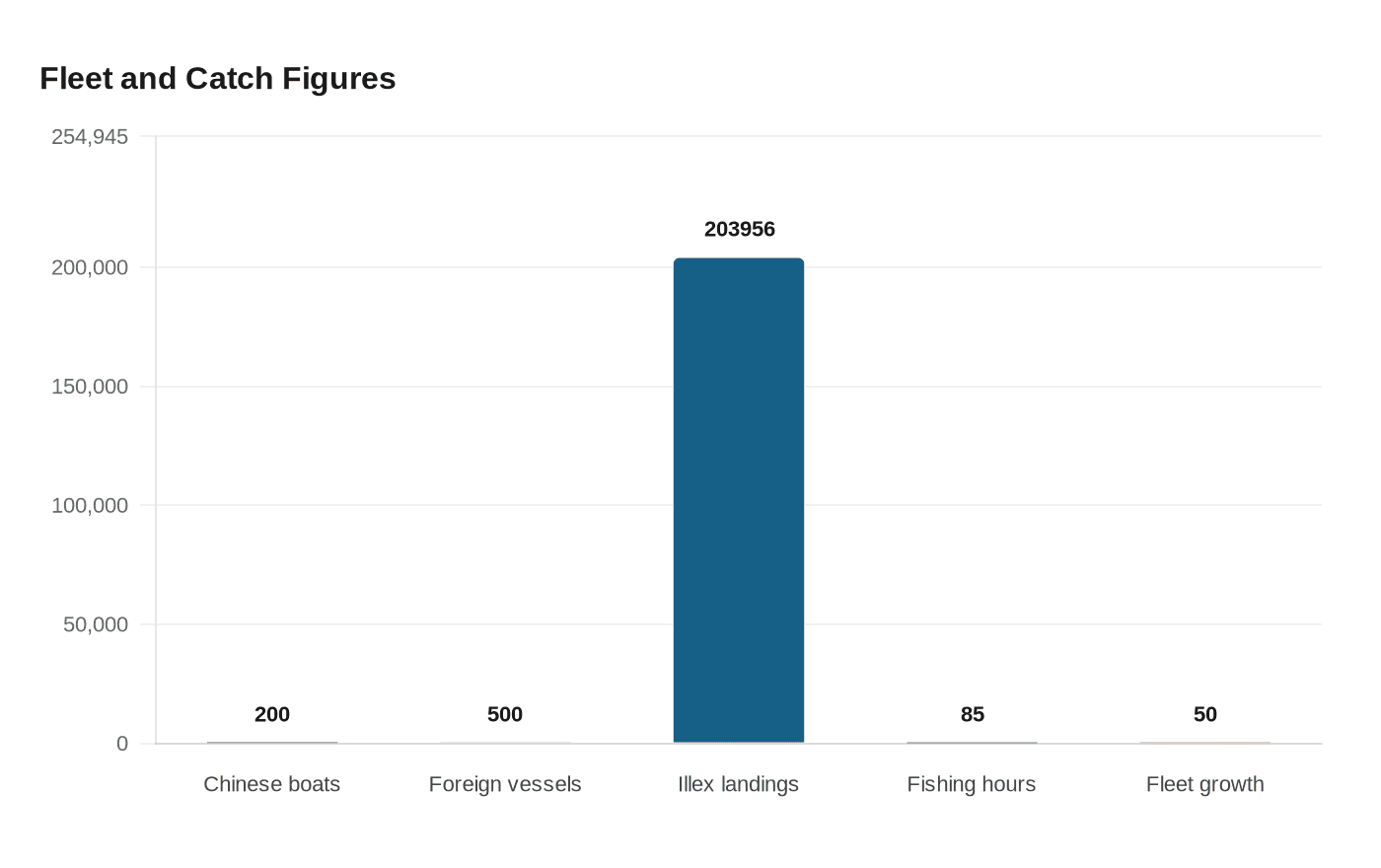
The stakes are not only ecological but economic. Argentina reported 203,956 tons of Illex squid landings at the close of the 2025 season, the highest total in 17 years. That record helps explain why Buenos Aires is treating the fishery as a national priority, while scientists and conservation groups warn that Illex argentinus, a major commercial squid species in the southwest Atlantic, is also an important part of the marine ecosystem.
The monitoring push has been paired with fresh science. On January 24, 2026, the Argentina National Institute for Fisheries Research and Development launched a new assessment campaign for the southern Patagonian stock of Argentine squid, underscoring how closely officials are still tracking the resource. Argentine authorities have also raised overfishing concerns with Beijing and other governments, as the fleet in the area has grown by nearly 50% over the past decade.
For Argentine crews on patrol, the dispute is visible on the radio as much as on the horizon, with nearby ships sometimes heard speaking garbled Mandarin. One Argentine squid specialist described the vessels as fishing “savagely” in the area. That tension captures the larger problem: even when the boats remain just outside the line, they still force countries to police a commons where commercial demand, ecosystem stress and geopolitics collide.
This article was produced by Prism’s automated news system from verified source data, official records, and press releases, then run through automated quality and moderation checks before publishing. The system is built and supervised by the people who set the standards it runs under. Read our full AI policy.
Did this article answer your question?


