Colombia approves culling 80 of Escobar’s invasive hippos
Colombia approved euthanizing 80 hippos descended from Escobar’s private zoo. Officials warned the herd could hit 1,000 by 2035.
Colombia has approved the euthanasia of an initial 80 hippos in the second half of 2026, a move that turns one of the country’s strangest ecological problems into a blunt state intervention. The animals are descendants of four hippopotamuses Pablo Escobar brought to Hacienda Nápoles in the early 1980s, and after his death in 1993 they escaped containment and spread through the Magdalena River basin.
The Colombia Ministry of Environment said the plan is meant to control an invasive population now estimated at about 200 hippos in the central part of the country. Officials warned that, if left unchecked, the herd could swell to as many as 1,000 by 2035. Environment Minister Irene Vélez said the animals threaten villagers and displace native species, underscoring how a legacy of cartel excess has become a present-day public safety and conservation problem.
That legacy still distorts the debate. Escobar’s private zoo at Hacienda Nápoles left Colombia with the only wild hippopotamus population outside Africa, a fact that has turned the animals into both an environmental challenge and a cultural symbol. For years, authorities tried to avoid killing them. Sterilization campaigns and relocation efforts were described by officials as costly, slow, and unsuccessful, and they said no country had agreed to take the hippos in.
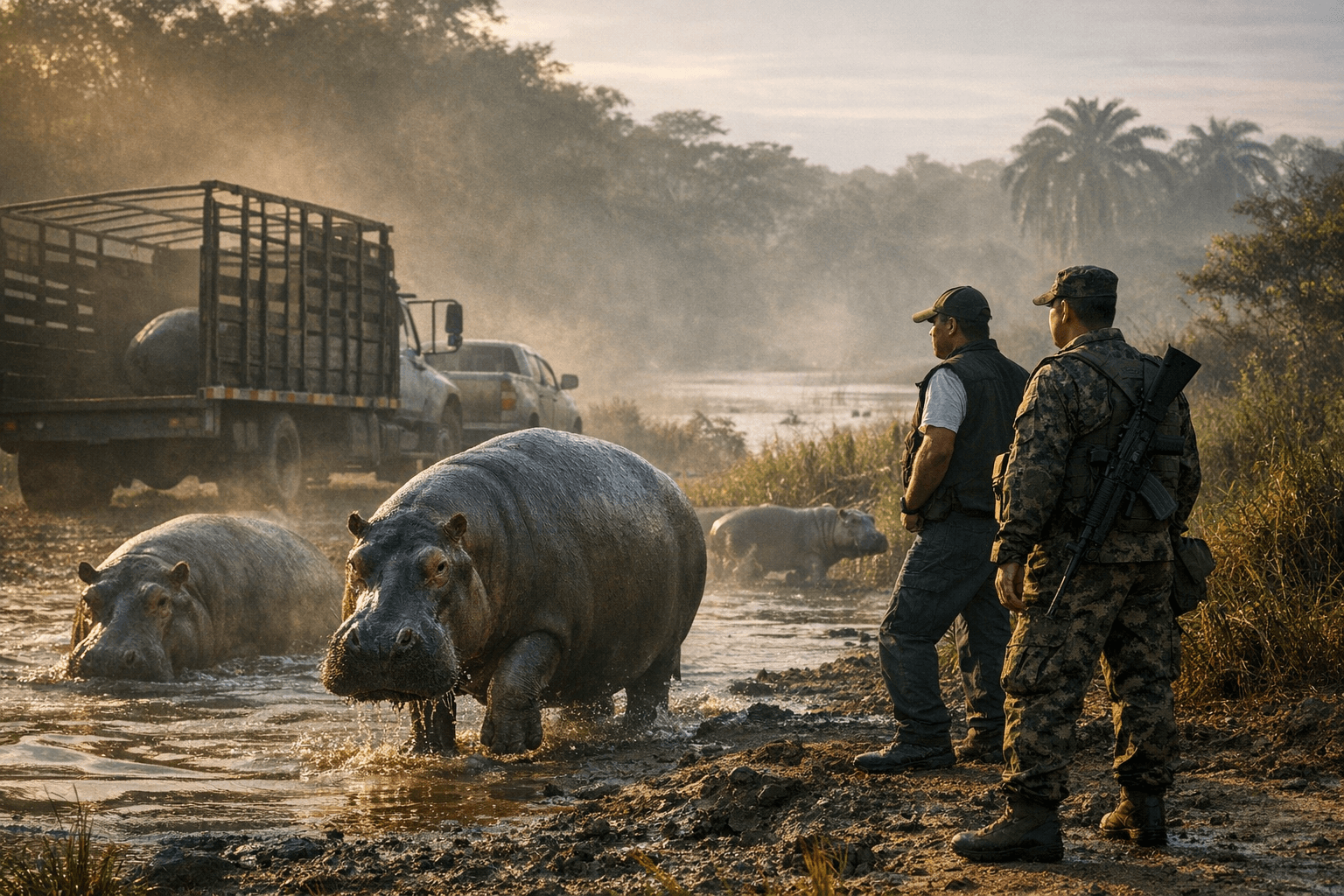
Scientists have repeatedly warned that the population is still growing. A 2023 study in Scientific Reports estimated 91 hippos in the middle Magdalena River basin and said the population was increasing by 9.6 percent a year. That study projected 230 hippos by 2032 and more than 1,000 by 2050. A separate study from the National University of Colombia, cited in reporting, put the number roaming freely at around 170 in 2022. The government’s estimate of about 200 hippos in the region reflects how quickly the issue has outpaced earlier assumptions.
The political cost of confronting the herd has been clear before. In 2009, hunters killed a hippo named Pepe, setting off protests that helped lead to a 2012 ban on hippo hunting. That backlash still hangs over the new culling plan, which is likely to renew arguments over conservation, animal welfare, and the long shadow of Escobar’s mythology.
This article was produced by Prism’s automated news system from verified source data, official records, and press releases, then run through automated quality and moderation checks before publishing. The system is built and supervised by the people who set the standards it runs under. Read our full AI policy.
Did this article answer your question?


