Commonwealth Fusion nears world’s first commercial fusion plant start
Commonwealth Fusion says its SPARC demo is 75% complete, but the harder test is turning a Virginia site, a 200-megawatt Google deal and $3 billion into usable power.
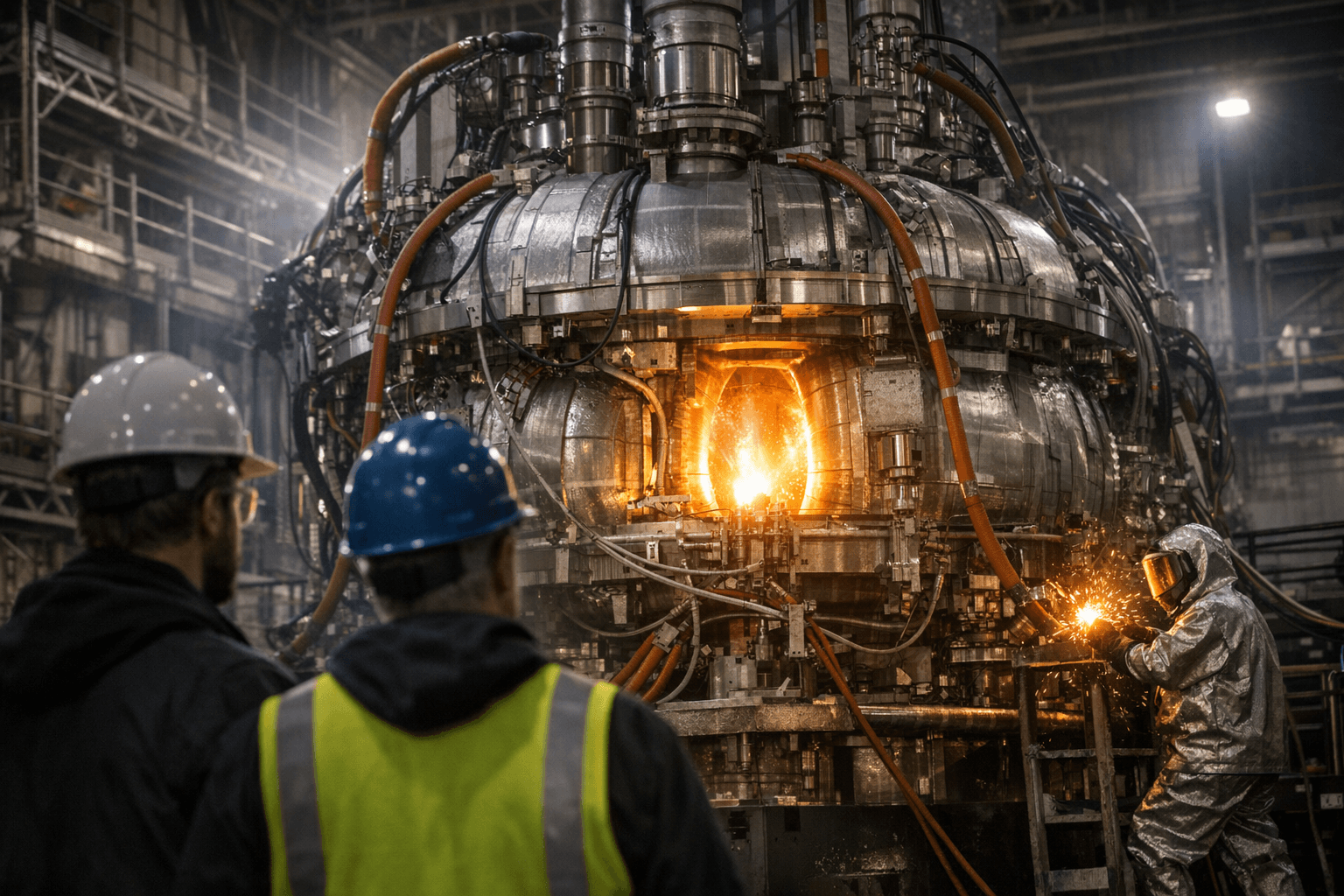
Commonwealth Fusion Systems is moving from laboratory promise to industrial test case, but the hard part is still ahead. The company says its SPARC demonstration machine in Devens, Massachusetts, is now about 75% complete and is intended to produce first plasma in 2026, with net fusion energy shortly after. If that machine performs as planned, the next step would be ARC, a proposed 400-megawatt plant in Chesterfield County, Virginia, on a 100-acre site at James River Industrial Park.
That is the point where fusion stops sounding like a scientific milestone and starts looking like a financing, permitting and grid-integration problem. Commonwealth Fusion Systems says it has raised almost $3 billion since it was founded in 2018, more than any other company pursuing fusion power plants, and it has already locked in a major commercial signal: in June 2025, Google agreed to buy 200 megawatts of electricity from ARC. Virginia officials have said the project is expected to power about 150,000 homes and create hundreds of jobs, while Virginia Energy’s Clean Energy Innovation Bank provided direct funding support.
The company still has to clear several electricity-side issues before construction can begin. Bob Mumgaard, the chief executive, has said the goal is to have everything lined up so work can start as soon as capital is available, and he has said a 2026 start remains possible, though the Virginia project would follow only after SPARC demonstrates the physics case. Commonwealth says ARC will be independently financed, built, owned and operated by the company, while Dominion Energy Virginia plans to lease the land and provide development and technical expertise through a non-financial collaboration.
The technical case rests on high-temperature superconducting magnets, which allow stronger magnetic fields and more compact tokamaks, along with work the company says traces back to the Massachusetts Institute of Technology’s Alcator C-Mod program. Commonwealth has also built out magnet manufacturing in Devens, a reminder that fusion is no longer only about plasma physics. It is also about supply chains, factory throughput and the kind of industrial discipline power markets demand before they commit to a new generating asset.
Policy makers are treating the sector as a strategic race. The U.S. Department of Energy released its Fusion Science and Technology Roadmap in October 2025, aiming to accelerate commercial fusion power to the grid by the mid-2030s and drawing on input from more than 600 scientists, engineers and industry stakeholders. The International Atomic Energy Agency says dozens of fusion plant concepts are now under development worldwide, and Commonwealth has pointed to sites in the eastern United States, the Rust Belt and the West, as well as the United Kingdom, Germany, Japan, Korea and Singapore, as possible future markets. For all the momentum, the checklist remains unforgiving: a working demonstration machine, a financeable plant, a permit in hand, a grid connection and a reactor that can deliver power at commercial scale.
This article was produced by Prism’s automated news system from verified source data, official records, and press releases, then run through automated quality and moderation checks before publishing. The system is built and supervised by the people who set the standards it runs under. Read our full AI policy.
Did this article answer your question?
%3Amax_bytes(150000)%3Astrip_icc()%2FCertificate-of-deposit-2301f2164ceb4e91b100cb92aa6f868a.jpg&w=1920&q=75)