Conservatives plan to tighten benefit cap, claim £1bn annual savings
The Conservatives say stripping disability-related exemptions from the benefit cap would raise £1bn a year, but could hit larger families and disabled households hardest.

Helen Whately has set out a Conservative plan to tighten the household benefit cap by removing some exemptions, a change the party says would save £1bn a year and force more working-age households to rely on wages rather than benefits.
The shadow work and pensions secretary wants the cap to bite whenever adults in a home who are deemed able to work are not employed for at least 16 hours a week. The party says that would close what it calls a loophole, where households can currently avoid the cap if one adult receives disability-related support even when other adults could work. Conservatives have described the current system as a “golden ticket to uncapped benefits” and argued that families should not receive more in benefits than working households earn from wages.

The proposal would target the exemptions that currently shield some claimants from the cap, including people receiving Working Tax Credit and households where the claimant or partner gets certain disability- or care-related benefits. Under current rules on GOV.UK, households are not affected if someone gets Universal Credit because of a disability or health condition that stops them working, or if they receive disability-related payments such as Personal Independence Payment, Disability Living Allowance or Attendance Allowance. Universal Credit claimants can also be exempt if household earnings are equivalent to at least 16 hours a week at the National Living Wage.
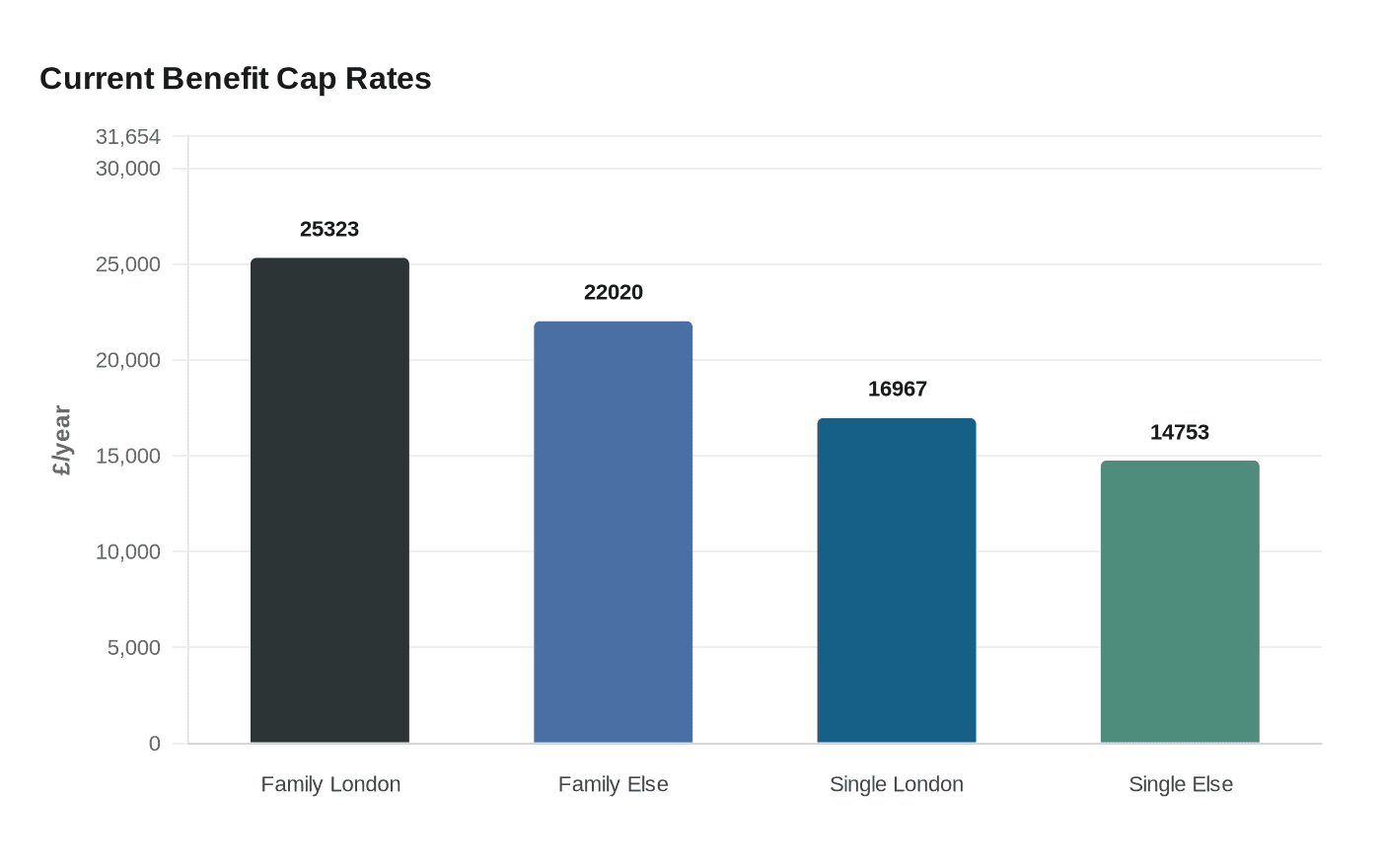
The benefit cap itself was introduced in April 2013 under the coalition government, with initial limits of £500 a week, or £26,000 a year, for families and £350 a week, or £18,200 a year, for single adults. It was lowered in November 2016, and different rates for London and the rest of Great Britain were introduced. Since April 2023, the cap has stood at £25,323 a year in Greater London and £22,020 elsewhere for families, and £16,967 in Greater London and £14,753 elsewhere for single adults.

Official figures show 115,000 households had their benefit capped in February 2025, with 99% capped through Universal Credit. The Department for Work and Pensions said London had the highest proportion of households affected, underscoring how the cap lands hardest where rents are highest and margins are thinnest.
Any move to remove exemptions would therefore do more than change the headline saving. It would push more larger households, disabled claimants and low-income families in expensive areas closer to the cap, forcing the welfare system to absorb a stricter test of work, family size and housing cost at the same time.
This article was produced by Prism’s automated news system from verified source data, official records, and press releases, then run through automated quality and moderation checks before publishing. The system is built and supervised by the people who set the standards it runs under. Read our full AI policy.
Did this article answer your question?