Control of the Strait of Hormuz Fuels a Nation's Newfound Power
Iran turned a 21-mile waterway into the world's most powerful economic weapon, collapsing global oil shipping by 94% and demanding sovereignty as the price of peace.
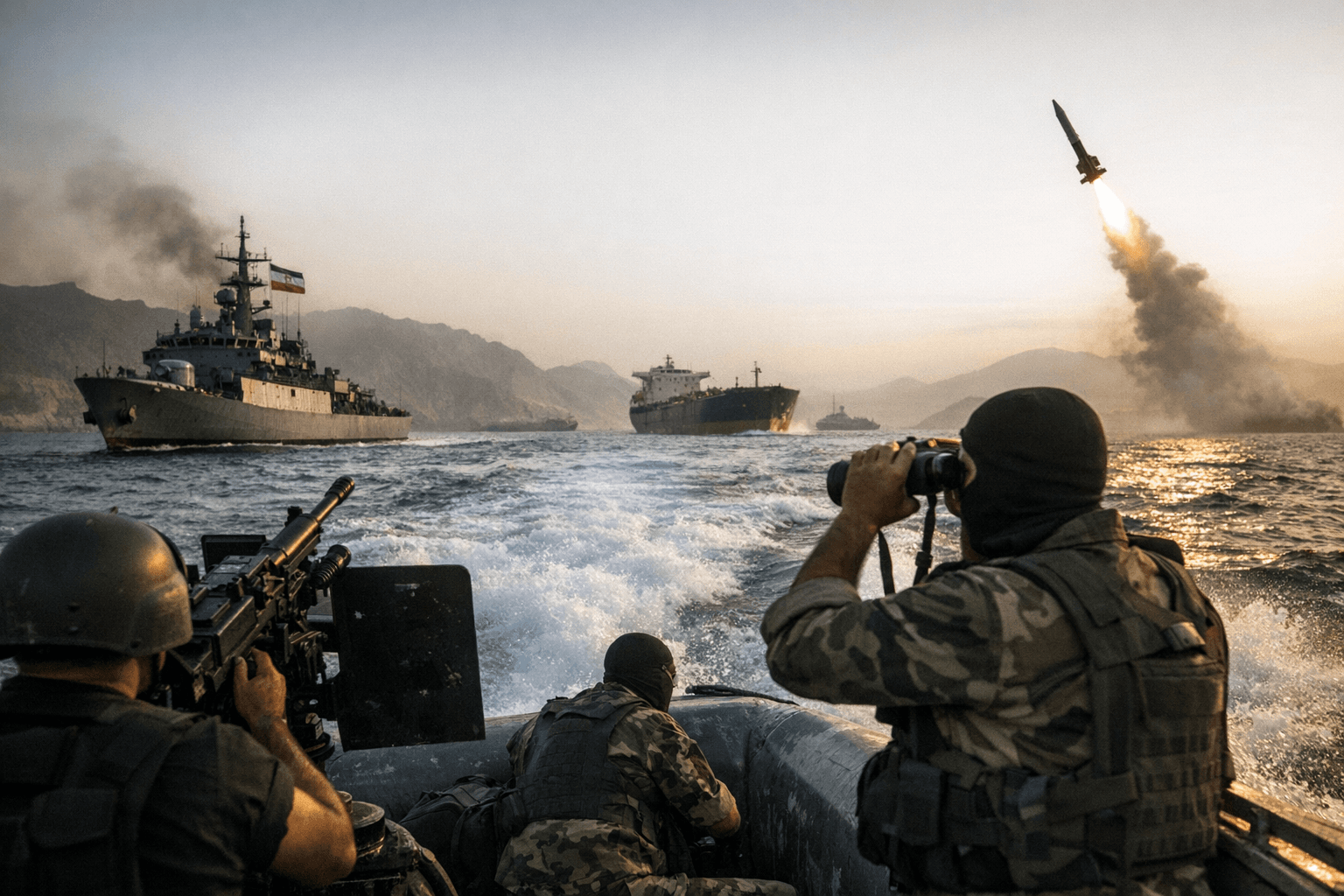
The Chokepoint That Changed Everything
At its narrowest, the Strait of Hormuz measures just 21 miles across, a sliver of water separating Iran's coastline from Oman. For decades, that geography was treated as a vulnerability Iran might exploit in a crisis. In 2026, the Islamic Republic transformed it into something far more formidable: a sovereign toll gate with the power to hold the global economy hostage. The strait ordinarily handles the transit of around 20 million barrels of oil per day, roughly 20% of global seaborne oil trade, flowing from Saudi Arabia, the United Arab Emirates, Iraq, and Kuwait to markets across Asia and beyond. When Iran effectively closed it, the consequences were immediate, sweeping, and unlike anything the world's energy markets had experienced since the 1970s.
How a War Became a Blockade
The sequence of events began on February 28, 2026, when the United States and Israel launched large-scale military strikes on Iran, strikes that included the killing of Supreme Leader Ali Khamenei. Iran's retaliation was not limited to missile barrages. Its Islamic Revolutionary Guard Corps (IRGC), which holds shared jurisdiction over the Strait of Hormuz alongside the regular Iranian Navy, immediately issued radio warnings prohibiting all vessel passage. On March 2, the IRGC officially confirmed the strait was closed to "unfriendly nations."
What made the closure particularly striking was the method. Iran achieved it not with a traditional naval blockade but primarily through cheap drones, a strategy that proved devastatingly effective against commercial shipping. As one analyst cited by NPR put it, "When analysts have looked at the things that could go wrong in global oil markets, this is about as wrong as things could go." Between February 28 and March 18, only 105 vessels transited the strait, compared to approximately 1,900 during the same period in 2025. That is a 94% collapse in traffic through one of the world's most critical shipping lanes. By mid-March, at least 21 confirmed attacks on merchant vessels had been carried out, with 23 direct attacks reported by early April and 11 crew fatalities.
The Economic Shockwave
The International Energy Agency characterized the resulting disruption as "the largest supply disruption in the history of the global oil market." Brent Crude surged past $120 per barrel immediately following the closure, and analysts at major financial institutions began discussing the prospect of prices reaching $200 per barrel if the strait remained shut. Fuel costs for consumers spiked by more than 50 cents per gallon in the United States alone. Stock markets declined globally, and warnings of stagflation and recession multiplied across financial capitals.
Nearly 2,000 vessels found themselves stranded near the strait's approaches. QatarEnergy declared force majeure on all its exports. Countries across Asia, which depend most heavily on Gulf oil, faced acute fuel shortages that analysts warned would soon spread westward through European markets. The parallel disruptions already affecting Red Sea cargo routes and the Suez Canal, where Houthi attacks had already been rerouting shipping, compounded the pressure.
The Toll Booth Strategy
Iran did not simply close the strait and wait. It began operating what analysts quickly labeled a "toll booth," selectively granting access to vessels in exchange for payments reportedly reaching $2 million per transit. On March 31, Iran's Parliament Security Committee formalized this approach by approving a "Strait of Hormuz Management Plan," a rial-based toll system that also explicitly bans passage for American, Israeli, and sanctions-participating nations. Iranian MP Mohammadreza Rezaei Kouchi stated the intent plainly: "Parliament is pursuing a plan to formally codify Iran's sovereignty, control and oversight over the Strait of Hormuz, while also creating a source of revenue through the collection of fees."
The financial architecture is itself geopolitically significant. Iran is reportedly accepting Chinese yuan and cryptocurrency as primary payment modes, a deliberate departure from the dollar-denominated maritime trade system that has defined global commerce for generations. Lloyd's List Intelligence confirmed at least two documented payments as of early April 2026.
Who Gets to Pass
Selective access became Iran's most potent diplomatic instrument. On March 26, Foreign Minister Abbas Araghchi announced that ships from five nations would be permitted transit: China, Russia, India, Iraq, and Pakistan. "We permitted passage through the Strait of Hormuz for friendly nations including China, Russia, India, Iraq, and Pakistan," Araghchi confirmed. Malaysia and Thailand subsequently secured access through direct diplomatic talks with President Masoud Pezeshkian and Iran's ambassador to Thailand. Some vessels from South Korea and Egypt have also been allowed through under certain conditions.
The classification system transformed the strait from an international passage into a strategic checkpoint shaped entirely by Tehran's geopolitical alignments. China, which imports more Gulf oil than any other single nation, was extended "friendly nation" status and has little incentive to challenge the system. India, which evacuated five LPG carriers from the strait in mid-March under Operation Sankalp with naval escorts, subsequently secured access as well. The arrangement effectively carved global shipping into two categories: nations Iran deems cooperative and those left stranded.
A Sovereignty Claim the World Cannot Ignore
Iran's ambitions extend well beyond the current conflict. Among the five ceasefire conditions Tehran laid out, the newest and most revealing was a demand for international recognition of its sovereignty over the Strait of Hormuz. Under international law, states may exercise sovereignty up to 12 nautical miles from their coastlines, and at its narrowest stretch, the strait's designated shipping lanes fall entirely within the territorial waters of Iran and Oman. That legal reality gave Tehran geographic leverage long before any conflict began. IRGC commander Esmaeil Kousari confirmed the posture explicitly, stating that shutting the strait would be executed "whenever necessary" to protect national sovereignty and deter further foreign aggression.
Mojtaba Khamenei, who has emerged in a public capacity following his father's death, signaled in his first address that the leverage of blocking the waterway "must continue to be used." That framing, sovereignty as a permanent instrument of statecraft rather than a wartime measure, is what distinguishes this moment from previous Iranian threats to close the strait, threats that were never carried out. This time, the closure is a fait accompli, and the world is negotiating around it.
The Coalition and Its Limits
The international response has been substantial but fractured. On April 2, more than 40 nations convened virtually in a coalition hosted by British Foreign Secretary Yvette Cooper, who accused Iran of "hijacking an international shipping route to hold the global economy hostage." The United States launched a military campaign to open the strait on March 19, though experts at the Foreign Policy Research Institute and Al Jazeera's Centre for Studies have cautioned that reopening the strait by force would be costly, time-consuming, and could itself trigger a further economic shock.
The coalition's cohesion is complicated by the fact that several of the world's largest economies, including China and India, have already made separate arrangements with Tehran. Nations outside that circle are left choosing between paying Iran's toll or waiting on a military solution with no certain timeline. The gap between legal norms and geopolitical reality, as one analyst put it, is precisely where Iran has planted its flag. For a country whose proxies have been degraded and whose nuclear program has faced sustained pressure, control of 21 miles of water has become something no military campaign or sanctions regime previously managed to deliver: a seat at the center of every conversation about the global economic order.
This article was produced by Prism’s automated news system from verified source data, official records, and press releases, then run through automated quality and moderation checks before publishing. The system is built and supervised by the people who set the standards it runs under. Read our full AI policy.
Did this article answer your question?


