Crane places first 3D-printed cabins at Welcome Home Village, San Luis Obispo
Crane lifts the first 3D-printed prefabricated cabins into place at Welcome Home Village, moving San Luis Obispo's homeless re-housing project forward.
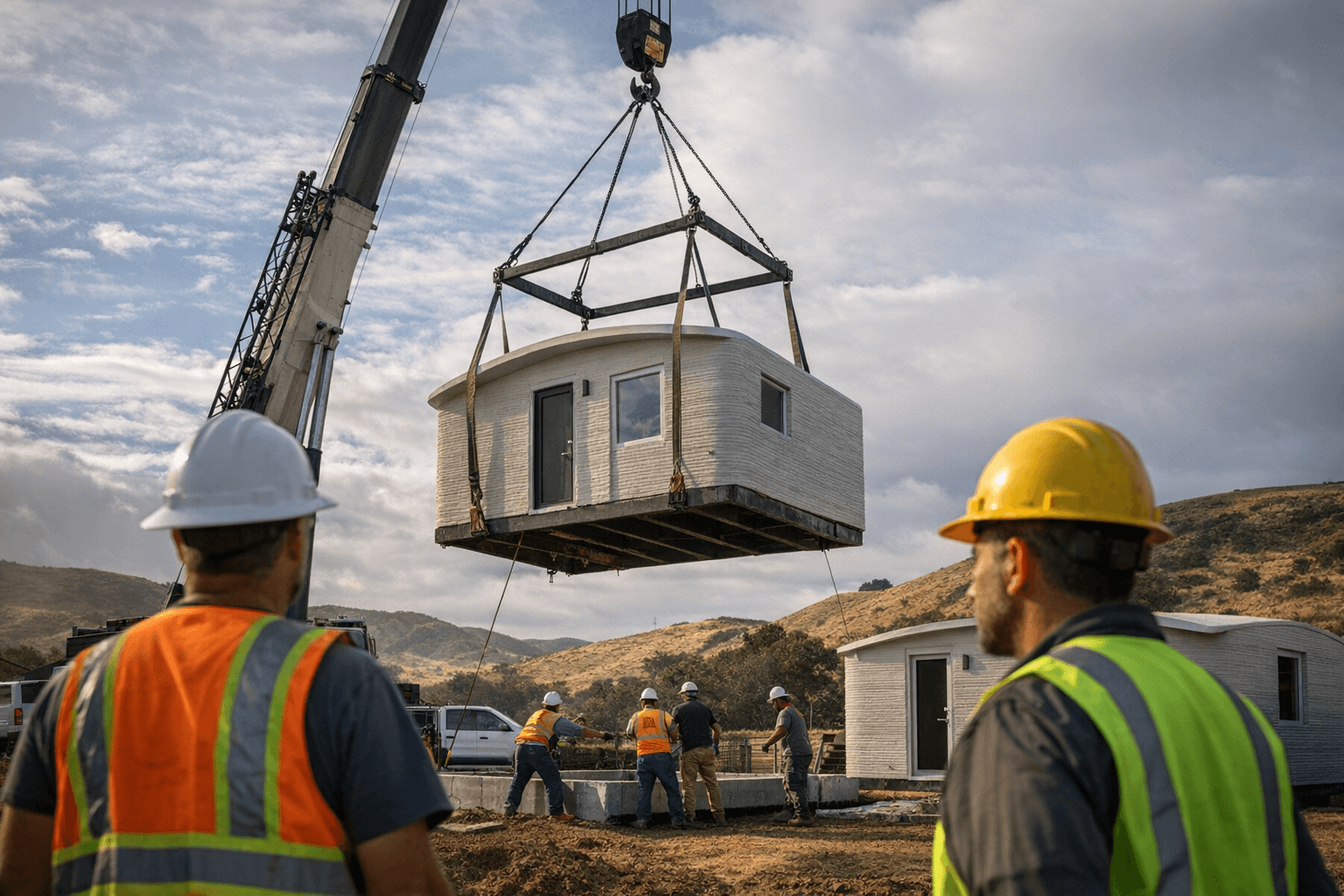
A crane placed the first prefabricated cabins at Welcome Home Village in San Luis Obispo, a visible milestone for the city’s homeless re-housing effort and a proof point for using 3D-printed construction in small-scale housing.
Crews set the initial units on site on Feb. 5, 2026, beginning a phase of assembly that project planners expect to accelerate occupancy and reduce on-site labor compared with traditional stick-built construction. The project will eventually include 54 prefabricated cabins designed to offer compact, private shelter as part of the wider Welcome Home Village initiative.
The placement operation was straightforward by construction standards: each cabin arrived as a finished module and was lifted into position by crane, then aligned on prepared foundations and hooked up to utilities. That modular workflow shortens the time workers spend on site, reduces exposure to weather delays, and concentrates much of the build work in factory settings. For San Luis Obispo neighbors and volunteers, the visible crane lift is a clear sign the village is moving from planning to physical build-out.
Welcome Home Village is being framed as a transitional re-housing project, using compact cabins to create immediate, dignified shelter while residents work toward longer-term housing solutions. For the tiny house community and local housing advocates, the site is a local case study in marrying micro-dwelling design with prefabrication and new fabrication technologies. The cabins described in local accounts as 3D-printed highlight a trend of experimenting with alternative materials and automated production to cut costs and speed delivery.
Practical impacts for readers include a likely faster timeline for getting people indoors, a reduction in neighborhood disruption from prolonged on-site construction, and the chance for community groups to engage around move-in supports and services. The modular nature of the cabins also makes future maintenance and replacement more manageable, since individual units can be swapped or upgraded without gutting entire buildings.
Next steps at Welcome Home Village include setting the remaining modules, completing utility and interior finishes, and coordinating resident move-ins as site infrastructure is completed. Observers planning similar projects can watch how the factory-to-site pipeline performs for scheduling, cost control, and resident outcomes.
The crane lift on Feb. 5 turns an idea into stacked cabins on-site and gives San Luis Obispo a working example of how prefabricated, 3D-printed modules can be deployed in re-housing work. For neighbors, service providers, and tiny house builders, the coming weeks will show whether this approach delivers the speed, cost savings, and resident stability that planners aim for.
Know something we missed? Have a correction or additional information?
Submit a Tip