Cuban President Miguel Díaz-Canel Tells NBC News He Will Not Resign
Díaz-Canel told NBC's Kristen Welker he won't resign, making him the first Cuban leader on U.S. television since Fidel Castro appeared on Meet the Press in 1959.
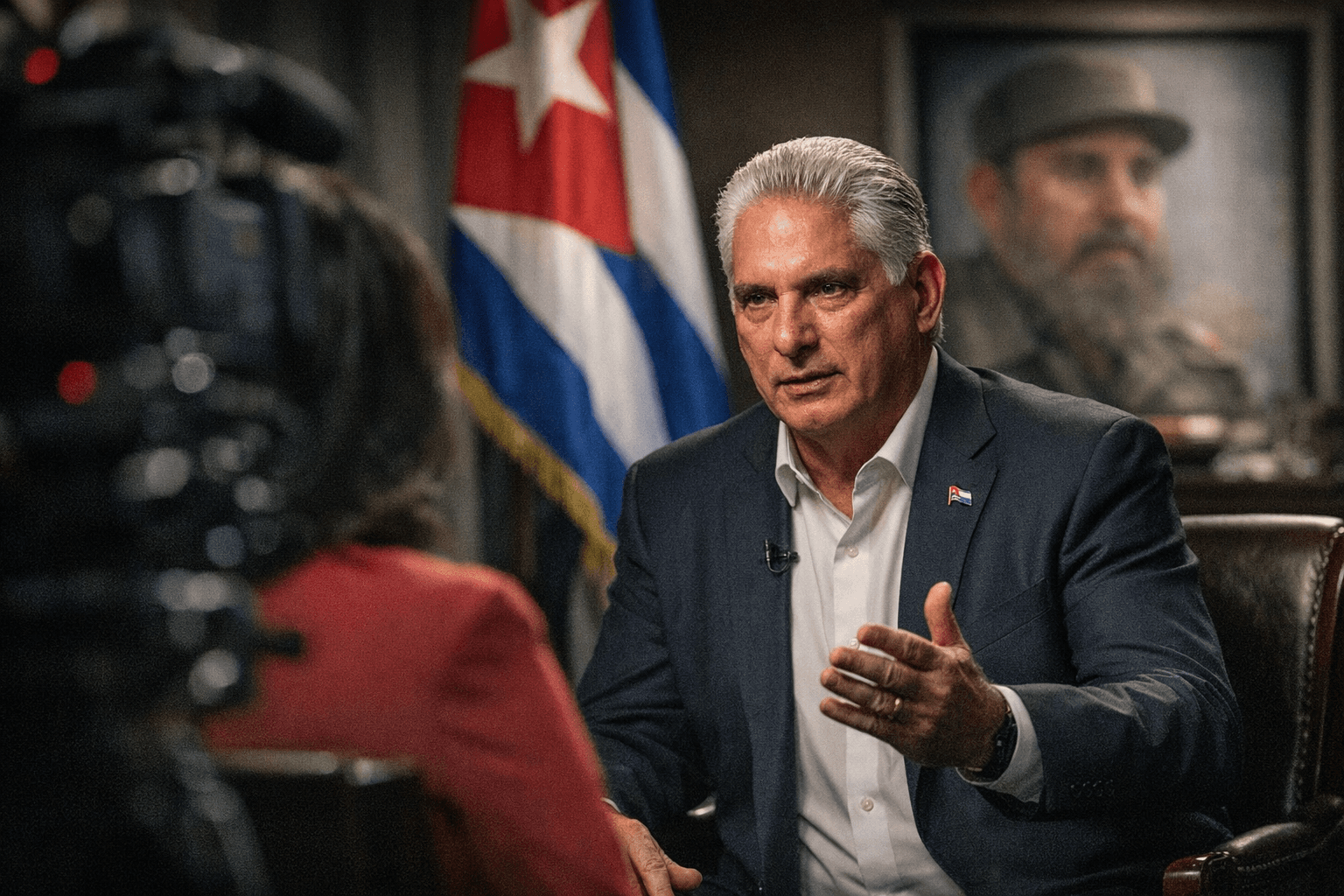
Cuban President Miguel Díaz-Canel flatly rejected calls to step down from power Thursday, telling NBC News' "Meet the Press" moderator Kristen Welker that "stepping down is not part of our vocabulary" in the first interview a Cuban leader has given to an American broadcast network since Fidel Castro appeared on the same program in 1959.
In a nearly five-minute clip from a longer interview scheduled to air in full on Sunday, Welker asked Díaz-Canel whether he would be "willing to step down if it meant saving Cuba." Before answering, Díaz-Canel asked whether she had ever posed that question to any other president, then fired back: "Is that a question from you, or is that coming from the State Department of the U.S.?"
"In Cuba, the people who are in leadership positions are not elected by the U.S. government, and they don't have a mandate from the U.S. government. We have a free sovereign state, a free state. We have self-determination and independence, and we are not subjected to the designs of the United States," Díaz-Canel said. He set one narrow condition for leaving office: "If the Cuban people understand that I am not fit for office, that I have no reason to be here, then I should not be holding this position of president, I will respond to them."
The interview came as the Trump administration has been ratcheting up pressure on the communist country and calling for a change in its government, with President Donald Trump calling Cuba a "failing nation" and saying last month it may be "a friendly takeover, it may not be a friendly takeover." Secretary of State Marco Rubio, whose parents left Cuba in the 1950s, called Cuba a "disaster," saying its "economic system doesn't work." "Cubans can only be successful if they leave the country," Rubio said. "That has to change, and for that to change, you have to change the people in charge." Rubio has publicly denied calling specifically for Díaz-Canel's resignation, though he has pressed for major leadership changes.
A White House official responded to the interview Thursday by saying that Cuba's leaders want to make a deal and should make a deal, which Trump believes "would be very easily made." "Cuba is a failing nation whose rulers have had a major setback with the loss of support from Venezuela," the official said.
That reference to Venezuela cuts to the core of Cuba's current predicament. Venezuelan oil supplies were cut off after President Nicolás Maduro's capture by U.S. special forces in January. In late March, a Russian tanker carrying 730,000 barrels of crude oil arrived in Matanzas, the first significant supply in over three months, but it barely covers nine or ten days of demand. The island is experiencing its most severe energy crisis in years, with power outages lasting up to 30 hours daily and electric generation deficits exceeding 1,800 megawatts. The Cuban economy has contracted by 23% since 2019, and the Economist Intelligence Unit projects an additional decline of 7.2% for 2026.
The interview carries significant historical weight, as the last time a Cuban leader appeared on "Meet the Press" was in 1959, when Fidel Castro was interviewed during his maiden visit to the United States. The full interview, taped Thursday morning in Havana, will air Sunday on "Meet the Press," with the complete version available on NBC's website. Díaz-Canel's willingness to speak directly to an American audience, even while denouncing Washington's "hostile policy," suggests the Cuban government is navigating a crisis severe enough to warrant an unprecedented level of public engagement with the very country it accuses of engineering its collapse.
This article was produced by Prism’s automated news system from verified source data, official records, and press releases, then run through automated quality and moderation checks before publishing. The system is built and supervised by the people who set the standards it runs under. Read our full AI policy.
Did this article answer your question?


