David Hockney’s Los Angeles years shaped his iconic pool paintings
A British outsider turned Los Angeles into a visual myth, using pools and bright light to fuse leisure, desire, and aspiration into one enduring image.

David Hockney turned Los Angeles into a visual idea as much as a place. The British-born artist, born on July 9, 1937, arrived intermittently in California in 1964 and quickly found in pools, light, and private domesticity a language the world would recognize as Southern California. His paintings did more than describe the city; they taught museums, collectors, and viewers how to see it.
The outsider who made Los Angeles legible
Hockney’s Los Angeles years mattered because he was not from the city, yet he helped define its modern image more powerfully than many native voices. The Tate says he owned two residences in California, while the Getty places his Los Angeles life from 1963 to 2005, a long stretch that gave his work a deep local anchoring even as he remained a Brit by birth. That tension between insider access and outsider distance is part of why the paintings feel so persuasive: they read like discovery, not souvenir.
The city that emerged in Hockney’s work was built from light, style, and ease. The notes describe him as a symbol of Los Angeles culture, stylish and alienating, with vivid swimming-pool paintings and an embrace of SoCal light, hedonism, and gay liberation. That combination gave his art a charge beyond mere landscape painting, because the city became a stage for freedom, sensuality, and self-invention.
Why the pool became the signature image
His best-known Los Angeles image, *A Bigger Splash*, was painted in 1967 and remains one of the clearest expressions of that vision. Tate says he painted it while teaching at the University of California at Berkeley, and that it belongs to a group of swimming-pool paintings drawn from his California years. The image of a sun-drenched pool is not just decorative in Hockney’s hands; it becomes a portrait of a way of life.
Tate explains that Hockney was fascinated by pools in California because they were not considered a luxury there in the way they were in Britain, and they could be used all year round. That detail matters because it shifts the pool from status symbol to everyday environment, a backdrop for leisure that feels both ordinary and aspirational. In Hockney’s paintings, water, patio space, and bright geometry turn the private life of Southern California into a modern myth.
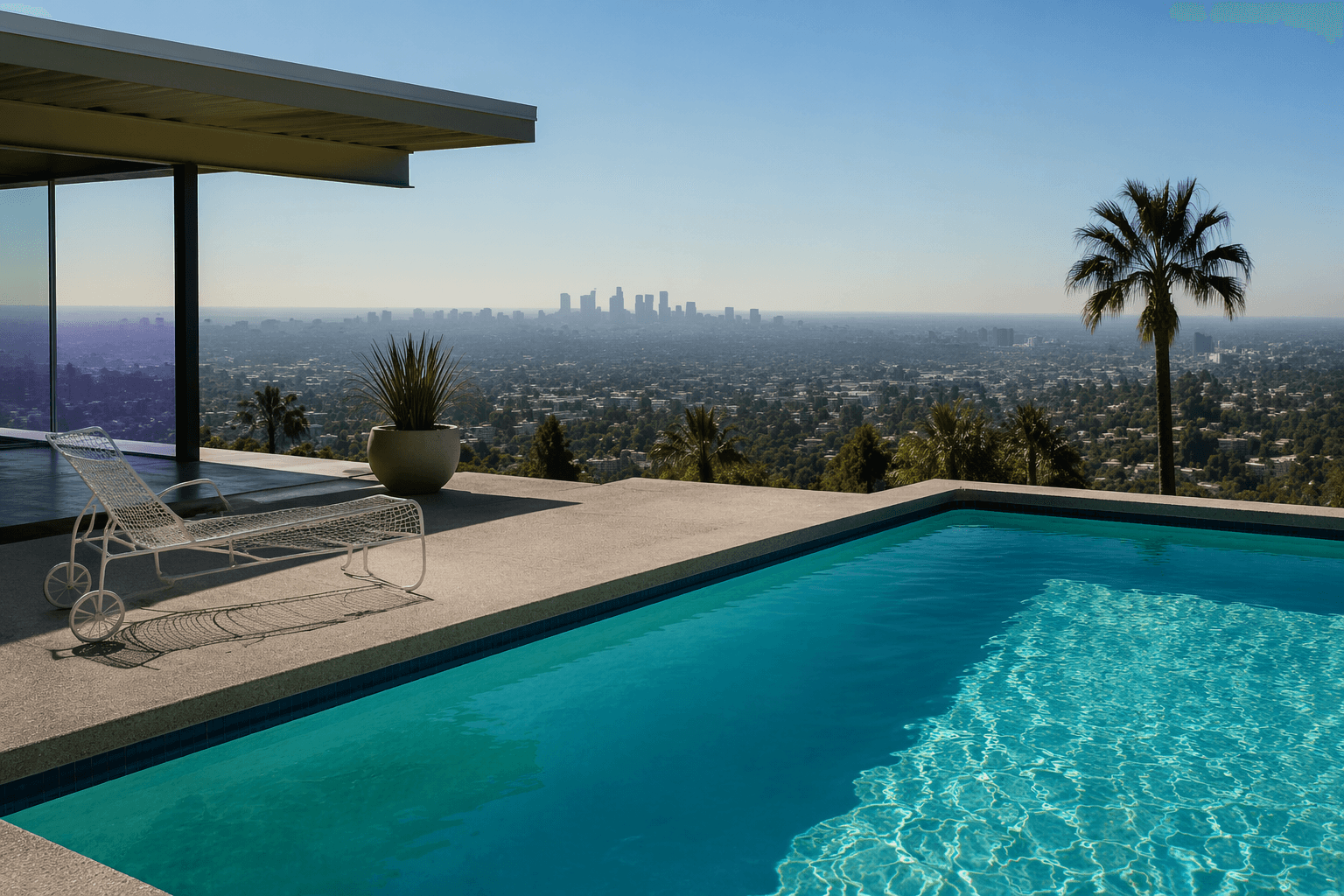
The Getty describes him as an artist associated with the unique landscape subject matter and sun-drenched color palette he developed in Los Angeles. That palette is central to the power of the work: it makes the city look perpetually available, physically open, and emotionally effortless. The result is an image of Los Angeles that is seductive even when it feels slightly detached, as if the city itself were performing its own glamour.
How museums helped cement the image
Los Angeles institutions quickly understood that Hockney had become part of the city’s cultural identity. MOCA opened *David Hockney Photoworks Retrospective* on July 22, 2001, an exhibition that showed photography had played a consistent role in his art for three decades while he continued to depict Southern California landscapes. That combination of photographic observation and painted invention reinforced his reputation as an artist who translated the city into a public visual vocabulary.
The Los Angeles County Museum of Art also treated him as a major figure in the city’s contemporary-art story. In a remembrance, curator Roberto C. recalled meeting Hockney at a 1976 opening on Santa Monica Boulevard and said that even then his images were already strongly associated with public perceptions of Los Angeles as sunshine, pools, palm trees, and portraits of close friends. The crowd included Billy Wilder, Christopher Isherwood, and Vincent Price, a reminder that Hockney’s circle connected art, literature, and Hollywood in a way that mirrored the city itself.
That museum memory reveals how quickly the city accepted his shorthand. Hockney did not need decades for Los Angeles to see itself in his work, because the imagery had already settled into the city’s public face by the mid-1970s. His paintings became part of the feedback loop in which Los Angeles looked at Hockney looking at Los Angeles, and liked what it saw.
A lasting feedback loop between art and self-image
Hockney’s influence endured because the city’s self-image and his pictures kept feeding each other. The notes describe him as a symbol of Los Angeles culture, but the bigger story is that he helped turn specific local conditions, sunshine, pools, palm trees, closeness among friends, and an atmosphere of ease, into an exportable idea of the city. That image still shapes how America imagines Los Angeles because it condenses the city into an instantly readable set of desires: comfort, beauty, freedom, and reinvention.
His work also helped define the emotional tone of Los Angeles for outsiders. The allure of the city in Hockney’s hands is not only visual; it is social and sexual, rooted in the freedoms of gay liberation and the fantasy of living openly in a place where pleasure feels built into the landscape. That is part of why his paintings endure in the American imagination: they present Los Angeles as a place where appearance and identity can be staged, revised, and made luminous.
The legacy beyond Los Angeles
Even far from California, Hockney’s stature continued to travel through major exhibitions. The David Hockney Foundation says a large-scale solo exhibition at the Museum of Contemporary Art, Tokyo ran from July 15 to November 5, 2023. It also says *Drawing From Life* at London’s National Portrait Gallery was restaged in 2023 after first opening just before COVID shutdowns in March 2020. Those exhibitions show that the visual language he developed in Los Angeles still carries international force.
But the California years remain the engine of his reputation. He came to the state as an outsider and left behind an image of Los Angeles so durable that it became part of the city’s brand, its fantasy, and its self-understanding. Hockney did not simply paint the pools of Los Angeles; he helped make them one of the city’s defining global symbols.
This article was produced by Prism’s automated news system from verified source data, official records, and press releases, then run through automated quality and moderation checks before publishing. The system is built and supervised by the people who set the standards it runs under. Read our full AI policy.
Know something we missed? Have a correction or additional information?
Submit a Tip