DeepSeek eyes $7.4 billion funding round with Tencent, CATL backing
DeepSeek is weighing a 50 billion yuan debut raise that could value it near $59 billion, a sign China’s AI race is entering a far costlier phase.

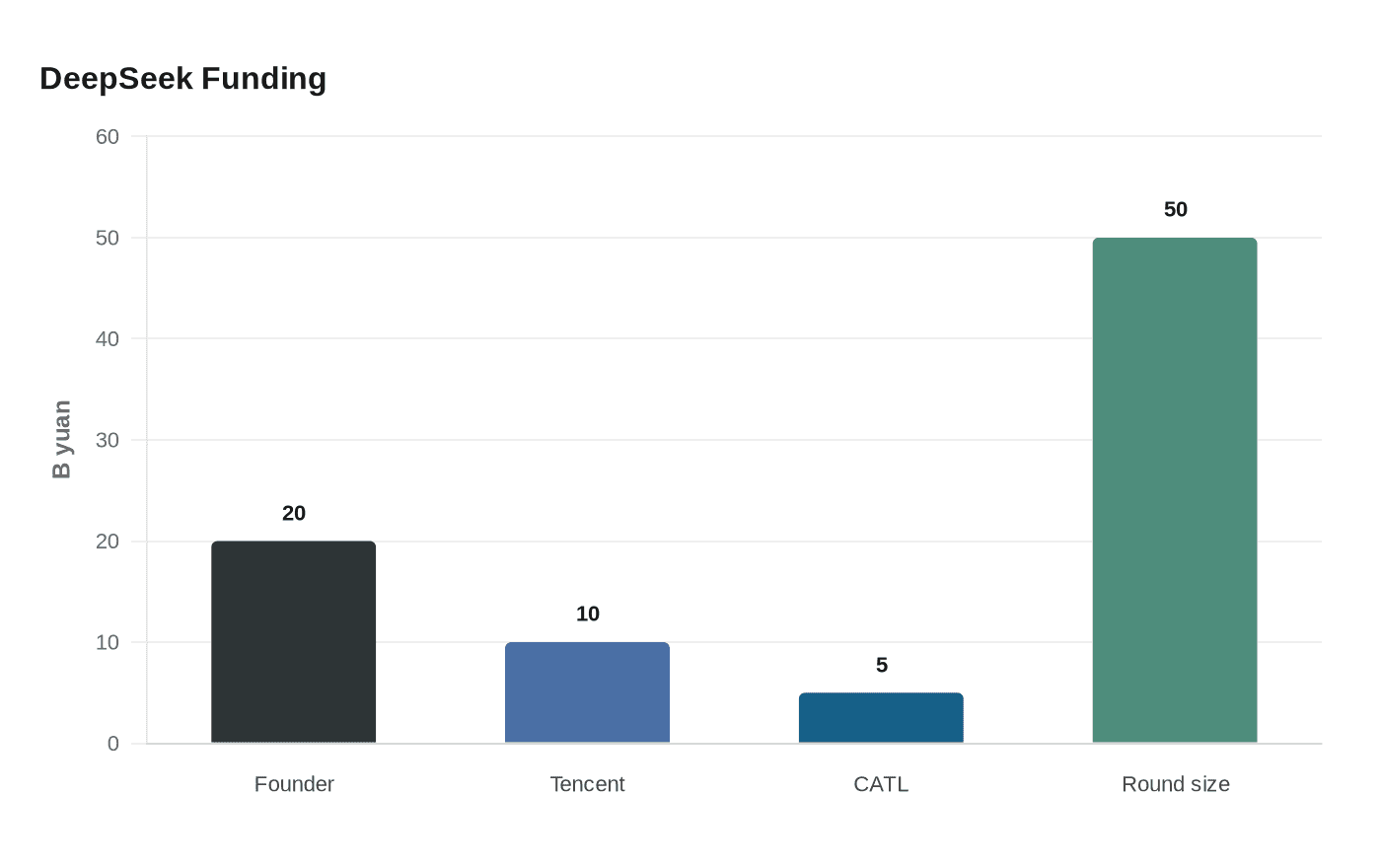
DeepSeek is preparing its first funding round and could raise about 50 billion yuan, or $7.4 billion, in a deal that would rank among the largest early financings in China’s AI sector. The startup is courting investors including Tencent Holdings and CATL, with the round expected to value the company at 350 billion to 400 billion yuan, or about $52 billion to $59 billion.
Founder Liang Wenfeng plans to put in 20 billion yuan of his own money, while Tencent is considering 10 billion yuan and CATL 5 billion yuan. Fewer than 10 investors are expected in total. The scale of the raise marks a sharp reversal for DeepSeek, which had spent years avoiding outside capital, a posture made possible by Liang’s backing from the quantitative hedge fund High-Flyer.
That shift matters because DeepSeek is no ordinary startup. Founded in 2023 and reported to have a team of about 200 employees, it became China’s breakout AI name after the release of its V3 model in December 2024 and its R1 reasoning model on January 20, 2025. R1 triggered a global reappraisal of AI economics, with Nvidia losing roughly $589 billion to $593 billion in market value in a single day as investors reassessed how much compute frontier models really require.
DeepSeek’s rise also resonated far beyond markets. In January 2025, scientists began testing R1 on tasks ranging from mathematics to cognitive neuroscience, a sign that the model’s influence extended into research settings as well as commercial ones. The company’s open-weight approach, combined with strong benchmark performance, challenged assumptions that China’s AI leaders had to rely on Western-scale capital and access to the latest chips to compete.
The new funding push would push DeepSeek into a more capital-intensive phase just as Chinese AI firms are fighting for compute, talent and product distribution under export controls and chip constraints. DeepSeek has also been moving carefully on monetization. In March 2025, it was reported to be prioritizing research over revenue, even as its revenues had become enough in February 2025 to cover ongoing costs for the first time.
If completed near the top of the range, the round would place DeepSeek among the most valuable private AI companies in China and sharpen the contest between domestic backers and U.S. incumbents such as OpenAI. It would also signal that investors still see room for a homegrown model builder to scale into a major commercial platform, not just a headline-grabbing research lab.
This article was produced by Prism’s automated news system from verified source data, official records, and press releases, then run through automated quality and moderation checks before publishing. The system is built and supervised by the people who set the standards it runs under. Read our full AI policy.
Know something we missed? Have a correction or additional information?
Submit a Tip