EU seeks to curb foreign tech dependence with cloud, chips push
Brussels is moving to cut its 80% dependence on foreign tech, with cloud, chips and AI rules aimed at lifting European rivals and pressuring U.S. giants.

Brussels is turning Europe’s technology dependence into a test of strategic autonomy. The European Commission is preparing a broad package, to be unveiled by technology chief Henna Virkkunen, that would expand European cloud capacity, strengthen domestic semiconductor production and push public institutions toward open-source software.
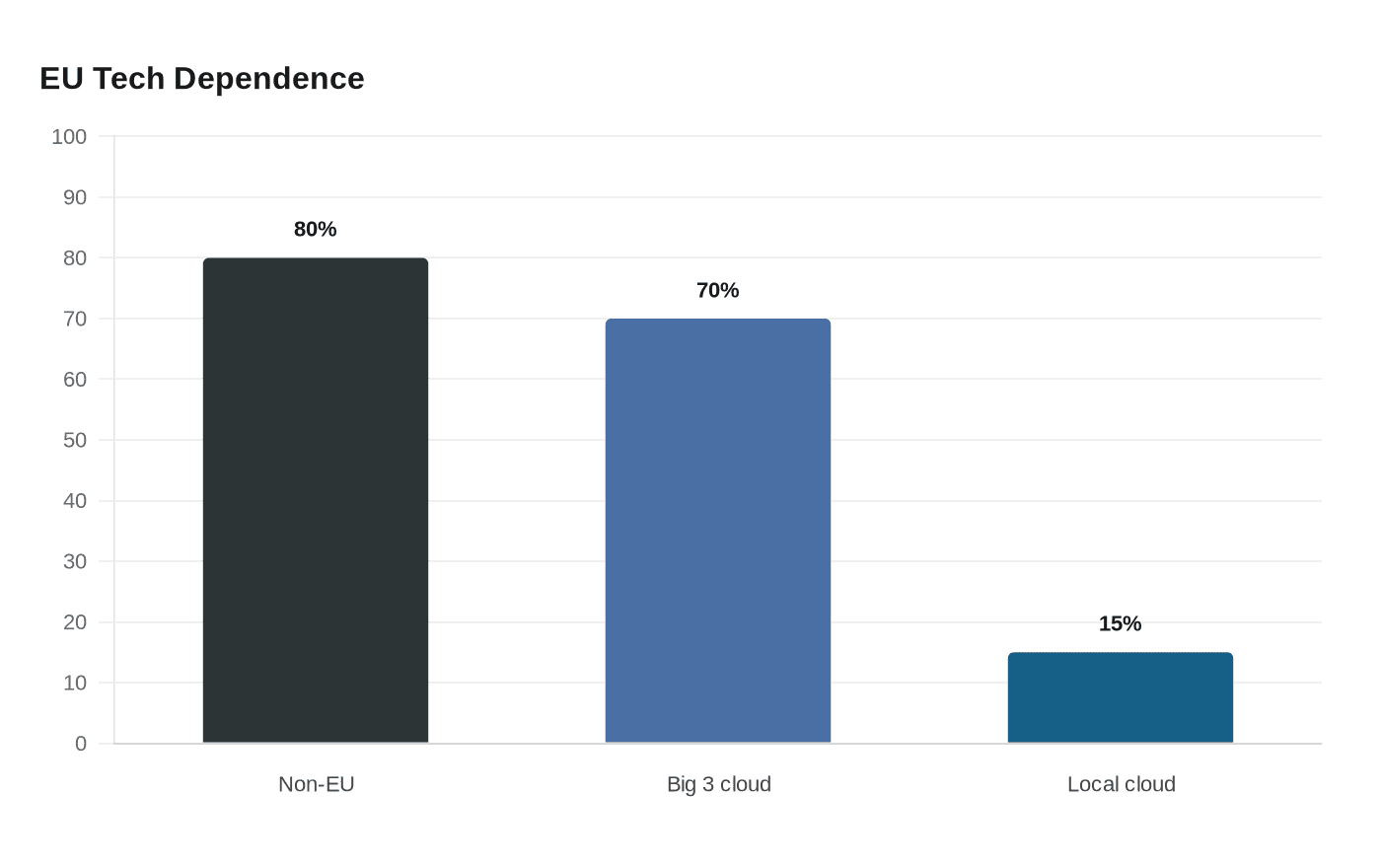
The stakes are stark. The Commission says the European Union relies on non-EU countries for more than 80% of key digital products, services, infrastructure and intellectual property. In cloud computing, the gap is even clearer: Amazon Web Services, Microsoft Azure and Google Cloud control about 70% of the European market, while local providers such as SAP, Deutsche Telekom and OVHcloud hold roughly 15%. Brussels argues that such dependence is not only a commercial weakness but a strategic vulnerability in an era of intensifying geopolitical rivalry and rapid artificial intelligence adoption.

The plan is expected to include a new cloud-and-AI law designed to encourage more data centers inside the bloc and triple capacity over the next five to seven years. A separate chips law would seek to boost demand for European-made semiconductors and support the continent’s supply chain. Another element would create a common system for rating the sustainability of data centers, part of a wider effort to steer public spending toward European infrastructure.
The political pressure behind the push has already been visible in the European Parliament. Lawmakers adopted a non-binding technological sovereignty report on Jan. 23, 2026, by 471 votes to 68, with 77% support. That report called for a “Eurostack” spanning semiconductors, cloud infrastructure, software and AI systems, and urged an “Open Source first” approach in government procurement. The document also laid out the market imbalance that Brussels is now trying to unwind, warning that Europe’s own providers remain far smaller than the American hyperscalers that dominate the cloud.
Officials in the Commission are making the political intent plain. Thibaut Kleiner, the Commission’s director for future networks, said on May 6, 2026, that the upcoming cloud law is meant to stop Europe becoming a technology “colony.” He also suggested the Commission may use public procurement to favor European industry, a move that could sharpen tensions with Washington as the U.S. continues to push back against EU fines and rules targeting major American technology companies.
European cloud providers are lining up behind the effort. Reuters reported on June 1, 2026, that 13 European cloud companies publicly backed the push to reduce reliance on U.S. technology. For Brussels, the question is whether sovereignty rhetoric can translate into real industrial capacity, or whether Europe will once again announce an ambitious digital strategy without the scale to compete with the firms it wants to dislodge.
This article was produced by Prism’s automated news system from verified source data, official records, and press releases, then run through automated quality and moderation checks before publishing. The system is built and supervised by the people who set the standards it runs under. Read our full AI policy.
Know something we missed? Have a correction or additional information?
Submit a Tip