Democrats face reckoning after Trump wins 2024 popular vote and Electoral College
Trump’s 312-226 win and popular-vote edge exposed a Democratic coalition that could not hold Arizona to Wisconsin, reopening a fight over the party’s shape.
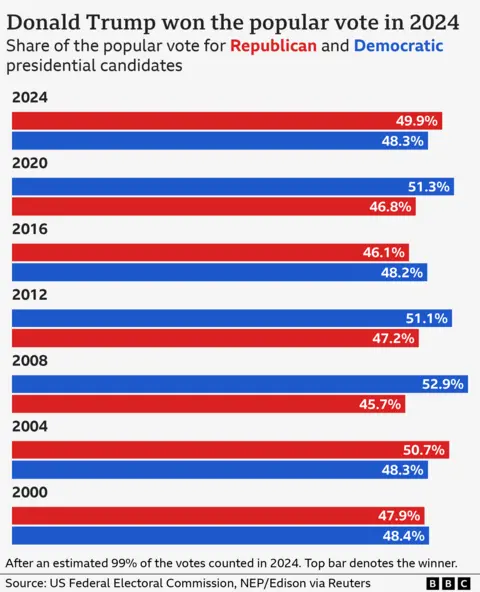
Democrats are confronting more than a bad night. Donald Trump’s 312-226 Electoral College win over Kamala Harris, along with his national popular-vote margin, forced a broader question inside the party: was 2024 a failure of messaging, or proof that the Democratic coalition itself has shrunk too far to win a majority of the country?
The data point to a structural problem. Trump flipped Arizona, Georgia, Michigan, Nevada, Pennsylvania and Wisconsin, six states that form the core of any modern Democratic path to the White House. It was also the third straight presidential election in which the incumbent party lost the presidency, underscoring how unstable the political environment has become for the party in power.
The national vote told a similar story. Certified totals put Trump at roughly 77.3 million votes to Harris’s 75.0 million, out of about 155.6 million ballots cast. The U.S. Census Bureau said turnout reached 65.3 percent of the voting-age population, and AP VoteCast interviewed more than 120,000 voters to understand who showed up and why. That is not the profile of a party on the brink of a durable majority; it is the profile of a coalition that can compete, but not yet command the center of the electorate.
That reality has sharpened the argument over what a candidate shake-up really means after 2024. Joe Biden withdrew on July 21, 2024, after the debate fallout intensified age concerns, and he endorsed Harris within minutes. Harris was then formally nominated in a virtual roll call on August 2, 2024. The speed of that reset solved a crisis of transition, but not the deeper problem of whether Democrats had built a broad enough coalition before the switch.
A May 2026 Democratic National Committee autopsy made that tension explicit, saying the Biden campaign failed to set up Harris properly and that Harris did not do enough to court rural voters. That critique pushes the party beyond personalities and toward structure: whether Democrats need new messengers, a different electoral map, or a more serious ideological reset to recover the working-class and rural voters they lost in states from Pennsylvania to Wisconsin.

The party’s next fight is no longer just about who stands at the top of the ticket. It is about whether the coalition beneath that ticket is still large enough to win.
This article was produced by Prism’s automated news system from verified source data, official records, and press releases, then run through automated quality and moderation checks before publishing. The system is built and supervised by the people who set the standards it runs under. Read our full AI policy.
Know something we missed? Have a correction or additional information?
Submit a Tip