Democrats Warn Trump's China Strategy Courts Catastrophic Strategic Failure
A new report ahead of Trump's summit with Xi Jinping attacks his China record as rival factions inside Washington push toward confrontation.

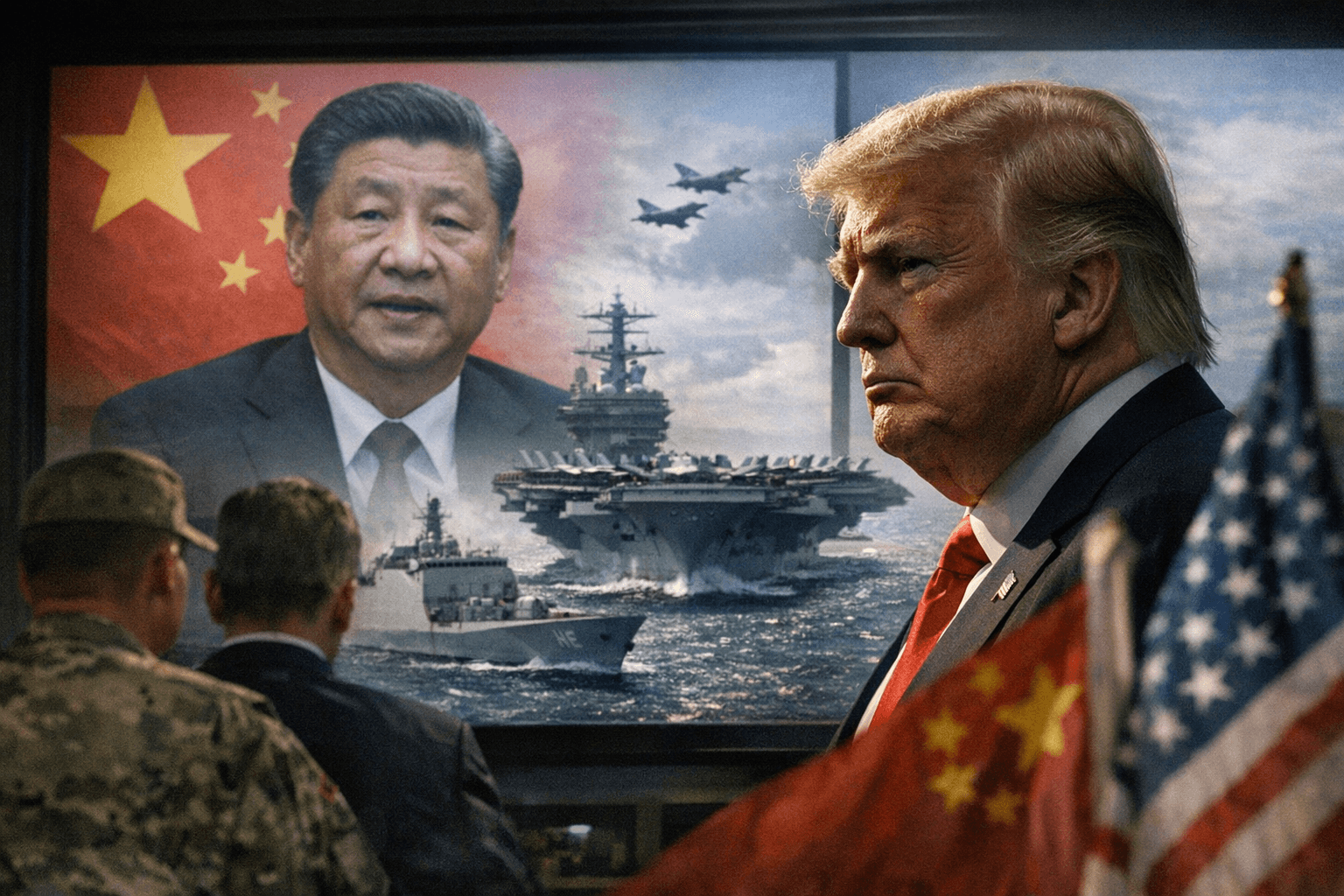
As President Trump prepares to sit down with Chinese leader Xi Jinping, a new report has taken direct aim at his administration's record on trade, diplomacy and American power, adding to a mounting debate over whether Washington's approach to Beijing risks long-term strategic collapse.
The report lands amid a fractured policy landscape. According to Responsible Statecraft, former Biden administration China officials and neoconservative Republicans are pressing for a sharper confrontational posture, demanding, in the outlet's words, that the United States "double down on this failed policy, driving it all the way to a permanent split in the global system." At the same time, factions within the Trump administration itself are reportedly pushing the president toward that same collision course.
The more unusual pressure is coming from the Democratic opposition. Responsible Statecraft alleges that "Democrats on the outside are trying to goad Trump into conflict by calling him 'chicken,'" a tactic it suggests is unlikely to succeed given Trump's instinct to reject what it calls the "sanctimonious moralizing that blinded the foreign policy establishment to the steep costs and terrible risks of the Biden China policy."
That critique of Biden-era strategy is central to the broader argument. Responsible Statecraft contends the most significant failure of the previous administration was in technology policy. The Biden White House, it argues, claimed its sweeping effort to restrict Chinese access to advanced semiconductors and quantum computing was driven purely by national security. But those technologies, the outlet argues, "are not primarily military in nature but the basis for high-value development across the whole economy," meaning Washington effectively "committed itself to sabotaging China's entire growth strategy." The consequence, Responsible Statecraft asserts, is stark: "If the attempt had succeeded, the two superpowers would have entered open conflict."
What is striking about this analysis is the speed of the political transformation it describes. Within a few years, the Washington consensus shifted from near-universal support for free trade with China to near-universal support for isolating and undermining it, with almost no serious debate along the way. "Antagonism to China was so appealing to so many in Washington, and the prospect of looking weak on China was so terrifying, that the bipartisan decision for confrontation received almost no critical discussion," Responsible Statecraft writes.
That consensus, the outlet argues, was fundamentally disconnected from public opinion. Polling cited without a named source suggests that by a margin of two-to-one or greater, Americans across party lines, including Republicans, Democrats and independents, preferred working to avoid military conflict with China rather than preparing for it.
The convergence of these pressures, a new critical report on the Trump record, internal administration hawks, Democratic taunts and a bipartisan hawkish establishment demanding continuity with Biden-era containment, frames the upcoming summit with Xi as a pivotal test. Whether Trump uses the meeting to stabilize the relationship or harden it will have consequences well beyond trade deficits and export controls.
The debate now is not simply between Democrats and Republicans, but between Washington's prevailing foreign policy instincts and a public that has consistently signaled it wants something different.
Know something we missed? Have a correction or additional information?
Submit a Tip