Djibouti’s Guelleh wins sixth term with 97.8% of vote
A 97.81% victory exposed how little electoral competition remains in Djibouti, where power, ports and foreign militaries intersect at a strategic Red Sea chokepoint.
A 97.81% victory with 80.4% turnout said less about a competitive race than about how thoroughly Ismael Omar Guelleh’s political system has been built to avoid one. The 78-year-old president secured a sixth term and extended his rule to 27 years, in a contest where the outcome was widely expected long before ballots were counted.
Guelleh first came to power in 1999, succeeding his uncle, Hassan Gouled Aptidon, after serving as chief of staff for 22 years. This time, he faced only one challenger, Mohamed Farah Samatar, a former ruling-party member who leads the Centre Démocratique Unifié, a party with no seats in parliament. Two of the country’s most vocal opposition forces, the Mouvement pour le renouveau démocratique et le développement and the Alliance républicaine pour la démocratie, have boycotted elections since 2016, arguing that the electoral system and political freedoms leave little room for real contest.
That weakness in electoral competition was reinforced by changes in the rules before the vote. In late October 2025, parliament removed the 75-year age limit for presidential candidates and also weakened the referendum requirement in a constitutional revision on October 26, 2025, clearing the way for Guelleh to run again. His party and the opposition-held bloc that occupies 7 of 65 parliamentary seats both endorsed him, narrowing the field further. After the result was announced, Guelleh posted the French word “RÉÉLU” on X, a brief declaration that his grip on power remained intact.
The scale of the win matters well beyond Djibouti’s 1.2 million people. The country sits on the Bab al Mandab Strait, through which roughly 12% to 15% of global trade and about 30% of container-ship traffic passes, making the presidency a matter of maritime security as much as domestic politics. Djibouti hosts foreign military bases for the United States, China, France, Italy and Japan, a rare overlap of major powers at the mouth of the Red Sea.
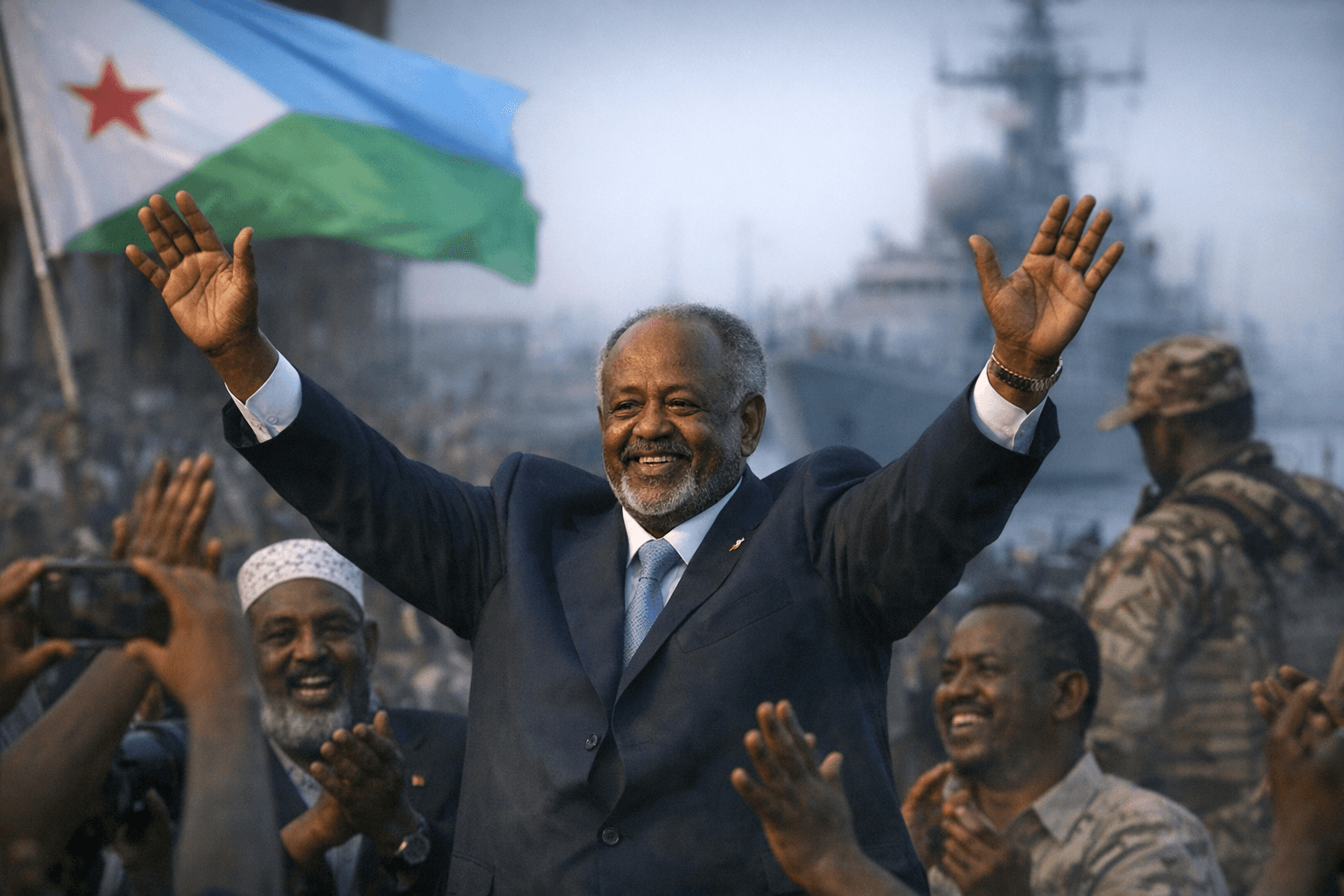
That strategic role has deepened since Houthi attacks on shipping in the region pushed damaged commercial vessels to dock in Djibouti. On April 2, the government inaugurated the Djibouti Ship Repair Yard, which officials described as the largest of its kind in the Red Sea and East Africa. The yard’s 217-meter floating dock, with a lifting capacity of 20,100 tonnes, is expected to generate about 350 direct jobs and 1,400 indirect ones.
For Guelleh’s government, the election confirmed continuity. For Djibouti’s partners, it preserved a political order that remains central to shipping lanes, military logistics and stability in the Horn of Africa.
This article was produced by Prism’s automated news system from verified source data, official records, and press releases, then run through automated quality and moderation checks before publishing. The system is built and supervised by the people who set the standards it runs under. Read our full AI policy.
Did this article answer your question?


