Duckworth, Baldwin press FAA on airline evacuation tests, staffing cuts
Duckworth and Baldwin warned the FAA that 90-second evacuation tests may not match real cabins, where reduced staffing could leave one attendant covering multiple exits.

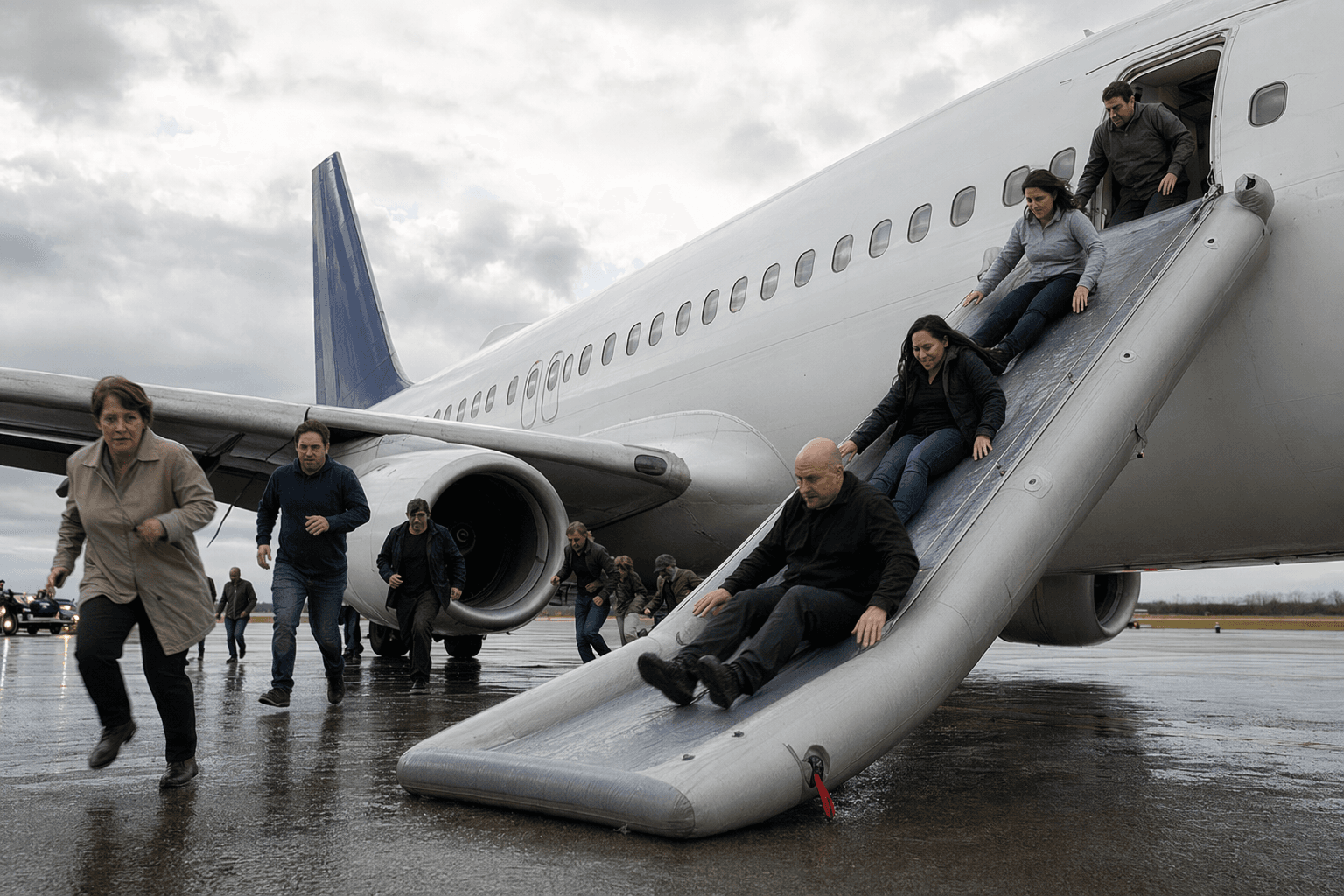
Senators Tammy Duckworth and Tammy Baldwin pressed the Federal Aviation Administration to explain why airline evacuation standards still rely on a 90-second benchmark that may not reflect what happens when older passengers, families, carry-on bags and a reduced cabin crew all collide in an emergency.
Their challenge went straight to the gap between the rule book and the aircraft cabin. Under 14 CFR 25.803, transport-category airplanes with more than 44 passenger seats must show that maximum seating capacity, including required crewmembers, can evacuate to the ground within 90 seconds under simulated emergency conditions. FAA advisory circular AC 25.803-1A, still active, governs full-scale evacuation demonstrations and when analysis and testing can substitute for an actual demonstration.
Duckworth and Baldwin told FAA Administrator Bryan Bedford that the agency has also approved reduced flight-attendant staffing on some widebody aircraft, raising the possibility that an evacuation could involve more exit doors than certified flight attendants. The senators warned that one attendant could be responsible for multiple exits, and that risk rises if a crewmember is injured or incapacitated during a serious incident.
The FAA’s own longstanding operations bulletin says evacuation capability is based on the complement of required flight attendants, and that their duties must be practicable and account for possible incapacitation. That language sits uneasily beside approvals that let American Airlines, Delta Air Lines and United Airlines operate some aircraft with fewer attendants under rules that require one flight attendant for every 50 passengers.
American’s new 787-9P configuration was certified with a minimum staffing level of seven flight attendants even though the aircraft has eight exit doors. American says it still assigns eight to 10 flight attendants on those flights depending on distance, but that the lower minimum gives it flexibility if a crew member becomes unavailable. The FAA later observed American complete evacuation demonstrations with seven flight attendants on its Boeing 787-9P airplanes, and said the 787-9P has a lower seating capacity than other 787 variants that require eight attendants.
The fight over staffing is part of Duckworth and Baldwin’s broader push to make evacuation standards reflect real-world conditions, including carry-on bags, passengers with disabilities, seniors and children. They first reintroduced the EVAC Act in 2022, and its provisions were folded into the bipartisan FAA Reauthorization Act of 2024, which President Biden signed on May 16, 2024. That law extends FAA authorities through fiscal year 2028 and requires a comprehensive evacuation study plus a committee of experts and stakeholders to help update the standards.
Duckworth has pointed to the January 2024 evacuation of Japan Airlines Flight 516 in Tokyo, which took roughly five minutes, and the 2016 evacuation of an American Airlines 767 at Chicago O’Hare International Airport, as reminders that real emergencies can run well beyond the FAA’s benchmark.
This article was produced by Prism’s automated news system from verified source data, official records, and press releases, then run through automated quality and moderation checks before publishing. The system is built and supervised by the people who set the standards it runs under. Read our full AI policy.
Did this article answer your question?

