Economic Collapse Fuels Nationwide Protests in Iran, Deepening Crisis
Widespread demonstrations over runaway inflation and a collapsing rial have widened into strikes and calls for regime change, pushing Tehran into a fraught political and economic moment. The unrest, linked to renewed international sanctions and recent regional conflict, raises the prospect of deeper instability at home and heightened tensions abroad.
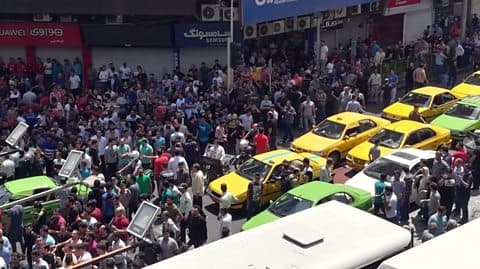
Protests that began with outcry over a collapsing currency have expanded across Iran into a broader social and political crisis, with strikes, student participation and calls for regime change intensifying pressure on Tehran. Demonstrations on Jan. 4 moved beyond traditional merchant-led actions to include salaried workers and sections of the squeezed middle, while reports gave divergent tallies of at least six to at least 10 deaths as clashes with security forces unfolded.
The immediate trigger has been economic. The rial has plunged to about 1.4 million to the dollar, eroding purchasing power for ordinary Iranians. One commonly cited example described a person earning 400 million rials a month, roughly $280, as falling below Tehran’s poverty line. A protester identified only as Morteza captured the public mood: "The economic situation is so dire that the government no longer dares to deny it. When someone earning 400 million rials a month (around $280) – still a dream salary for many – is below the poverty line in Tehran, it means almost no worker or employee can endure the pressure anymore. Everyone has reached their limit, in every sense."
The unrest has been catalyzed by a widening bazaar strike that began among traders and shopkeepers and drew in students and office workers, amplifying economic disruption and signaling a rare cross-class alliance. Photographs from Jan. 4 show scenes in Tehran that juxtapose public anger with official propaganda, including a car passing an anti-U.S. and anti-Israeli billboard.
Officials have signaled a firmer posture. Authorities’ rhetoric hardened even as state media showed cautious nods to the scale of discontent; in one hardline formulation the leader said rioters "must be put in their place." Local crackdowns were reported in several cities, but concrete nationwide measures beyond intensified security responses were not detailed in contemporaneous accounts.

Analysts and activists trace the deeper causes to international pressures and recent conflict that have squeezed Iran’s economy. Sanctions reimposed by the United Nations in September 2025, together with fallout from a 12-day conflict in June that involved attacks on Iranian sites, are cited as intensifying economic strain. The convergence of sanctions, currency instability and sharp inflation has shrunk living standards for broad swathes of the population, turning economic grievance into political mobilization.
International rhetoric has already sharpened. A video headline noted that former U.S. President Donald Trump "threatens to intervene in Iran if regime continues to kill protesters," a statement likely to deepen regional anxieties even as it does not document any concrete policy. Such exhortations also complicate legal and diplomatic calculations; any external military intervention would confront clear barriers under international law and risk wider regional escalation.
For Tehran, the immediate challenge is twofold: stabilizing a collapsing currency and containing a politically volatile protest movement without provoking further bloodshed. For the international community, the tests are equally complex, balancing pressure over nuclear and security concerns with the humanitarian and diplomatic imperatives of crisis de-escalation. Casualty figures and economic data remain fluid; independent verification of deaths, inflation metrics and the rial’s trajectory will be essential to understanding whether this moment becomes a short-lived convulsion or the opening of a prolonged period of instability.
This article was produced by Prism’s automated news system from verified source data, official records, and press releases, then run through automated quality and moderation checks before publishing. The system is built and supervised by the people who set the standards it runs under. Read our full AI policy.
Did this article answer your question?


